Offshore Mobile Application Development: My No-BS Guide to Hiring & Management

Victor
Posted on 2 February 2026




Let's be honest. Funding a world-class mobile app with US-based talent feels like bankrolling a moon mission. But here’s the good news: there’s more than one way to hire elite developers without mortgaging your office ping-pong table.
It turns out offshore mobile application development is the go-to strategy for startups and enterprises that want to build faster, smarter, and without that eye-watering price tag.
Table of Contents
Funding a new mobile app is a delicate balancing act. On one hand, you need top-tier engineering talent to build something people will actually use. On the other, every dollar you pour into inflated local salaries is a dollar you can't spend on marketing, sales, or, you know, keeping the lights on.
This is the conversation I wish I'd had before sinking a small fortune into local hires who didn't pan out. It’s not just about saving money; it’s about plugging into a global talent pool that’s often more specialized and ready to go than what you can find in your own backyard.
The old stereotypes about offshoring are dead. Forget the days of spotty communication, questionable code quality, and time zones from another planet. That's ancient history.
The game has completely changed, especially with the explosion of tech hubs in Latin America. You now have direct access to senior-level engineers who are just a few hours away, speak perfect English, and work on your schedule.
This isn’t some niche trend, either. It’s a massive market shift. The global offshore software development market is projected to surge to $283 billion by 2031. That kind of explosive growth tells you one thing: US companies are no longer just experimenting with offshore development; they're making it a core part of their growth strategy. You can read more about the offshore development market explosion to see just how fast this is moving.
We’re not just talking about finding cheaper developers. We’re talking about finding better developers for the same price as a junior engineer in San Francisco. It’s an arbitrage opportunity that smart founders are jumping on.
This guide cuts through the noise and gets straight to what works. I’ll lay out my practical framework for tapping into global talent, focusing on what actually matters:
Forget the outdated myths. Let's talk about how to build a killer app without going broke.
Picking how you engage an offshore team is the single most critical decision you'll make. Seriously. Get this wrong, and you're setting yourself up for missed deadlines, a bloated budget, and a codebase so messy you’ll wish you'd just learned to code yourself.
Forget a dry pros-and-cons list. Let’s have a real-world talk about where your money actually goes and what you get for it. This isn’t just theory; it’s a boots-on-the-ground breakdown of the three main paths you can take in your offshore mobile application development journey.
This flowchart maps the high-level decision between sticking with expensive US talent and exploring the strategic advantages of going offshore.
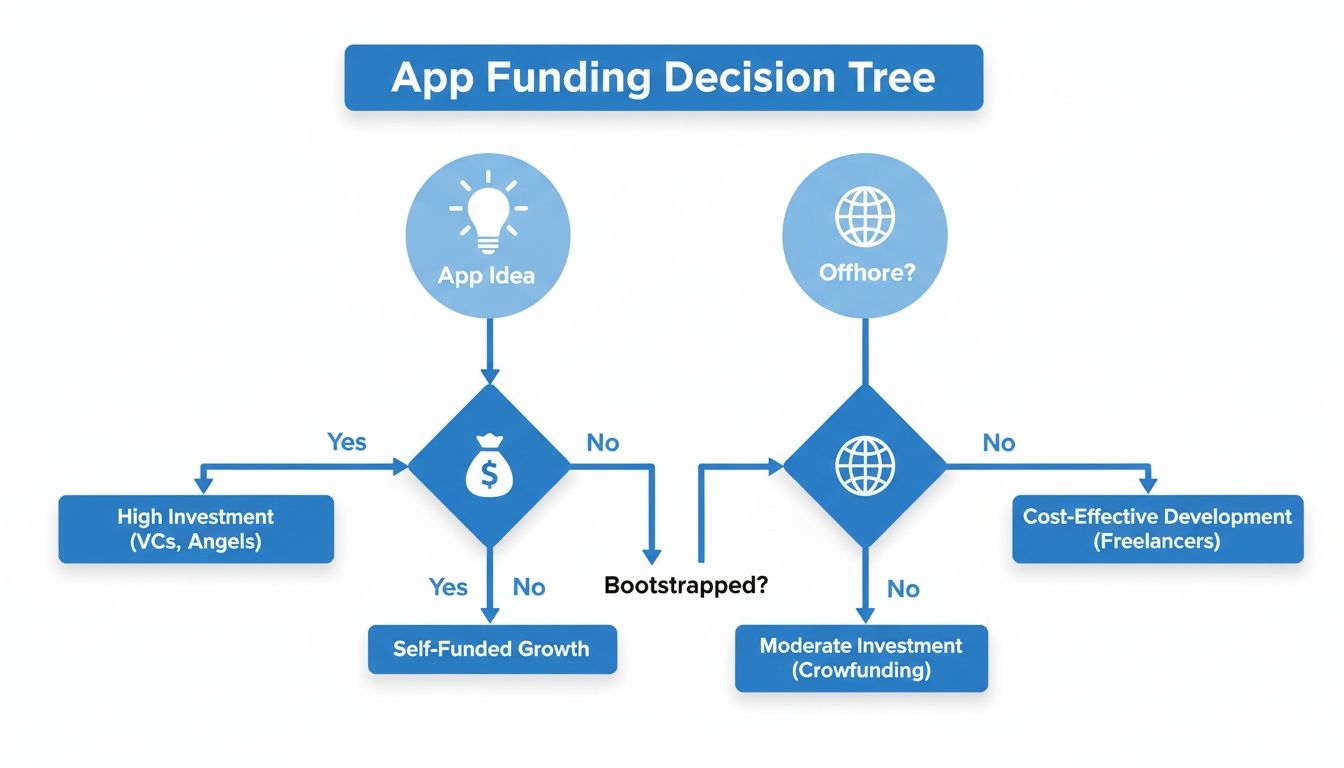
Ultimately, the choice hinges on balancing your budget against your need for speed and top-tier talent—a trade-off where going offshore, done right, often wins out.
First up, the freelance marketplaces. You know the names. They promise a world of rockstar developers for the price of a few pizzas. And sometimes, you find a gem.
More often, you find yourself in the middle of a bidding war where the lowest price almost always means the lowest quality. It's a classic race to the bottom, and it’s a trap.
Hope you enjoy spending your afternoons fact-checking resumes and running technical interviews—because that’s now your full-time job. You're responsible for everything: vetting, project management, and praying the developer you just hired doesn't vanish a week before launch. It's a high-risk, high-effort gamble that rarely pays off for serious projects.
The Brutal Truth: You might save money on the hourly rate, but you’ll pay for it in management overhead, missed deadlines, and the inevitable cost of rewriting shoddy code. This model is fine for a tiny, one-off task, but it’s a terrible way to build a real business.
Next, we have the old-school outsourcing agencies. These firms promise a "fully managed" experience. They handle the hiring, the project management, and all the administrative headaches. Sounds great on the surface, right?
The problem is the price tag and the utter lack of transparency. Agencies are notorious for marking up developer salaries by 50-100% or more. You're paying a massive premium for a project manager who acts as a middleman, often slowing down communication and creating a frustrating game of telephone between you and the people actually writing the code.
You rarely get to choose your developers. And if someone on the team isn't a good fit? Swapping them out can be a bureaucratic nightmare. It's a rigid, costly model that treats your project like just another ticket in their system.
This is where the game has changed. Platforms like ours have carved out a middle ground that genuinely offers the best of both worlds. We do the heavy lifting of sourcing and vetting, presenting you with a shortlist of elite, senior-level talent.
But here’s the key difference: you interview and choose your developer. They work directly for you, integrated into your team, your Slack, and your workflow. It’s your team, just remote.
This model gives you:
You're not just outsourcing tasks; you're building a genuine extension of your in-house team with top-tier talent from places like Latin America. You get the cost benefits of offshoring without sacrificing quality or control. For most startups and growing companies, it's a no-brainer.
To put it all in perspective, here's a no-fluff comparison of how these models stack up when it comes to the things that actually matter: your money, your time, and your control over the final product.
| Model | Typical Cost | Your Level of Control | Time to Hire | Best For |
|---|---|---|---|---|
| Freelance Marketplace | Lowest hourly rates, but high hidden costs | High, but comes with huge management burden | Days to weeks, plus vetting time | Tiny, non-critical, one-off tasks |
| Outsourcing Agency | Very High (developer rates marked up 50-100%+) | Low (you communicate through a PM) | Weeks to months | Large enterprises with big budgets and no desire for direct oversight |
| Direct-Hire Platform | Moderate (transparent developer rates + platform fee) | High (direct hire, direct communication) | 24-72 hours | Startups & SMEs needing quality, control, and value |
As you can see, the direct-hire model hits that sweet spot. It cuts out the bloat of agencies and the chaos of marketplaces, letting you build a high-performing remote team on your own terms.
Are you ready to spend your days sifting through résumés and running endless technical interviews? I didn't think so. Sourcing top-tier talent from thousands of miles away is easily the hardest part of going offshore, but it doesn't have to become your full-time job. This is your battle plan for finding developers who do more than just talk a good game—they actually ship code.

We’re going to dig into where to find these engineers beyond the usual LinkedIn scroll and what to look for that goes deeper than a polished GitHub profile. Forget the generic advice. Let's get into what really works.
If your entire strategy is just posting a job on LinkedIn, you're throwing yourself into a global mosh pit, competing with every other company for the same small pool of active job seekers. The reality is, the best engineers are rarely "looking." They're too busy building things.
So, where are they hiding?
A little strategic thinking here can save you hundreds of hours. Instead of drowning in a sea of a thousand unqualified applicants, you start with a much smaller, higher-quality pool from the get-go.
A polished résumé and a slick interview performance mean absolutely nothing if the developer crumbles when faced with a real-world problem. Your vetting process should feel less like a pop quiz and more like a simulation of a typical day on the job.
The talent pool is massive and only getting bigger. By 2025, there will be 35 million professional mobile app developers active worldwide, a significant jump from 28 million in 2024. And with Android still dominating the market at 72.55%, the demand for sharp, cross-platform experts is fierce. This makes a killer vetting process non-negotiable.
Your goal is simple: separate the talkers from the builders.
The $500 Hello World: A classic mistake is throwing a generic, algorithm-heavy coding challenge at candidates. These academic tests rarely reflect the actual work your app needs. A developer who can ace a complex algorithm might still write messy, unscalable UI components.
Instead, try a small, paid, practical challenge. Give them a real-world task that mirrors a feature in your actual app. For instance: "Build a simple login screen that connects to a mock API and properly handles various error states."
This approach works brilliantly for three reasons:
In a remote team, communication isn't just a "nice-to-have" skill; it's the entire operating system. A brilliant coder who can't clearly explain a technical trade-off or is afraid to ask for help when they're stuck is a massive liability.
During the interview, zero in on these areas:
Ultimately, this is where platforms that pre-vet engineers for both technical and soft skills become a founder's secret weapon. They’ve already done the hard part, letting you focus on finding the right cultural fit for your team. Our guide on hiring offshore developers breaks this down even further.
Nothing kills the excitement of finding a rockstar developer faster than a surprise legal notice from Bogotá. Welcome to the unsexy but mission-critical part of taking your offshore mobile application development global.
Let’s be real, nobody gets into tech to become an expert on international labor law. But ignoring this stuff is like building a beautiful app with a fatal security flaw—it’s only a matter of time before it all comes crashing down. We're going to tackle the three biggest headaches: enforceable contracts, international payments, and local compliance.
Think that standard US contractor agreement you downloaded will hold up in Brazil? Think again. Every country has its own specific labor laws, and a poorly drafted contract is basically worthless. It leaves your intellectual property completely exposed.
Your contract is your first and last line of defense. It needs to be ironclad on two key points:
This isn't the place to cut corners. A flimsy contract is an open invitation for future disputes over who owns the code—a nightmare you don’t want.
Now for the fun part: getting your team paid. What's the best way to send money to a developer in Argentina without losing a fortune on conversion fees and navigating byzantine bank transfers?
You have a few options, each with its own level of pain:
You're a tech company, not an international payroll processor. Your time is better spent on product, not on figuring out the latest currency controls in Colombia. Let someone else handle the financial plumbing.
This is where things get really complicated. Every country in Latin America has its own set of rules regarding contractor vs. employee classification, mandatory benefits (like the "13th-month salary" common in Brazil), and termination requirements.
Getting this wrong can lead to misclassification risk. That’s when a local court decides your "contractor" is actually an employee, leaving you on the hook for back taxes, benefits, and severe penalties. It's a costly, time-consuming mess that can derail your entire operation.
This is precisely why working with a partner who understands the local legal landscape is non-negotiable. They act as your compliance shield. A good starting point is to use an HR outsourcing compliance checklist to understand and avoid these exact costly mistakes.
Ultimately, navigating contracts, payroll, and compliance isn't about becoming a legal expert yourself. It's about putting a system in place that protects your business so you can focus on what you do best: building an amazing mobile app.
So, you’ve assembled your dream team. The contracts are signed, the Slack channel is buzzing, and you’re ready to build. Now what?
If you think you can manage an offshore team with the same playbook you use for in-house folks, you’re in for a rude awakening.
Managing a remote, cross-cultural team is a completely different ballgame. It’s less about watching the clock and more about measuring outcomes. Forget butts-in-seats management; your new religion is clarity, autonomy, and trust.

This isn’t about micromanaging from a different hemisphere. It's about building a system where your offshore developers feel like an integrated part of your core team, not a disconnected silo.
Your calendar is probably a technicolor nightmare of back-to-back Zoom calls. That habit has to stop. The goal isn't to replicate the in-office experience—it’s to build something better and more efficient. That means fully embracing asynchronous communication.
It’s a simple concept: send a detailed message, let your team respond when it’s their turn, and kill the endless cycle of “sync-up” meetings that could have been an email. This doesn’t mean you never talk face-to-face. A daily stand-up and a weekly demo are non-negotiable. But for everything else, get it in writing.
Here’s how we see it done right:
If you are just starting out with remote teams, check out our guide to remote team project management for more deep-dive tactics.
Most managers see time-zone differences as a logistical headache. That's amateur thinking. With a team in Latin America, you have a golden opportunity: a few hours of overlap for real-time collaboration, and the rest of the day for uninterrupted deep work.
Structure your day to exploit this. Use the morning overlap for your daily stand-up, planning sessions, and any high-touch collaboration. Then, let your developers go dark. Let them code without a constant barrage of Slack notifications.
The magic of a well-run offshore team is that work happens while you sleep. You end your day by assigning a clearly defined task, and you wake up to a pull request. It’s the closest thing to a productivity cheat code.
This requires a massive cultural shift from "availability" to "accountability." You stop measuring presence and start measuring progress. Who cares if a developer takes a two-hour lunch if they’re consistently shipping clean, well-tested code ahead of schedule?
To get there, you'll need to adapt your operational mindset. Here's a quick-reference guide to adapting your management style for a remote, international team.
| Operational Area | Typical Onshore Approach | Effective Offshore Approach |
|---|---|---|
| Communication | Spontaneous meetings, "quick chats" | Deliberate, documented, asynchronous-first |
| Task Assignment | Brief verbal instructions | Hyper-detailed tickets with full context |
| Productivity Metric | Hours worked, online status | Tasks completed, code quality, pull requests |
| Collaboration | Constant real-time syncs | Scheduled overlap for high-priority items |
| Manager's Role | Direct supervision, unblocking | Providing clarity, removing obstacles in advance |
Adapting to these new workflows is the secret sauce. It forces you to become a better, more intentional manager, which benefits everyone, not just your offshore crew.
The right tool stack is the central nervous system of your remote team. It’s what keeps everyone aligned and moving in the same direction. Your goal is to create a single source of truth for everything.
There’s no magic bullet, but a solid setup usually includes:
Don't overcomplicate it. The best tools are the ones your team will actually use. Pick your stack, get everyone trained, and be religious about keeping it updated.
Specialization and technical expertise have fundamentally transformed offshore mobile app development pricing. Developers with deep experience in AI/ML, blockchain, or complex cloud architectures now command premium rates, regardless of where they live. Smart collaboration practices, built on the right tools, have been shown to improve output by up to 30%, turning a good hire into a great one. The focus has shifted from finding the cheapest hourly rate to finding the best technical value for your dollar.
Building a world-class offshore team isn't about finding a magic platform. It’s about building a culture of trust, empowering your engineers with clear goals, and then getting out of their way. Do that, and you'll wonder why you ever did it any other way.
Alright, let's get right to it. You've heard the pitch and you see the potential, but you’ve still got those nagging questions rattling around in your head at 2 AM. Good. Skepticism is healthy.
This isn't some generic FAQ copied from a corporate brochure. These are the real, gritty questions that founders and CTOs ask when the pressure is on. We’re going to tackle them head-on, with answers forged in the trenches of building actual products with offshore teams.
This is the big one, isn't it? It’s the fear that "offshore" is just a polite word for "shoddy code."
Let me be brutally honest: quality has nothing to do with geography. It's about your process and your standards. Your app’s quality has far more to do with how you build than where you build.
Your first line of defense is a merciless vetting process. If you’re just trusting a resume, you’ve already lost. Practical coding challenges and deep architectural discussions are completely non-negotiable. This is why using a platform that lives and dies by its vetting is a massive shortcut—we’ve already filtered out the bottom 98% of applicants for you.
Next, you establish crystal-clear rules of engagement from day one. This means:
Here’s the secret nobody tells you: managing for quality remotely forces you to adopt the engineering best practices you should have been using all along. It makes your entire operation stronger, not just the offshore part.
Everyone throws around big numbers, but what does that actually mean for your burn rate? The savings are substantial, but looking only at the hourly rate is a rookie mistake.
Yes, you can expect to save 40-60% on salary compared to hiring a developer in San Francisco or New York. That’s a given.
The true savings, however, come from all the costs you don't have to pay. We're talking about avoiding the "fully-loaded" costs of a US employee:
When you work with a platform that handles all the local compliance and payroll, you’re not just saving on salary; you’re dodging a small fortune in administrative and legal headaches. That said, be extremely wary of rates that seem too good to be true. The goal isn't to find the cheapest developer on the planet. The sweet spot is finding an elite, senior-level engineer in Brazil whose fully-loaded cost is still less than a comparable mid-level developer in the US.
You handle it by being intentional. You can't just throw a bunch of people from different countries into a Slack channel and hope for the best. That’s a recipe for misaligned expectations and quiet frustration.
First, you weaponize the time zone overlap. That small window you share with Latin America is a gift. Use it for a daily, high-energy stand-up. Make it the one sacred meeting. For everything else, default to asynchronous, written communication.
Second, be painfully explicit. Vague instructions are the enemy of remote work. Don't say, "Let's get this done soon." Say, "We need the pull request for the login feature submitted for review by 3 PM EST on Wednesday."
Culturally, the key is to create an environment of psychological safety. Make it clear that it's okay to ask "dumb" questions and, more importantly, to push back. You don't want hired hands; you want partners who will tell you when your brilliant idea is technically a dumpster fire. It’s all about building a single, unified team culture, not an "us vs. them" dynamic.
This is another one that keeps founders up at night. The thought of your secret sauce ending up on GitHub is terrifying.
The good news is that protecting your IP is entirely solvable with a two-pronged approach: legal and operational.
Legally, your foundation is the contract. Working through a reputable Employer of Record (EOR) or a platform like ours is your safest bet. We provide battle-tested international agreements that are actually enforceable in the developer's home country. Your contract MUST include:
Operationally, you lock things down. Don't be sloppy. Control access to systems with a secure password manager and require VPNs. Most importantly, ensure all code is committed daily to your company-owned repositories on GitHub or GitLab. No code should ever live solely on a developer's local machine.
This combination of strong legal agreements and smart operational security is your best defense. It makes IP theft incredibly difficult and legally disastrous for anyone who tries.
Ready to find elite mobile developers who are vetted, compliant, and ready to integrate with your team? At CloudDevs, we connect you with top-tier talent from Latin America in just 24 hours. Skip the recruiting headaches and start building your app with a 7-day, risk-free trial. Find your developer today.

Stop burning cash on software development. Learn battle-tested strategies to reduce software development costs from a founder who has seen it all.


Let's be honest. Most 'Top 10' lists for data modeling interview questions are a snooze-fest of regurgitated textbook definitions. They test memory, not mastery. If you want to hire someone who can architect a database that won't buckle under the first traffic spike, you need questions that probe real-world trade-offs, not just academic theory. I've...

Learn how to improve team communication with actionable strategies. Enhance collaboration and productivity today. Click to discover effective ways!