Backend Developer Languages: The 2026 Founder’s Guide

Victor
Posted on 8 April 2026




You’re probably in one of two moods right now.
Either your team is arguing about backend developer languages in Slack like it’s a religious war, or you’ve already picked one and now you’re wondering whether you just signed up for a scaling problem, a hiring problem, or both.
I’ve watched founders overcomplicate this decision for years. They obsess over syntax and benchmark charts, then get blindsided by the boring stuff that hurts: hiring delays, weak senior talent, expensive rewrites, and a codebase nobody wants to maintain once the first heroic engineer leaves.
That’s why this decision matters more than most architecture docs admit. A backend language shapes how fast you ship, how much infrastructure pain you absorb, how easy it is to recruit, and how ugly your trade-offs get when traffic, scope, and investor expectations all show up at once.
Table of Contents
Founders love to frame this as an engineering choice. It isn’t. It’s a business bet with technical consequences.
Pick a language with a huge ecosystem and broad hiring pool, and you’ll usually move faster early. Pick one with elite performance and stricter constraints, and you may save yourself pain later, but you’ll pay for that choice in hiring difficulty and team ramp-up.
That tension is real. So is the cost of pretending it isn’t.
A startup builds an MVP. The first version works. Customers arrive. Then the original “quick” backend becomes the permanent backend, and suddenly every roadmap discussion includes the same questions.
Can this stack handle growth? Can we hire more people for it? Are we shipping features or babysitting infrastructure?
That’s why generic language roundups are so unhelpful. They tell you Python is easy, Go is fast, Rust is safe, Java is mature. Thanks. Stunning insight. You already knew that.
What matters is whether the language helps you hit the next business milestone without creating a hiring tax.
There’s a reason Python keeps showing up in serious backend conversations. Python holds a 25.98% market share in the TIOBE Index for September 2025, is the most demanded by recruiters at 45.7% globally, and saw a 7 percentage point increase from 2024 to 2025 in the Stack Overflow Developer Survey (daily.dev programming language trends).
That tells you three things fast.
If you’re building AI-heavy products, internal tools, analytics services, or web backends with Django, Flask, or FastAPI, Python is often the practical choice. Not the romantic one. The practical one.
Pick a backend language the team can ship in, hire for, and maintain under pressure. Clever choices look a lot less clever when payroll and uptime are both on the line.
The right question is not “What language is best?”
It’s this:
Backend developer languages are never just about code. They’re about impact.
Let’s call the cast list what it is. Every backend language has a personality, a fan club, and a downside people conveniently leave out during architecture debates.
Here’s the short version before anybody opens another tab and starts a “Top 10 Languages” article.
| Language | Best known for | Real strength | Real drawback | My blunt take |
|---|---|---|---|---|
| Python | AI, APIs, speed of development | Huge ecosystem, readable code, broad hiring market | Lower raw throughput in typical web workloads | Great default for startups, data products, and AI-heavy backends |
| JavaScript / Node.js | Full-stack familiarity, event-driven apps | One language across frontend and backend | Performance ceiling and ecosystem inconsistency | Useful, but too often chosen for team convenience over backend fit |
| Java | Enterprise systems | Mature tooling, stability, deep enterprise adoption | More ceremony, heavier developer experience | Boring in the good way if you run serious systems |
| Go | Cloud services, concurrency | Simple deployment, strong throughput, easy concurrency model | Less expressive than some teams want | Excellent for APIs and infrastructure-heavy backends |
| Rust | Performance and memory safety | Fast, safe, strong for low-latency systems | Harder hiring, steeper learning curve | Worth it when failure is expensive |
| Ruby | Rails productivity | Fast product iteration and conventions | Lower performance ceiling | Still a sharp MVP tool if you know what you’re doing |
| PHP | Web workhorse | Massive install base, practical frameworks | Image problem, uneven code quality across teams | Not glamorous, still useful |
Python gets mocked by performance purists and then chosen by teams that need to ship. That pattern exists for a reason.
It works across AI, data workflows, internal platforms, dashboards, and standard web backends. It also wins on readability, which matters more than people admit when a team is growing and half your roadmap depends on engineers understanding code they didn’t write.
Node.js is the language equivalent of ordering the same thing as the rest of the table. It keeps life simple for teams with strong JavaScript talent, and it’s perfectly workable for many APIs and real-time systems.
But convenience is not strategy. Too many teams choose Node because they already have frontend engineers, not because it’s the strongest backend fit.
Java is not trying to be cool. That’s part of its charm.
Banks, large enterprises, and operationally heavy organizations keep betting on Java because it has mature tooling, a deep talent pool, and a lot of battle-tested patterns. If you need more context on the trade-offs, this breakdown of Java vs Python for business use cases is worth a look.
Go has become the favorite of teams building cloud-native systems, microservices, and network-heavy APIs. It’s straightforward, deploys cleanly, and handles concurrency without making engineers feel like they need a PhD in runtime behavior.
Rust is different. It gives you power, control, and safety, but it demands discipline. Rust is rarely the wrong technical answer. It’s often the wrong staffing answer.
Good. They shouldn’t.
Ruby on Rails still shines when you need fast product development with strong conventions. PHP remains practical for web backends and legacy-heavy environments. Neither wins the hype cycle. Both can still make money.
Backend developer languages don’t age out just because social media moved on. They age out when they stop solving business problems.
Your CTO wants Rust. Your product lead wants Python. Your finance lead wants to know why the cloud bill doubled after launch. That is the core backend language argument. Teams often make this decision too narrowly. They treat runtime speed, framework quality, developer productivity, deployment friction, and hiring cost like one category. They are separate costs. You need to price each one with care, especially if you expect to hire in Latin America and care about how fast you can build a real team.
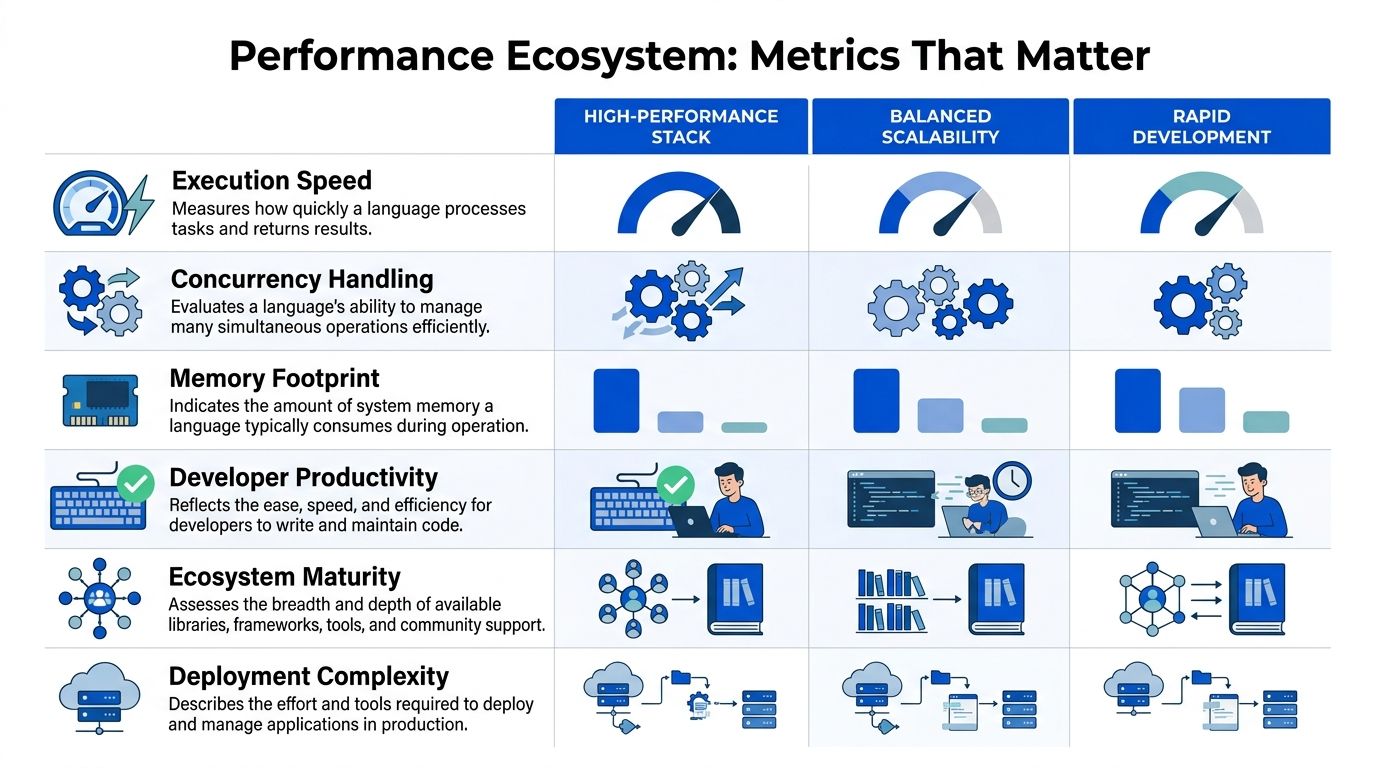
If you are building an API gateway, event-heavy service, or backend that lives under constant concurrency, throughput affects margin.
In a 2025 Fortunes benchmark, C# with ASP.NET reached 609,966 requests per second, Go Fiber hit 338,096, Rust Actix reached 320,144, Java Spring hit 243,639, Node.js Express handled 78,136, Ruby on Rails handled 42,546, and Python Django handled 32,651 (backend framework performance benchmark).
| Framework (Language) | Requests per Second (RPS) | Relative Performance |
|---|---|---|
| ASP.NET (C#) | 609,966 | 36.3 |
| Fiber (Go) | 338,096 | 20.1 |
| Actix (Rust) | 320,144 | 19.1 |
| Spring (Java) | 243,639 | 14.5 |
| Express (JavaScript/Node.js) | 78,136 | 4.7 |
| Ruby on Rails (Ruby) | 42,546 | 2.5 |
| Django (Python) | 32,651 | 1.9 |
| Laravel (PHP) | 16,800 | 1.0 |
That spread is large enough to change hosting decisions, scaling plans, and incident frequency.
It still does not mean every company should chase the fastest stack. A workflow app, internal platform, admin system, or AI orchestration layer usually gets more value from faster iteration than from benchmark bragging rights. Startups lose more money from slow product delivery than from serving a moderate workload in Python or Node.
Concurrency is where language choice becomes operational reality.
Go remains attractive because goroutines let small teams build network-heavy services without wrestling the runtime every week. Java stays relevant because the JVM has decades of tuning behind it and behaves well under serious production pressure. C# performs far better than many teams assume, especially on modern .NET. Rust gives you control and memory safety, but it also raises the bar for who you can hire and how quickly they can contribute.
Python can handle a lot with the right architecture. You still pay for its limits once low latency and heavy concurrency become core requirements. Node.js sits in a similar bucket. It is productive and flexible, but long-running CPU-heavy work usually pushes teams toward different patterns, extra services, or a different language entirely.
Web requests are only one part of backend cost. Background jobs, media processing, data transforms, pricing engines, and rule evaluation can dominate the bill.
The benchmark numbers on compute-heavy tasks are blunt. C completes one binary tree test in 0.095s using 2MB of memory, while Python takes 3.099s and 11MB, as noted earlier in the article. If your product spends real time on compute, those differences show up in response time and infrastructure spend.
That is why Go, Rust, and sometimes Java earn their keep. They do not just look efficient. They often reduce the amount of hardware you need to buy.
Elegant language design does not rescue a weak framework ecosystem.
Python keeps winning because teams can ship with Django, Flask, and FastAPI without building half the plumbing themselves. Java gives large organizations mature tooling, predictable patterns, and a huge body of operational knowledge. Node.js gives you speed and breadth, though package quality can be uneven and security review takes more discipline. Rails still earns its place because conventions remove a lot of wasted engineering debate.
Rust has improved fast, but it still asks teams to integrate more carefully and write more intentionally than older ecosystems usually demand. That is a good trade if performance and safety are central to the business. It is a bad trade if you just need to launch a billing API, hire quickly in LATAM, and keep payroll under control.
A language decision is also a staffing model.
Python, Java, PHP, Node.js, and Java generally give you a wider hiring lane. Go is narrower, but still practical. Rust is the expensive option, not only in salary pressure but in time-to-hire and onboarding depth. For a startup, that can delay roadmap delivery more than any performance gain will save. For an enterprise, it can increase dependency on a small set of hard-to-replace engineers. That hiring reality is one reason companies use remote developer hiring options that expand access to LATAM talent.
This is also where operations and people issues collide. Performance problems hurt margins. Hiring bottlenecks hurt delivery. Retention problems hurt both. The broader HR challenges and solutions for the tech industry are not separate from language choice. They shape whether your stack remains sustainable after the first hires are made.
Go is simple to package and ship. That matters. Rust is deployable, but the team needs stronger systems instincts. Java and C# are mature in production and fit organizations that already run structured platform environments. Python and Node.js are approachable, but dependency drift, runtime surprises, and uneven operational discipline create avoidable messes. Ruby and PHP can be either smooth or painful, depending on how opinionated your setup is.
For teams carrying both product and platform responsibilities, operational discipline matters as much as the language itself. If your leads need a stronger process for CI/CD, infrastructure reliability, and production automation, this AWS Certified DevOps Engineer Professional study guide is a useful companion resource.
My recommendation is simple. Choose for delivery speed first. Switch to a faster backend language only when workload, latency targets, or cloud costs clearly justify the extra hiring and maintenance burden. That is the decision a startup can afford, and it is usually the one an enterprise can defend.
Most articles on backend developer languages suddenly develop amnesia here.
They’ll compare syntax, performance, and framework philosophy for two thousand words, then ignore the part where you need to hire actual humans who can build and maintain the thing. Cute. Unfortunately, payroll still exists.
You can choose Rust because it looks brilliant on a benchmark chart. Then spend months trying to assemble a team that can deliver in it.
You can choose Java because it’s enterprise-safe. Then discover your startup candidates think your stack sounds like a pension plan.
You can choose Python and benefit from broad availability, especially if your product overlaps with AI, data, automation, or internal tooling. That flexibility matters because hiring pressure rarely stays confined to “backend only” for long.
This is the practical gap many US hiring guides miss.
CloudDevs draws from a pool of over 500,000 professionals in Latin America, supports hiring in 24 to 48 hours, and can reduce labor costs by 60%. JetBrains’ 2025 Developer Ecosystem data also shows LATAM backend developer demand for Go and Rust growing 25% year over year (analysis of backend hiring gaps and LATAM talent trends).
That matters for one reason above all. It changes what is feasible.
A language that feels expensive or slow to hire for in the US can become much more practical when you widen the search to Brazil, Mexico, Argentina, Colombia, and Peru. Python, Java, and JavaScript talent are already abundant. Go and Rust are less saturated, but clearly growing.
They underestimate the operational cost of hiring badly.
Not just salary. I mean time-to-screen, resume noise, weak interviews, false positives, timezone friction, compliance headaches, and all the little HR tasks that swallow leadership time. If your company needs a deeper look at those people-ops landmines, this guide on HR challenges and solutions for the tech industry is useful reading.
The problem is not finding applicants. The internet is full of applicants.
The problem is finding backend engineers who can think in systems, communicate clearly, and contribute without needing six weeks of hand-holding.
A rough practical view:
There are only a few workable options.
Build your own recruiting funnel and spend leadership time screening. Use a general freelance marketplace and accept more variance. Work with specialist recruiters. Or use a marketplace that already vets technical talent and handles compliance.
One option in that last category is CloudDevs, which focuses on pre-vetted Latin American developers and handles the administrative side that founders usually pretend will “sort itself out.” It won’t.
The best language choice on paper means very little if hiring for it takes longer than shipping the product.
The bottom line is blunt. The best backend language is partly the one you can hire well for, quickly, and at a cost that doesn’t wreck your runway.
It is Monday morning. Your team needs to ship an API for the product launch in six weeks, the infra bill is creeping up, and hiring is already slower than the roadmap. That is the critical backend language decision. You are not picking syntax. You are picking delivery speed, operating cost, and how hard it will be to hire in a market that can support your plan.
The right language is the one that fits the workload and the team you can afford to build. For companies hiring in Latin America, that matters more than language tribalism.
Choose Python.
This is the clearest use case on the board. If your product depends on model orchestration, data pipelines, analytics, internal tools for analysts, or rapid experimentation, Python gets you from prototype to production faster than anything else here.
It also keeps your backend closer to the work done by data engineers, ML engineers, and product teams running experiments. That cuts handoff friction. For a startup, that means faster iteration. For an enterprise, it means fewer disconnected teams and less glue code.
Python also gives you a wider hiring lane in Latin America than more specialized options. That lowers time-to-hire and reduces the risk of one hard-to-replace engineer becoming a bottleneck.
Choose Go first. Use Rust only when the technical case is obvious.
Go is the practical answer for microservices, internal platforms, request-heavy APIs, developer tooling, and network services. It compiles fast, deploys cleanly, and stays readable as teams grow. That combination matters in production.
Rust earns its place in systems that are latency-sensitive, security-sensitive, or expensive to get wrong. If you are building a trading engine, security-critical service, or a component that needs strict memory safety under load, Rust is a serious option. If you are building a standard SaaS backend, Rust usually costs more in hiring, onboarding, and development speed than it returns.
That trade-off is not theoretical. In Latin America, good Go developers are easier to find than strong Rust developers. If you need to hire quickly through a vetted channel such as CloudDevs, Go is far more likely to match the business timeline.
Choose Java or C# based on the rest of your environment.
If the company runs on Microsoft infrastructure, pick C#. It will fit better with your identity systems, internal tooling, and existing engineering habits. If the organization is already invested in JVM tooling, Java remains a disciplined choice for large business systems, long-lived services, and teams that need mature conventions.
These languages are not fashionable. That is fine. They are built for organizations that care about uptime, governance, and predictable delivery.
For enterprises hiring in Latin America, both can work well, but the surrounding stack usually decides the answer faster than any benchmark ever will.
Choose Python or Ruby on Rails. Choose Node.js if your team already has strong JavaScript depth and the backend is not doing heavy compute. Founders often waste time here. Early products rarely fail because the language was not fast enough. They fail because the team shipped too slowly, changed direction too often, or hired into a stack they could not staff well.
Rails is still excellent for CRUD-heavy products, internal tools, admin workflows, and SaaS backends where convention beats customization. Python gives you more flexibility across APIs, background jobs, data work, and adjacent AI features. Node.js works well for full-stack teams that want one language across the stack, but it is not automatically the best choice for every backend just because the frontend team knows JavaScript.
Pick the language that helps you release features, debug production issues, and hire the next two engineers without drama.
Use a compiled language for the hot path.
As noted earlier, compiled languages can outperform interpreted ones by a wide margin on compute-heavy workloads, and they usually do it with lower memory use. That matters in services doing intensive parsing, scheduling, media processing, search infrastructure, real-time decisioning, or large-scale background computation.
Do not overreact and rewrite the whole platform in a lower-level language. Keep the product layer in a language that supports fast development. Move the expensive part into Go, Rust, or another compiled service only when profiling shows a real bottleneck.
That is how disciplined teams handle cost. They do not optimize the whole stack preemptively. They optimize the part that is burning money or hurting latency.
Start with the stack you can ship and hire for. Specialize only where the workload proves it pays back.
AI product or data platform
Python
High-concurrency API or microservices platform
Go
Low-latency or safety-critical service
Rust
Enterprise app with deep internal system integration
Java or C#
MVP under heavy product iteration pressure
Python or Ruby on Rails
Full-stack product team standardizing on one language
Node.js, if the backend workload is a good fit
The smart choice is rarely the most impressive one. It is the one your team can build, operate, and hire for at the right cost.
Here’s my blunt recommendation.
If you are an early-stage startup and you do not have unusual performance constraints, choose Python or Go.
Python wins when product speed, ecosystem depth, AI adjacency, and hiring flexibility matter most. Go wins when you know concurrency, operational simplicity, and long-term service performance matter more.
If you are in a large enterprise, choose the language that aligns with your existing ecosystem unless there is a very strong reason not to. Reinventing your stack to impress engineers is expensive and rarely heroic.
If you are tempted by Rust, earn that decision. Rust is excellent. It is not free. The business case should be obvious.
Ask these before you commit.
What does the current team already know well?
A language your team can use confidently is usually better than a theoretically superior one they barely understand.
What are the actual bottlenecks of the product?
Teams generally do not need extreme throughput on day one. They need fast iteration, clear code, and fewer deployment mistakes.
How hard will this be to hire for?
The stack is only half the decision. The team you can assemble around it is the other half.
Founders need to get honest about this.
Eighty percent of 2025 job postings demand concurrency, latency, and consistency models regardless of whether the stack is Python or Go. A CNCF survey also found that 62% of system failures stem from misaligned consistency models, not language choice (discussion of backend skill gaps and failure causes).
That should snap a lot of teams back to reality.
You do not win by picking the coolest backend language. You win by hiring engineers who understand system behavior, data trade-offs, failure modes, and production constraints.
A good engineer with the right operational judgment beats a fashionable stack with weak system design behind it.
So what should you choose?
Choose the language that helps your team ship now, scale sensibly, and hire without pain. Then build the team around sound backend fundamentals instead of chasing stack prestige.
No. It’s too slow for some backend workloads, not all of them.
If you are building APIs, internal tools, AI services, dashboards, or business systems, Python is often a very practical choice. If you’re building highly concurrent or latency-sensitive services, you should be more skeptical.
Not automatically.
Go is excellent for many backend systems, especially services that need clean deployment and strong concurrency handling. But if your team is much stronger in Python and your product is still finding its shape, Python may create more business value early.
No. Not for most.
Rust is worth it when the system benefits from its performance and safety model. If you’re building a standard product backend, it’s often more language than you need.
Yes.
A stack you can’t hire for efficiently becomes a business problem fast. Founders often learn this after the architecture decision, which is a painfully expensive time to become practical.
Prioritize system thinking.
Language matters. But engineers who understand concurrency, latency, data consistency, and production trade-offs usually create more value than engineers who know the syntax of a fashionable stack.
If you’ve settled on a stack and now need people who can build with it, CloudDevs is a practical place to start. It gives US companies access to pre-vetted Latin American developers across backend languages like Python, Java, JavaScript, Go, Rust, PHP, and Ruby, with hiring in 24 to 48 hours and up to 60% labor cost savings. That’s useful when the primary deadline is not picking a language. It’s shipping with the right team.

Think of a contract-to-hire role as a "try before you buy" approach to finding top talent. Turns out there’s more than one way to hire elite developers without mortgaging your office ping-pong table. A company brings someone on for a fixed term, usually between 3 to 12 months, with the clear goal of making a...

The different levels of engineers are best defined by their scope of impact—not just how many years they’ve been on the job. A junior engineer might focus on a single, specific task. A mid-level engineer takes ownership of a whole feature. A senior engineer is responsible for an entire system, with staff and principal engineers...

Unlock project success with the right software development team structure. Discover proven models and expert strategies to build a team that delivers.