Leadership and Management Definitions for Tech Teams

Victor
Posted on 11 April 2026



Most writing about leadership and management definitions sounds like it was approved by a committee that’s never shipped software.
You’ve seen it. Leadership is “vision.” Management is “execution.” Everyone nods, nobody changes anything, and then Tuesday arrives with a blocked deploy, a confused product roadmap, and two engineers updating LinkedIn.
That’s the core problem. Confusing these terms isn’t academic. It burns teams out. It creates founders who think charisma can replace process, and managers who think Jira hygiene is a substitute for direction. Both are wrong. And both are expensive.
In engineering, the distinction matters more than people admit. A remote team can survive imperfect strategy for a while. It won’t survive muddy expectations, absent feedback, and leaders who confuse being hands-off with enabling autonomy. Freedom without clarity is neglect wearing startup merch.
Table of Contents
Leadership and management are two words that make smart engineers stare into the middle distance.
The problem is not the vocabulary. The problem is the lazy advice attached to it. In tech, the distinction matters because bad definitions turn into bad hires, weak technical leads, and remote teams that look calm on Zoom while drifting off course.

I find most writing on leadership and management definitions useless the moment an engineering team hits real pressure. A sprint slips. Production gets noisy. A founder changes priorities twice in one week. Suddenly the tidy slogans fall apart.
Here is what the confusion looks like in software teams:
Analysts cited by Seattle University note that managers heavily influence employee engagement. In an engineering org, that shows up fast. Motivation drops, handoffs get sloppy, and your best people start answering recruiters.
Engineers do not need word games. They need clear priorities, fast feedback, decent judgment, and someone willing to make a call before an architecture debate turns into a philosophy podcast.
A simple test works. If your team can explain the mission but cannot name the next three priorities, leadership is present and management is missing.
That waste gets expensive in distributed teams, especially across LATAM time zones where small gaps in ownership turn into full-day delays. If you are hiring for senior engineering roles, learn the difference between title inflation and technical leadership in engineering teams.
The reverse problem is just as common. You can run perfect standups, maintain spotless Jira boards, and still have a team doing mechanically correct work that means nothing. Process without direction is organized drift.
Good teams need both. They also need judgment, restraint, listening, and follow-through. Rallyday Partners makes that case well in their piece on human skills that drive real impact. Those traits matter long before performance review season.
Stop treating leadership and management like branding terms for LinkedIn bios.
In engineering, leadership sets direction people can believe in. Management turns that direction into shipped work, clear ownership, sane priorities, and fewer surprises at 11:47 p.m.
Call the roles what they are. Hire for the gaps you have. That alone will save you months of pain.
Titles confuse people. Work clarifies them.
A leader decides where the engineering team is going, why that direction matters, and which tradeoffs are worth the pain. A manager turns that direction into execution. They set priorities, assign ownership, remove blockers, and keep the team from producing a beautiful pile of unfinished work.
Companies blur those jobs all the time. Then they wonder why a “Head of Engineering” spends the week fixing sprint hygiene while nobody makes the hard calls on architecture, hiring standards, or product direction.
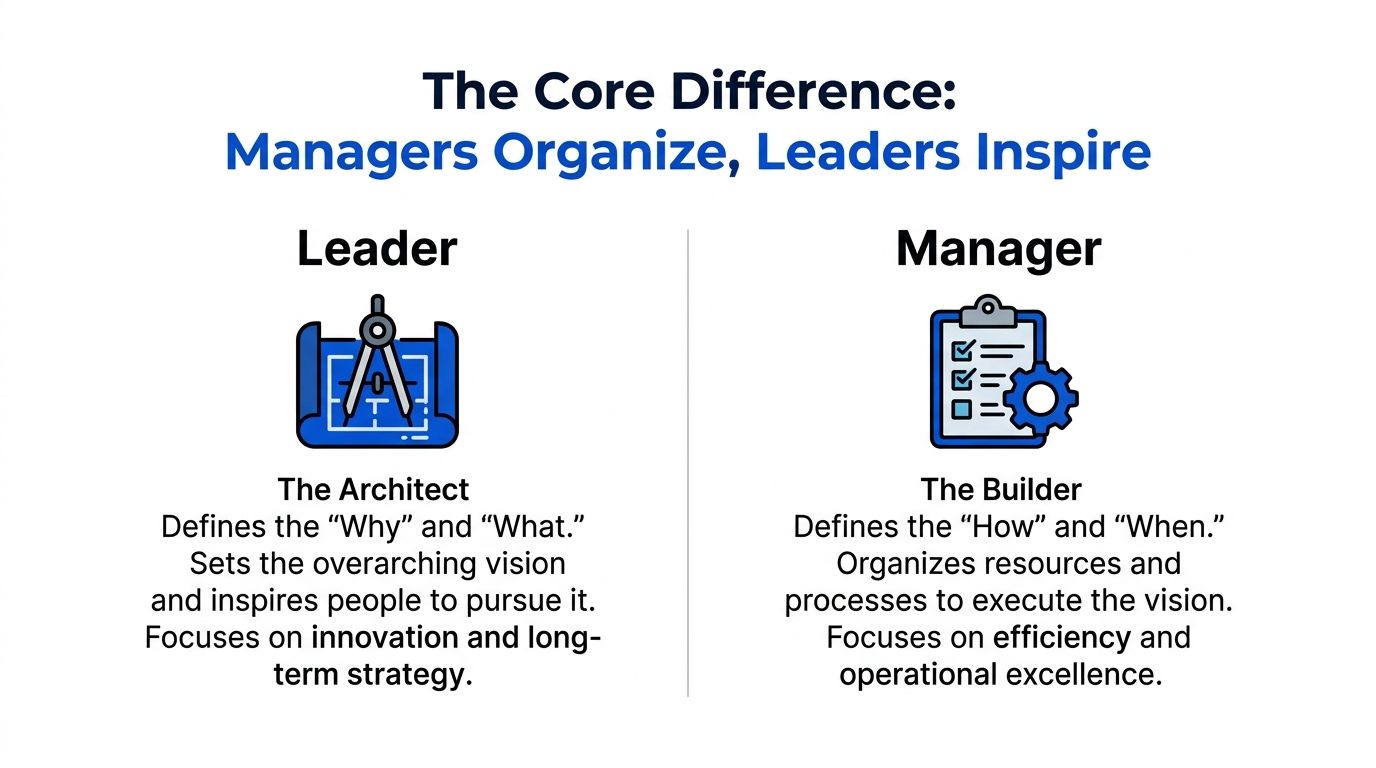
A systematic review of 44 articles found a consistent split. Leadership was commonly defined around motivating people toward goals and driving change, while management focused on planning, systems, and stability (PMC systematic review).
In engineering, that distinction gets muddy fast because senior ICs, tech leads, engineering managers, and CTOs often carry pieces of both jobs. That is why a practical explanation of technical leadership in engineering teams matters more than another generic business-school definition.
Leadership is not seniority with better posture.
Management is not Jira worship.
Leadership creates alignment around direction. Management turns direction into coordinated action.
| Attribute | Leadership (The Architect) | Management (The General Contractor) |
|---|---|---|
| Primary focus | Direction and meaning | Coordination and delivery |
| Core question | Why are we doing this | How will we get it done |
| Time horizon | Longer term | Near term |
| Main job | Set vision, influence, align people | Plan work, allocate resources, maintain accountability |
| Typical strengths | Strategic thinking, inspiration, change handling | Delegation, sequencing, execution, performance oversight |
| Failure mode | Big ideas with no traction | Efficient activity with no purpose |
| Team impact | Motivation and belief | Clarity and consistency |
Leaders matter most when the path is unclear.
They make decisions under uncertainty, explain the tradeoffs, and give the team a reason to stick with a difficult plan after the novelty dies. In software, that means choosing the platform bet, setting the engineering standard, and saying no to work that burns time without changing the outcome.
Good leadership also has a human side. Engineers do not quit because a roadmap lacked bullet points. They quit because priorities thrash, trust disappears, and nobody explains why the pain is necessary.
Managers handle complexity before it turns into chaos.
They decide who owns what, what gets done first, where delivery is slipping, and which issue needs escalation now instead of three status meetings later. A good manager protects focus, keeps commitments honest, and makes the system work for the team instead of forcing the team to work around the system.
“Tracking progress” sounds harmless. In practice, it often means watching a project fail in high resolution. Real management means tightening scope, clarifying decisions, and fixing the process while there is still time to matter.
A leader says, “This is the hill.” A manager says, “Here’s the route, the gear, the timeline, and who covers the pager if this goes sideways.”
Founders and executives often rank leadership above management because vision sounds glamorous and management sounds administrative. That is a great way to build a team that can pitch beautifully and ship badly.
The opposite failure is quieter and just as expensive. Teams with strong management and weak leadership hit deadlines for a while, but they slowly lose judgment, initiative, and context. They become efficient ticket-closers.
If you run a distributed engineering team, especially across LATAM, this distinction is not academic. Leadership sets the direction clearly enough that people can make decisions without waiting for headquarters to wake up. Management builds the operating rhythm that keeps handoffs, ownership, and communication from slipping through the time-zone cracks.
You need both functions. You just need to stop pretending they are the same job with different calendar invites.
Founders love the fantasy hire.
They want the person who can set product direction, coach seniors, manage underperformers, resolve architecture disputes, recruit top talent, run planning, calm anxious stakeholders, and still jump into the codebase like some benevolent unicorn with perfect Git hygiene.
That person exists in the same place as bug-free migrations and “quick” enterprise procurement.

A CTO should spend serious time on leadership work.
That means technical direction, platform bets, hiring standards, and deciding which problems matter enough to consume team attention. A CTO who spends every day chasing sprint burndown is compensating for a structural gap below them.
An engineering manager carries a different load. They translate goals into workflow, make sure feedback happens, keep priorities from colliding, and handle the human side of delivery. If your CTO is doing all that personally, the org probably hasn’t scaled. It has stretched.
Tech leads are where leadership and management definitions stop being neat and start getting real.
A strong tech lead leads through technical judgment. They influence architecture, shape engineering standards, mentor others, and create local clarity. But they don’t own formal people management, and that distinction matters.
Here’s the trap. Companies promote a brilliant engineer into a lead or management role because they’re technically sharp, then act shocked when the team gets awkward.
Research shows 60% of engineers feel unprepared for management roles because the move requires a shift from technical depth to people skills like communication and conflict resolution (Mad Devs). Of course it does. Debugging a production issue and mediating a disagreement between two senior engineers use different muscles.
When you write a role badly, the hire fails before day one.
Here’s what gets lumped together by accident:
One person can handle pieces of all three. Few people can carry all three at scale for long without dropping something important.
If your job description sounds like “strategic visionary who also runs standup and fixes morale,” you don’t have a role. You have wishful thinking in bullet-point form.
You don’t need a giant org chart. You need cleaner ownership.
That’s not rigid dogma. It’s a sanity-preserving default.
Engineers should know who to go to for each of these:
| Situation | Best owner |
|---|---|
| Product direction changed and priorities need reframing | CTO or senior leader |
| Team velocity is wobbling and commitments are fuzzy | Engineering Manager |
| Architecture choice is risky and needs technical judgment | Tech Lead |
| An engineer is struggling with communication or collaboration | Engineering Manager |
| A critical initiative needs both technical and organizational alignment | Shared leadership between EM and tech lead, with executive support if needed |
The best senior engineer isn’t automatically the best manager.
Some engineers should stay on an expert track. They can mentor, influence design, and raise the quality bar without owning performance reviews or interpersonal conflict. That’s not a consolation prize. It’s the wiser move.
The worst promotion logic in tech is still “they’re great at the work, so let’s make them manage the people doing the work.” Hope you enjoy preventable attrition.
Most founders don’t hire the wrong manager because they picked someone too strict.
They hire the wrong manager because they mistake passivity for team autonomy.
That mistake hides better in interviews. A candidate sounds thoughtful, says the right things about culture, and talks a good game about team autonomy. Fine. But you need operating proof.
Ask questions that force specifics.
Tell me about a time a strong engineer kept missing commitments.
Don’t accept “I coached them” as an answer. Ask what changed in the system, what expectations were set, and how follow-up worked.
How do you know when your team is confused rather than slow?
Strong managers can diagnose ambiguity. Weak ones default to “the team needs to step up.”
What cadence do you use for feedback and prioritization in a distributed team?
You’re looking for structure, not theater.
Describe a moment when you had to be more hands-on than you prefer.
Good managers adapt. Dogmatic ones cling to style over outcomes.
A sloppy job description attracts sloppy fit.
Instead of asking for a “visionary leader with startup grit,” spell out what the role must do.
Hiring gets easier when you stop recruiting for vibe.
A manager’s job is not to look impressive in a founder interview. It’s to create enough clarity, support, and accountability that engineers can do excellent work without reading tea leaves in Slack threads.
Remote leadership gets romanticized too.
People talk about async culture, trust, and flexibility like those words alone will carry a distributed engineering team through roadmap shifts, production issues, and cross-functional confusion. They won’t. Remote teams need stronger leadership and tighter management, not vaguer versions of both.
That gets more important with distributed LATAM teams because the setup is full of upside and full of ways to get lazy. Time zone alignment helps. It doesn’t fix unclear priorities, weak communication habits, or leaders who think empathy means avoiding direct feedback.

In distributed teams, the loudest person is rarely the best leader.
Quiet and undervalued leadership traits such as empathy and transparency are critical because they build the trust remote teams need to combat isolation (DSG). That doesn’t mean being soft. It means being clear, consistent, and human enough that people don’t waste energy decoding your intent.
The leaders who work well across borders do a few things relentlessly well:
Remote trust isn’t built by slogans. It’s built when a manager responds clearly, follows through, and doesn’t vanish the second things get uncomfortable.
A lot of founders think remote engineers need less management because they’re senior. Wrong.
Senior people want less hovering, not less clarity.
If you’re managing a distributed team across the US and Latin America, tighten the mechanics:
Use tools like Slack, Notion, Linear, Jira, GitHub, and Google Docs in a way that leaves a readable trail. If a decision only happened in someone’s head or in a side DM, expect confusion later.
Status updates belong async whenever possible. Problem-solving deserves focused meetings with a decision owner. Don’t turn every sync into a vague catch-up call that somehow creates more work.
Not every message deserves instant attention. Say what’s urgent, what can wait, and where escalation happens. Otherwise everyone lives in fake emergency mode.
Some US leaders overcorrect for politeness and become frustratingly indirect.
They soften expectations so much that nobody knows what “good” looks like. Or they assume silence means agreement. It doesn’t. Sometimes silence means caution, respect, or uncertainty about whether dissent is welcome.
That’s why transparency matters. Not performative transparency. Real transparency.
If you want a useful benchmark for companies doing remote work well, this list of top remote companies is handy for studying how serious distributed organizations present themselves and structure remote expectations.
For a more hands-on management angle, this guide on managing a remote team manager role gets into the operating realities leaders tend to underestimate.
A quiet Slack channel doesn’t mean focus. It can mean people have stopped raising issues.
An “independent” team isn’t always a mature team. It can mean they’ve learned not to expect help.
Distributed LATAM teams can be phenomenal. But they thrive under leaders who communicate context and managers who create predictable operating rhythms. Remote work rewards discipline. It punishes vagueness.
By now, the binary should annoy you a little.
Good. It annoys me too.
Leadership and management definitions are useful only if they help you switch modes on purpose. Real teams don’t live in neat boxes. Tuesday morning might need strong management. Tuesday afternoon might need leadership because the roadmap changed, the customer escalated, and your best engineer is wondering whether any of this makes sense.
The best operators can do both. Not all at once, and not perfectly, but deliberately.
Research on management and leadership as a continuum argues that top performers combine both through “power-added” competencies, a fusion of people-handling and technical expertise that lets them switch roles as the situation demands (PMC on power-added managers).
This is the practical test I use.
If the team lacks direction, they need leadership.
If the team lacks coordination, they need management.
If they lack both, congratulations. You’ve got the sort of week that creates strong opinions and new coffee habits.
Use this when the team is uncertain about purpose, tradeoffs, or what matters most.
You should be doing things like:
Leaders earn trust by making decisions legible.
Use this when the direction is clear but execution is wobbling.
That means:
A surprising number of leaders stay in architect mode because it feels more important. It also lets them avoid the unglamorous work of checking whether anything is moving.
Use this when the system is fine but a person needs support, correction, or challenge.
Consider these questions:
The right style is the one that reduces confusion and increases responsibility. Everything else is personal branding.
Most leaders overestimate their strength in the mode they enjoy.
Visionary types think they’re enabling when they’re absent. Process-heavy managers think they’re providing structure when they’re smothering judgment.
Try this quick diagnostic:
| If your team says this | You probably need more of this |
|---|---|
| “We’re busy, but I’m not sure why this matters” | Leadership |
| “We agree on the goal, but work keeps slipping” | Management |
| “I didn’t know that was expected” | Management |
| “Decisions keep changing and nobody explains them” | Leadership |
| “I only hear feedback when something goes wrong” | Better coaching and management |
You don’t become effective by calling yourself a leader.
You become effective by knowing when to set direction, when to tighten execution, and when to get close enough to a person or problem to make progress possible.
A few habits make that switch easier:
Start meetings by naming the mode
Is this meeting for alignment, decision-making, troubleshooting, or accountability? If you don’t know, the team won’t either.
Match your tools to the job
Use roadmaps and memos for leadership work. Use task boards, scorecards, and one-on-ones for management work. Stop trying to solve operational drift with inspirational speeches.
Review your calendar
If every slot is strategy, you’re probably neglecting management. If every slot is status review, you’re probably starving leadership.
Promote people on demonstrated range
Reward people who can move between technical depth, human judgment, and execution discipline. The title matters less than the range.
The strongest engineering organizations don’t worship one style. They build leaders and managers who can read the moment and respond accordingly.
That’s what mature leadership and management definitions are for. Not labeling people. Running teams better.
If you’re scaling engineering and need people who can operate effectively, not interview well, CloudDevs is worth a look. You can hire pre-vetted Latin American developers and designers readily, work in aligned time zones, and avoid turning your internal team into a full-time recruiting department. That’s useful when you need execution without adding more chaos.

You got the title, the login credentials, and a calendar full of “quick syncs.” Nice. Then reality shows up. The ticket queue is ugly. The infrastructure diagram is either outdated or fictional. Half the team works remotely. The other half says they do, but somehow still depend on hallway conversations. And your CEO wants “better...

Choosing between contract vs direct hire? This guide helps you decide. Explore costs, flexibility, and compliance for hiring LATAM developers.


Learn how to hire remote developers with expert strategies for sourcing, vetting, and onboarding top global tech professionals. Start hiring smarter today!