Unlock Success with Inter Department Communication

Victor
Posted on 25 April 2026




Sales promised the client a workflow. Product nodded because the roadmap doc sort of implied it. Engineering stared at the Jira board like it had personally betrayed them. Support found out on launch day. Then the CEO jumped into Slack asking why a “small update” had turned into a fire.
If you run a tech company, this isn’t a weird edge case. It’s Tuesday.
That’s why inter department communication matters so much. Not because it sounds nice in an HR handbook. Because bad communication creates fake deadlines, fake confidence, and very real costs. If your US product team works with remote engineers across countries and time zones, the pain gets sharper fast. Tiny misunderstandings turn into blocked tickets, duplicate work, and meetings that should’ve been a two-line async update.
Table of Contents
A few years ago, I watched a product launch go sideways for the dumbest reason imaginable. Sales had been telling prospects a feature was “coming this sprint.” Engineering thought it was still in discovery. Design had mocks in Figma, but no one had tagged the API team. Support had already drafted help docs for a flow nobody had built.
Sound familiar?

People love to call this a “misalignment.” Cute word. What it usually means is nobody owns the handoffs, nobody documents decisions, and everyone assumes someone else said the important bit out loud.
This isn’t a soft-skills problem. It’s an operating problem.
According to a 2017 Harvard Business Review Analytics Services survey summarized here, 67% of collaboration issues stem directly from interdepartmental communication problems, and a single employee can lose over 35 working days per year due to these inefficiencies. That’s not “some friction.” That’s a giant hole in your execution engine.
If you want a good companion read on the cost of communication silos, it’s worth your time. Especially if your org keeps mistaking departmental independence for maturity.
You don’t need a dramatic meltdown to know your system is broken. The warning signs are boring, repetitive, and expensive:
Bad inter department communication rarely explodes all at once. It leaks time in tiny, unglamorous ways until your roadmap starts missing dates for “mysterious” reasons.
The frustrating part is that departments frequently already have the tools. Slack. Jira. Notion. Google Docs. Zoom. The issue isn’t the lack of software. The issue is that there’s no shared rulebook for how information moves between departments.
And without that rulebook, every team invents its own little kingdom. Sales talks in promises. Engineering talks in tickets. Product talks in priorities. Nobody’s wrong, exactly. They’re just not speaking the same operational language.
Most founders handle communication failures the wrong way. They identify a few “bad communicators,” run a workshop, tell managers to over-communicate, and hope things improve.
That doesn’t scale.
Good inter department communication is not a personality trait. It’s a system. If your system rewards people for hoarding context, hiding uncertainty, or making decisions in private messages, that’s what people will do. Not because they’re evil. Because they’re busy, overloaded, and following the path of least resistance.
McKinsey research, cited in these internal communication statistics, shows that employee productivity increases by 20-25% in organizations where employees are effectively connected. The same source says 74% of employees feel they’re missing out on company news. That’s the upside and the failure mode in one shot.
If you want the productivity upside, stop making communication optional craftsmanship. Build it into the work itself.
Here are the three rules I’d enforce before buying one more tool.
Private channels should be the exception, not the norm. If a product decision affects engineering, design, support, and success, it should live in a place all four groups can access. Not in a DM. Not buried in someone’s personal notes. Not trapped in a meeting half the team didn’t attend.
Open-by-default communication does two things. It reduces repeated questions, and it lets new people self-serve context without interrupting half the company.
Practical rule: If a decision matters beyond two people, document it somewhere searchable the same day.
Ambiguity kills speed. “We’re handling it” is not ownership. “The team is on it” is not ownership. A task with five partial owners has zero owners.
You need one person accountable for the outcome, even when several people contribute. Not because accountability is trendy, but because handoffs collapse when nobody knows who is supposed to close the loop.
A lot of teams hear “async-first” and turn it into “never talk live again.” That’s just a different flavor of dysfunction.
Async-first means routine updates, status changes, decisions, and handoffs should happen in writing by default. Live calls are for debate, conflict resolution, and decisions that benefit from real-time back-and-forth. If your calendar is packed with status meetings, you haven’t built a communication culture. You’ve built theater.
Organizations often keep communication norms in the CEO’s head and then act shocked when departments improvise. Write them down. Channel purpose. Expected response times. What belongs in Jira versus Slack versus Notion. Who updates whom, and when.
If your team has never formalized this, a guide on creating standard operating procedures is a useful place to start. Not because SOPs are sexy. They aren’t. But they stop your company from relearning the same lesson every quarter.
A strong communication system should make the right action obvious. That’s the bar. If people have to guess where a launch decision lives, where to escalate a blocker, or who informs support before release, your system is still running on vibes.
Organizations often don’t have a communication problem. They have a rhythm problem.
They either talk constantly and still miss things, or they avoid structure and then patch the gaps with panic meetings. Neither works. You need a weekly cadence that tells people when updates happen, where they happen, and what “good” looks like.

I’m biased toward fewer meetings and better writing. Try this rhythm for two weeks before you add anything else.
Monday kickoff in Slack
Every cross-functional team posts one async update in a dedicated channel. Not a novel. Just:
Daily written standup
Skip the round-robin call unless you need it. Each person posts:
Midweek dependency check
Product, engineering, design, and any adjacent team with active dependencies reviews blockers in Jira or Asana. Keep it tight. If there’s no blocker, there’s no meeting.
Weekly demo or review
One live meeting. Show progress. Confirm decisions. Capture follow-ups in the tracker before everyone leaves.
According to this communication protocol guide, a successful communication protocol specifies channels and response times, like Slack for daily collaboration with a less than 1 hour response time for urgent matters, and email for policy changes. The same source notes that organizations that document and train on these standards report 20-30% faster project delivery.
That sounds obvious, but many teams still refuse to do it. They use every tool for everything, then wonder why nobody knows where the truth lives.
A sane baseline looks like this:
| Rhythm | Tool | Rule |
|---|---|---|
| Daily collaboration | Slack | Ask, unblock, clarify. Don’t treat it as permanent documentation. |
| Work status | Jira or Asana | If the task changed, update the ticket. Not just the chat thread. |
| Decisions and process | Notion or Confluence | Final decisions go in docs people can find later. |
| Formal announcements | Use when everyone must receive the same message in the same format. |
If your team needs help tightening the basics, this guide on how to improve team communication is a solid tactical reference.
Some meetings are pure administrative compost. Get rid of them.
If a meeting exists because nobody trusts the written system, fix the written system.
One reason async fails is that people write terrible updates. Too vague, too long, no ask, no deadline.
Use a template people can skim in under a minute:
That last line matters. A lot. Teams drown in updates that describe a problem but never ask for a decision.
The point of a rhythm isn’t bureaucracy. It’s reducing randomness. When inter department communication follows a known cadence, teams stop chasing context and start shipping.
Let’s say it plainly. Most RACI charts are decorative bureaucracy.
They look serious in kickoff decks. Then nobody checks them again because they’re too abstract, too crowded, and too polite to answer the only question that matters. Who is on the hook when this goes sideways?
You don’t need more letters. You need cleaner responsibility.
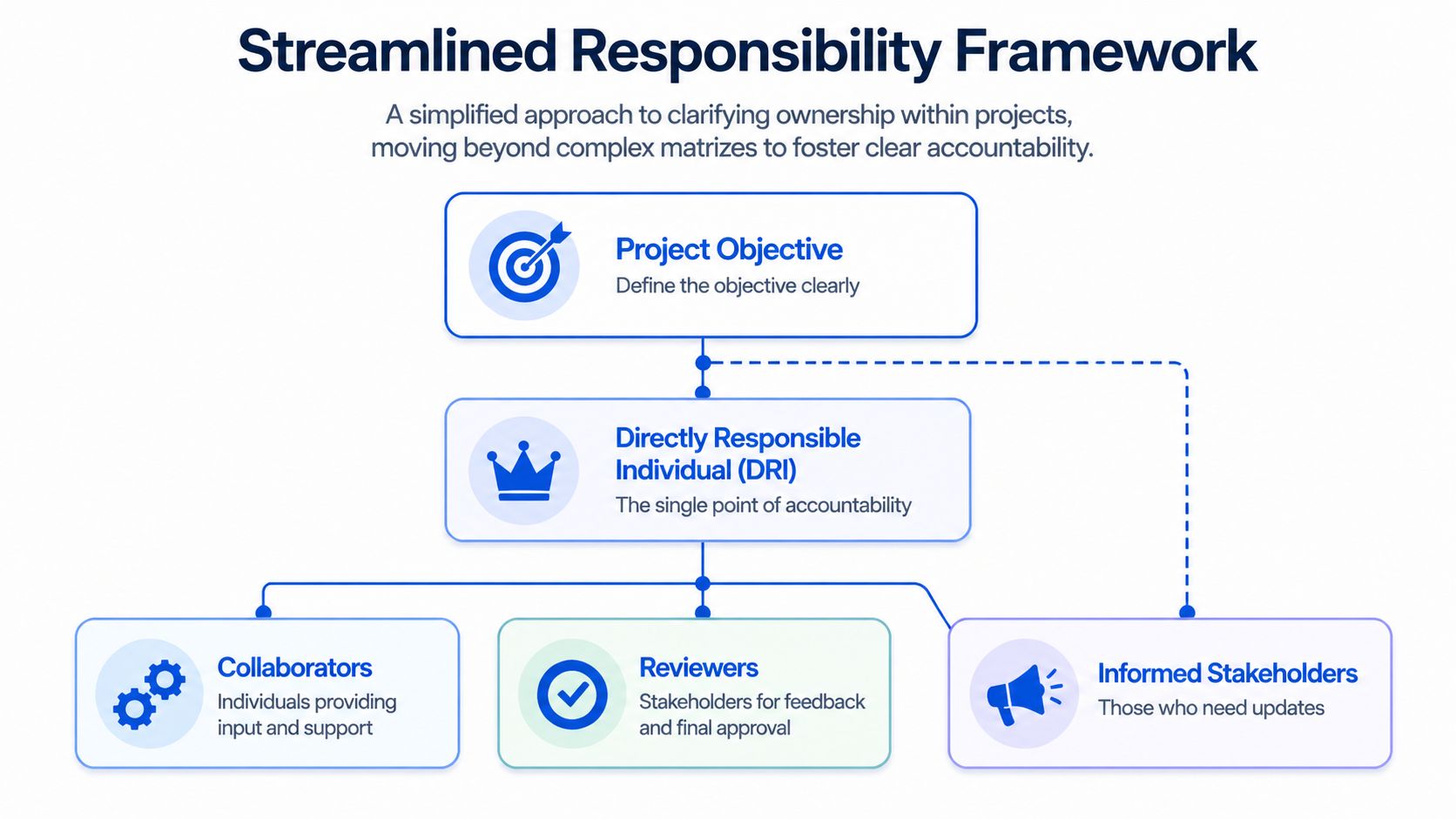
My preferred version is brutally simple:
DRI
One Directly Responsible Individual. One. Not a duo. Not “shared between product and engineering.”
Collaborators
The people doing meaningful parts of the work.
Reviewers
The people who approve, QA, or provide formal feedback.
Informed stakeholders
The people who need updates but should not become surprise decision-makers.
This framework works because it respects reality. Projects need many contributors, but they still need one accountable owner.
Say you’re launching a new billing feature.
| Role | Example owner | What they actually do |
|---|---|---|
| DRI | Product manager | Owns scope, timeline, and cross-team follow-through |
| Collaborators | Engineering lead, designer, QA | Build, test, and refine the feature |
| Reviewers | Finance lead, support lead | Validate customer impact and readiness |
| Informed stakeholders | Sales, customer success, exec team | Get updates, don’t rewrite the plan mid-flight |
That setup avoids the classic nonsense where Sales thinks launch date is theirs, Support assumes docs will appear magically, and engineering waits for decisions nobody formally requested.
The ownership model gets much stronger when every department is working toward the same outcome instead of defending local KPIs. According to this cross-functional communication framework, teams do better when they set SMART shared goals and form interdepartmental task forces. The same source notes that starting with low-stakes social integrations can boost willingness to communicate by 40%.
That second point sounds fluffy until you’ve watched two departments misread each other for months because nobody has any relationship capital. People collaborate faster when they know each other well enough to ask dumb questions without posturing.
Teams don’t avoid ownership because they’re lazy. They avoid it because the org has trained them to expect blame without clarity.
At every project kickoff, answer these four questions in writing before anyone starts building:
If those answers aren’t obvious, your launch plan is still fiction.
A lot of inter department communication problems are really ownership problems wearing a fake mustache. Fix the ownership, and half the communication mess disappears with it.
Tools don’t fix chaos. They expose it.
I’ve seen companies with Slack, Jira, Notion, Confluence, Google Docs, Zoom, Loom, Linear, and a small museum of abandoned project apps. Still a mess. Why? Because nobody agreed on what each tool is for. So every important decision ends up half-documented in four places and fully trusted in none of them.
Here’s my opinionated version.
Slack is for fast collaboration, clarifying ambiguity, and unblocking work. It is not where final decisions should live. If your team keeps saying “it was in Slack,” congratulations, you’ve built an operational memory with the lifespan of a fruit fly.
Jira and Asana are for work status. Not vibes. Not “we’re almost there.” If the work moved, the ticket gets updated. If the dependency changed, the ticket gets updated. If the date slipped and only Slack knows, your tracker is a liar.
Notion or Confluence is your external brain. Process docs, decision logs, onboarding guides, release notes, definitions, team agreements. If it matters next week, put it in a durable place.
| Communication Type | Correct Tool | The Golden Rule |
|---|---|---|
| Urgent blocker | Slack | Ask fast, tag the owner, then log the outcome elsewhere if it changes work |
| Task status | Jira or Asana | The board is the source of truth, not the chat |
| Product decision | Notion or Confluence | Write the final decision, owner, date, and impact |
| Customer issue crossing teams | Support system plus Jira | Tie support and engineering together with a visible handoff |
| Company-wide policy update | Email plus wiki | Announce once, document permanently |
| Demo or walkthrough | Zoom or Loom | Use video for nuance, then summarize the decision in writing |
A lot of inter department communication breaks at the support-to-engineering boundary. Support logs a customer issue. Engineering wants reproduction details. Product wants impact. Everyone copies and pastes between tools like it’s 2009.
That’s why a practical guide to a seamless Jira Integration Zendesk workflow matters. Not because integrations are glamorous, but because they reduce the chance that a customer issue dies in a tab nobody reopened.
You don’t need more apps. You need clearer rules:
And here’s the essential part.
I’d bake these into your handbook tomorrow:
Slack message: “Can someone look at this?” is weak. Slack message: “@Alex blocker on API contract, need decision by 2 PM ET to keep QA on track” is useful.
Most communication stacks fail because leaders tolerate sloppy tool behavior. People follow incentives. If promotions reward heroics over clarity, they’ll keep solving preventable confusion with late-night Slack bursts and emergency calls.
That’s not speed. That’s operational debt with better branding.
Remote hires don’t fail because they’re remote. They fail because companies throw them into a communication maze and call it onboarding.
This gets even more obvious with distributed engineering teams. A new developer joins from Latin America, gets invited to fifteen tools, sees five overlapping Slack channels, hears three different definitions of “done,” and spends the first week guessing which questions are safe to ask. Then managers blame “ramp-up time.”
No. The system was sloppy.

One of the biggest mistakes US teams make is treating time-zone overlap like a scheduling nuisance instead of a collaboration asset. You usually have a solid shared work window. Use that for high-bandwidth decisions, pair sessions, and blocker clearing. Keep status updates and routine context async.
That matters because, according to this remote alignment write-up, 68% of distributed tech teams report “misaligned expectations” from poor async communication. The same source says over-reliance on video calls pushes burnout up by 40% in global teams. More calls won’t save a weak system. Better async will.
If I were onboarding a remote LATAM engineer into a US team, I’d run it like this.
Day 1
Week 1
Week 2
Days 15 to 30
If you need a stronger remote ramp-up checklist, this guide on how to onboard remote employees covers the mechanics well.
Most managers fixate on English fluency and miss the underlying issue. Communication norms vary. Some people come from environments where pushing back feels risky. Others are used to escalating early. Some wait for perfect information before speaking. Others think aloud in public.
None of that is a problem if your system is clear.
Remote onboarding succeeds when a new hire can answer three questions without asking around. Where do I find truth? How do I raise a blocker? Who decides?
That’s the standard. Not whether they smiled on Zoom.
If your communication plan ends with “the team feels more aligned,” you’re not finished. You’re guessing.
The hard truth is that many leaders talk about better collaboration and never measure whether anything changed. According to this analysis of communication initiative ROI, only 28% track quantifiable outcomes from communication initiatives. The same source notes that interdepartmental email volume can correlate to 18% faster project velocity, and frames that measurement against the 60% cost savings from hiring LATAM talent.
That’s the right mindset. Don’t just praise communication. Instrument it.
You don’t need a giant analytics project. Start with a few operational signals tied to work that crosses departments.
| Signal | What to watch | Why it matters |
|---|---|---|
| Project velocity | How quickly work moves through Jira after handoff points | Reveals whether cross-team coordination is improving |
| Emergency meetings | Count how many “urgent” meetings appear from nowhere | Good systems reduce panic scheduling |
| Handoff quality | Look for reopened tickets or missing context between teams | Shows whether updates are clear enough to act on |
| Support escalation flow | Track issues that require product or engineering follow-up | Exposes whether customer-facing and technical teams sync cleanly |
| Decision latency | Measure how long blockers wait for an owner decision | Tells you where authority is muddy |
These aren’t vanity metrics. They connect communication habits to delivery.
Not a therapy session. An operating review.
Ask each team lead for short answers to questions like:
Then pick one system fix. Just one. A renamed channel, a sharper Jira workflow, a new release checklist, a rule for documenting launch decisions. Small fixes compound when they target repeatable failure points.
Some chaos is process. Some chaos has a face and a calendar invite.
Here’s the blunt version.
An information-hoarding manager
Move key decisions into shared channels and docs. If they resist, make transparency part of role expectations, not a polite suggestion. Leaders don’t get to run private kingdoms inside a scaling company.
A team that ignores the tracker
Don’t plead. Tie reviews and planning to documented work only. If it isn’t in Jira or Asana, it doesn’t exist for prioritization purposes.
A real crisis
Yes, sometimes you break the async rules. Security issue. Production outage. Major customer incident. Fine. Jump on the call. Open the war room. But once the crisis ends, write the timeline, decisions, owners, and follow-ups in a durable doc. Chaos is not an excuse for memory loss.
The best communication systems are flexible under pressure and disciplined after the pressure passes.
Too many channels, too little clarity
Archive aggressively. Rename confusing channels. Publish a short directory that explains what belongs where. Slack should feel like a map, not a flea market.
Inter department communication isn’t magic. It’s engineered. You define ownership. You choose tools on purpose. You create rhythms. You onboard people into the system. Then you measure whether the machine is producing cleaner handoffs, faster decisions, and fewer surprises.
That’s the game.
Most companies won’t do it because it feels less exciting than shipping features. Then they spend the next year paying for preventable confusion in rework, missed deadlines, and executive babysitting.
You can keep doing that.
Or you can build a company where people know where truth lives, who owns the next move, and how information travels without needing a heroic rescue in Slack.
If you want to scale engineering without adding communication chaos, CloudDevs helps US teams hire pre-vetted LATAM developers and designers who work in your time zone and fit into remote-first workflows fast. That means less coordination drag, cleaner handoffs, and a much better shot at growing without turning your calendar into a crime scene.

Learn how to improve team communication with actionable strategies. Enhance collaboration and productivity today. Click to discover effective ways!


Ace your next interview with our list of 10 essential full stack interview questions. Covers frontend, backend, databases, and DevOps to help you land the job.

Hiring? Use these 7 sample IT job description templates for roles like Software Developer, Cloud Architect, and more to attract top talent.