Get a Top Java Developer for Hire Quickly

Victor
Posted on 17 May 2026




You're probably here because the normal hiring playbook has already annoyed you.
A Java engineer quit. A roadmap didn't. Now you're staring at recruiter fees, bloated resumes, and interview loops that somehow consume your calendar while producing exactly one thing: fatigue. Meanwhile, the codebase still needs someone who can handle real production work, not just talk confidently about Spring and then melt during code review.
That's the trap with searching for a java developer for hire. Most advice treats hiring like a paperwork problem. It isn't. It's a delivery problem. You need someone who can join fast, understand the mission, and ship without turning your team into a babysitting service.
Table of Contents
Local hiring for Java roles often looks respectable from a distance. Then you zoom in and it's the same circus every time. Recruiter outreach. Resume archaeology. Three rounds of interviews. A final candidate who wants compensation that makes your finance lead stare into the void.

The market hasn't gotten easier. It's gotten more cautious. In a 2025 Perforce survey reported by InfoWorld's coverage of Java hiring plans, 51% of Java shops planned to add more developers, down from 60% in 2024. That matters because companies are hiring with tighter scrutiny now. They still need output. They just have less patience for slow, expensive mistakes.
The classic U.S. hiring loop assumes you have time to wait and budget to burn. Most startups have neither.
You need someone who can overlap with your team, communicate clearly, and start contributing before the role becomes a company-wide hostage situation. That's why founders keep drifting toward nearshore hiring in Latin America. Not because it sounds trendy on a podcast. Because timezone alignment and pre-vetting beat chaos.
Stop optimizing for resume volume. Optimize for how fast a developer becomes useful.
If you're still posting everywhere and hoping the right person wanders in, at least tighten your distribution. A curated board for remote jobs can help you reach candidates who already want distributed work, which removes a lot of pointless filtering up front.
It's just a better operating model.
Instead of spending weeks proving who isn't qualified, you start with talent that has already been filtered for remote readiness and relevant skill. That's the move. Especially for Java, where the gap between “knows syntax” and “can own production systems” is wide enough to drive a burned sprint through.
Most job descriptions are junk. They read like someone dumped a Java glossary into a bulleted list and called it strategy.
“Must have Spring Boot, Hibernate, Kafka, Docker, AWS, Kubernetes, GraphQL, NoSQL, SQL, microservices, leadership, startup mindset.” Great. You've described half the internet and none of the actual problem.

The first thing you should write is a one-page mission. Not a bloated req. A mission.
What must this person accomplish in the first stretch of work? Stabilize a brittle API layer. Untangle a slow billing service. Build the first version of an event-driven backend. Reduce operational pain in a legacy monolith. If you can't say that clearly, you're not ready to hire.
Arc's guide makes the point cleanly in its Java hiring guidance on specialization. You must first define whether you need developers for algorithms, AI, or mobile apps, and it notes that enterprise application development, microservices architecture, and API integrations are distinct use cases requiring different types of Java specialists. That's the actual filter. Not “seven years of Java.”
Use this structure:
That brief forces clarity. It also makes interviews better because you stop asking random framework questions and start asking, “How would you handle this exact mess?”
Practical rule: If your brief could describe five different roles, it's not a brief. It's fog.
Yes, you can dress up a role on LinkedIn. That's useful. But a polished post won't rescue a vague hiring target. If your team is publishing roles or founder-led hiring content there, a solid LinkedIn posting strategy can improve how clearly the opportunity lands. Just don't mistake distribution for definition.
The best Java hires happen when the candidate can see the mission and say, “I've solved that kind of problem before.” Everything else is noise in business casual.
You've got three realistic ways to find Java talent. One is slow and expensive. One is fast and chaotic. One is boring in the best possible way. Boring wins.
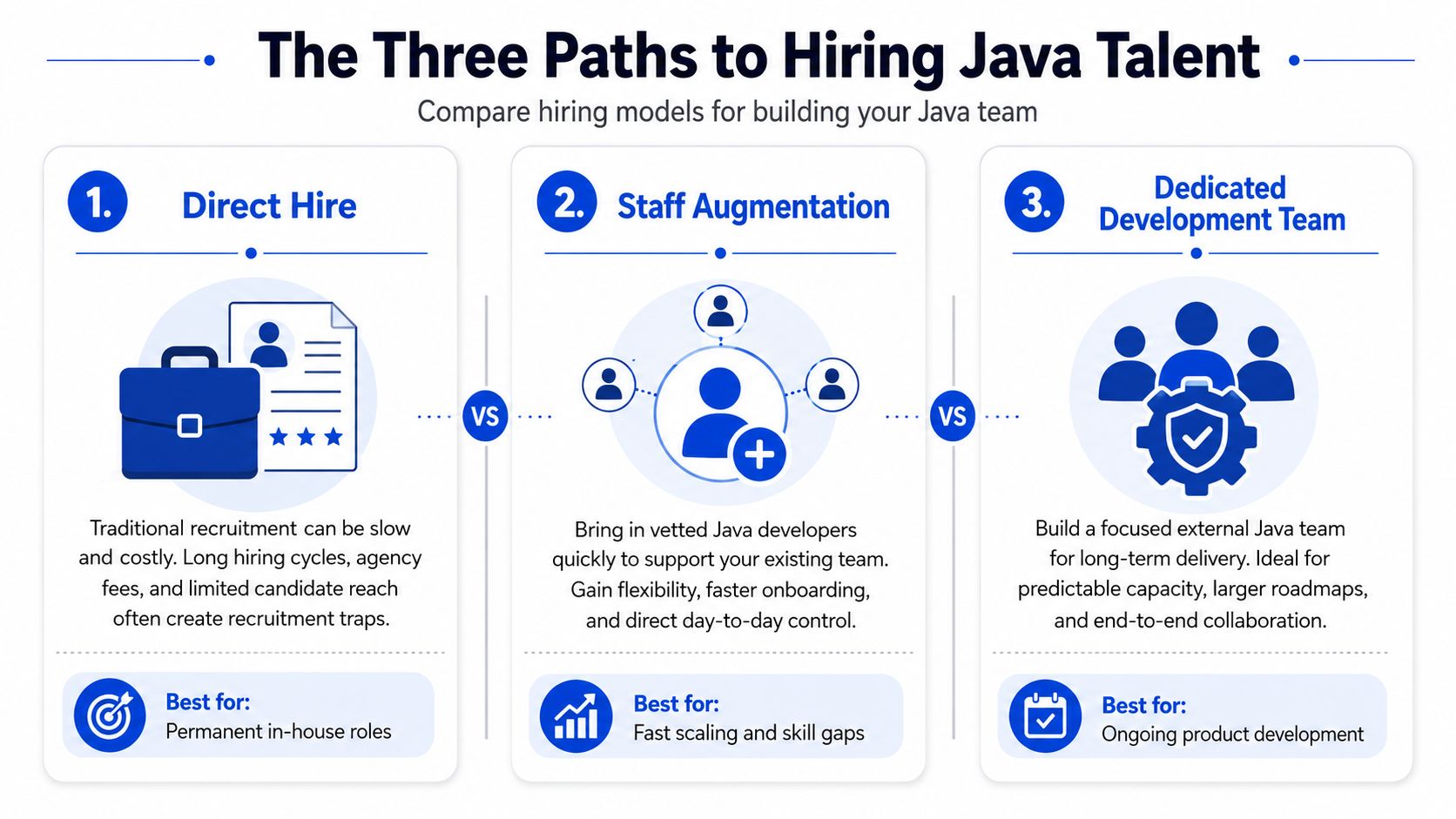
This is the traditional route. Internal recruiting, outbound sourcing, agencies, long interviews, scheduling drama.
It works if you're building a long-term local team and have patience. It fails when you need speed. It also hides costs well. Recruiter spend is obvious. Executive time, engineering interview time, and project delay are the sneakier line items that punch you later.
A lot of teams lean on LinkedIn for this stage, and fair enough. If you're building your own outbound funnel, understanding LinkedIn sourcing tool capabilities helps you avoid doing candidate search with oven mitts on. But tooling doesn't fix the fact that direct hire is still a slow pipe.
Here, optimism goes to die.
You post a role and get a flood of responses. Some are competent. Some are copied-and-pasted bids from people who clearly didn't read the scope. Some might be fine, but now your engineering manager is spending their week doing forensic HR work instead of shipping product.
This model can work for tiny, self-contained tasks. It's rough for core Java systems where reliability, maintainability, and collaboration matter.
You can save money on hourly rate and still lose badly on management overhead.
This is the path I'd recommend when speed matters and you don't want to gamble on basic professionalism.
The operational question for remote hiring is simple: how fast can you get to a productive hire, and how much failure risk sits between now and then? Scalable Path notes in its comparison of Java hiring speed and models that some agencies take 3–14 days to find a candidate, while vetted marketplaces can deliver a productive, timezone-aligned hire in under 3 days. That shifts the decision away from rate shopping and toward speed-to-output.
| Hiring path | Good for | Main problem | What you're really buying |
|---|---|---|---|
| Direct hire | Core long-term local roles | Slow process and heavy internal effort | Control |
| Open marketplaces | Small one-off tasks | Vetting burden and uneven quality | Optionality |
| Vetted platforms | Fast remote team scaling | Less raw volume to browse | Speed and reduced hiring risk |
CloudDevs is one example of this category. It's a marketplace focused on pre-vetted Latin American talent and presents developers for remote work with timezone overlap, which is the part too many buyers realize they needed only after the third failed hire.
The punchline is simple. If you need a java developer for hire this quarter, don't choose the model that creates extra work for your already busy technical staff.
Please stop asking senior Java candidates to do party-trick puzzles that have nothing to do with your production environment.
A developer can ace algorithm trivia and still wreck your service boundaries, write unreadable code, or freeze when they hit a messy dependency graph. Java hiring needs realism, not theater.
Industry guidance is blunt on this. Effective assessments should use realistic, work-simulated tasks mapped to job requirements, not trivia. The technical assessment guide for hiring Java developers recommends replicating real-world projects and using objective scoring to evaluate problem-solving and clean-code habits.
That's the right approach because Java work usually lives in systems, not in toy functions.
Here's a simple format that works:
Pick one realistic task
Use a scoped assignment that mirrors actual work. Examples: fix a performance bottleneck in a microservice, add an API endpoint with tests, or diagnose a concurrency issue in a small service.
Keep it short and paid
A short paid exercise respects the candidate's time and gives you better signal. Unpaid take-homes often select for desperation or people with spare evenings, not necessarily the best engineers.
Score against a rubric
Judge code clarity, correctness, tradeoff awareness, test quality, and communication. Don't invent criteria halfway through.
After the task, run a short review call. Have the candidate walk through decisions.
Ask things like:
A strong senior engineer won't just defend code. They'll explain tradeoffs without turning the conversation into a TED Talk.
The review call tells you how they think under normal conditions. That matters more than whether they can recite framework trivia from memory.
If you hire too narrowly, you'll miss good engineers who can adapt quickly. That's especially true in Java, where buyers often over-index on one framework as if talent begins and ends with it.
Use a language-appropriate screen, then layer in a practical discussion around architecture, debugging, and code quality. If you want a stronger interview structure, this bank of Java interview questions with answers is useful for building follow-up conversations after the work sample. Use it as support material, not as your whole process.
A modern Java interview should feel like a lightweight simulation of the actual job. If it feels like exam prep, you're screening for the wrong thing.
Let's talk money, because everyone eventually asks the same question with slightly different wording. “What should a java developer for hire cost me?”
The wrong answer is to chase the cheapest rate. The second wrong answer is to assume local hiring is automatically safer. Cost only makes sense when paired with delivery, reliability, and how much overhead your team absorbs.
Lemon.io's 2026 rate calculator, summarized in the verified data, says Java developer pay runs on a median basis from about $30 to $68 per hour depending on seniority, with strong senior U.S. Java developers reaching $100 per hour in that market. The same source set also notes that a mid-level Java developer in San Francisco can cost about $80 per hour, while the same skill set in some global markets may cost about $25 per hour, a 70% difference. That contrast is a big reason companies look at nearshore hiring through the Java developer rate calculator from Lemon.io.
Here's the practical view:
| Location | Mid-Level Rate (Hourly) | Senior-Level Rate (Hourly) |
|---|---|---|
| San Francisco | about $80 | U.S. market can reach $100 |
| Some global markets including LATAM-aligned sourcing comparisons | around $25 | varies qualitatively by market and seniority |
A direct employee costs more than salary or hourly pay. You also carry recruiting effort, payroll administration, benefits overhead, and the cost of a bad hire hanging around too long because replacing them is painful.
A managed marketplace invoice can look higher than a freelancer's sticker price, but lower than the all-in cost of assembling everything yourself. That's why mature teams compare total cost of talent, not just hourly numbers.
Cheap developers are expensive when your staff has to supervise every decision.
Use a simple filter:
If you're hiring nearshore from Latin America, the key advantage isn't “cheap labor.” It's getting capable Java talent at a sustainable rate while keeping collaboration practical for a U.S. team. That's a grown-up operating decision, not bargain hunting.
Interviews are educated guessing. Onboarding is where the truth shows up.
That's why a short trial period matters. You're not just checking code quality. You're checking responsiveness, ownership, judgment, and whether the person can function inside your actual workflow without creating a trail of confusion behind them.
Day one should be boring and efficient. Give access to GitHub, Slack, Jira, cloud dashboards, documentation, and staging environments. If access takes three days, that's not a candidate problem. That's your process waving a red flag.
Then assign a small first win. A bug fix. A minor endpoint improvement. A test suite cleanup. Something real, visible, and contained.
Use a short cadence for communication:
A short trial tells you whether the person can:
If the fit is wrong, you want to know quickly. Dragging a weak hire through a month of polite optimism is how teams lose time they don't have.
The old hiring game still exists if you want it. Recruiters, endless loops, inflated local competition, and a nice stack of resumes from people who may or may not be able to own production code.
Or you can build differently.
A strong LATAM team gives U.S. companies something very close to an unfair advantage. You get real timezone overlap, easier collaboration, and access to talent without forcing your roadmap to wait on local market bottlenecks. That matters more than polished hiring slogans.
You don't need magic. You need fewer failure points.
Nearshore hiring through a vetted marketplace reduces three problems that routinely hurt software teams:
That's why more buyers are focusing on speed-to-output and failed-hire prevention instead of obsessing over the lowest visible hourly rate. If you want to build that way, start with a partner that understands how to hire nearshore developers and can support the operational side, not just hand you a resume and disappear.
The smartest hiring move is the one that lets your team keep building while the hiring machine runs in the background.
The companies that move fastest aren't always the ones with the biggest budgets. They're the ones that stopped hiring the hard way.
If you need a faster path to a reliable Java hire, CloudDevs is worth a look. It connects U.S. companies with pre-vetted Latin American developers, supports timezone-aligned remote hiring, and gives teams a low-friction way to test fit before committing long term.

Outsourcing to Latin America isn't some fleeting trend; it's a strategic playbook US companies are using to scale fast without torching their runway. It hits a sweet spot that’s hard to find elsewhere: significant cost savings, real-time collaboration, and genuine cultural alignment. This makes it a powerful alternative to both eye-watering domestic hiring and the...

Learn the essential tips for hiring developers for startup success. Discover sourcing, interviewing, and closing talent without overspending.


Stop Hiring "TypeScript Experts" Who Can't Type So, you're hiring a TypeScript developer. You post a job, get a flood of resumes all claiming "expert" status, and spend weeks in interviews. You finally hire someone who aced the basic questions, only to find their code is an any-riddled mess that breaks at 3 AM. Sound...