AWS vs GCP vs Azure: Founder’s 2026 Cloud Verdict

Victor
Posted on 19 April 2026



You’re probably in one of two situations.
Either you’re launching something new and trying to avoid a cloud decision that turns into a five-year architectural tattoo, or you’re already on one provider and getting that uneasy feeling that the bill, team structure, and operational sprawl are starting to run the company instead of support it.
I’ve built on all three. AWS wins on breadth. Azure wins in Microsoft-heavy environments. GCP wins when data, ML, and developer sanity matter most. That’s the short version.
The longer version is where the expensive mistakes hide.
Table of Contents
A founder asked me recently which cloud to pick. Not because they loved infrastructure, obviously. Nobody wakes up excited to compare IAM weirdness, regional quirks, and egress gotchas. They asked because they knew the choice would shape hiring, roadmap speed, compliance posture, and how painful the next migration would be.
That’s the essence of aws vs gcp vs azure. It isn’t a tooling decision. It’s an operating model decision.

The market makes that painfully clear. In Q3 2025, global cloud infrastructure services spending hit $107 billion, and AWS, Azure, and GCP controlled over 65% of that market. AWS held 29%, Azure 22 to 24%, and GCP 13 to 14% according to CRN’s coverage of Synergy Research. You’re not choosing from a hundred equal vendors. You’re choosing which giant gets to influence your architecture and hiring for the next few years.
If your finance lead still thinks cloud means “renting servers,” send them something like cloud computing simplified. It’s useful because a lot of bad cloud decisions start with bad mental models.
All three providers can run your app. That’s not the issue.
The issue is what happens after month six:
If you want a broader sense of where infrastructure is heading, this overview of trends in cloud computing is worth a skim before you commit your team to one path.
Pick a cloud the way you pick a co-founder. The upside matters, but the friction matters more.
Your cloud choice decides who you can hire quickly, what they’ll spend time on, and how often your team gets dragged into platform-specific rabbit holes instead of shipping product.
That’s why this comparison isn’t about who has the shinier service catalog. It’s about who helps you move without tripping over your own infrastructure.
Before getting cute with service names, let’s call each provider what it is.
| Platform | Best description | Best fit | Biggest headache | My blunt verdict |
|---|---|---|---|---|
| AWS | The giant toolbox | Teams that need breadth and optionality | Complexity creep | Safe default if you have strong platform engineering |
| GCP | The data-first engineer’s cloud | AI, analytics, Kubernetes-heavy products | Smaller comfort zone in traditional enterprise shops | Best product-builder cloud for many startups |
| Azure | The enterprise diplomat | Microsoft-centric, compliance-heavy, hybrid environments | Feels like it expects a procurement department | Excellent if your business already speaks Microsoft |
AWS is the incumbent for a reason. It got there first, it has a service for almost everything, and it still feels like the broadest platform when requirements start getting weird.
That breadth is both the superpower and the trap.
You can build almost anything on AWS. You can also spend a shocking amount of time choosing between three valid services for the same job, then discover a fourth service existed all along. AWS tends to reward teams with strong internal standards. Without them, the platform becomes a junk drawer with billing attached.
GCP feels like it was designed by people who care about networks, containers, analytics, and not wasting everyone’s time with six layers of naming nonsense.
I like that.
It’s usually the cleanest experience for engineering teams building data-heavy products, internal platforms, or AI systems. BigQuery, GKE, and Google’s networking story aren’t just good on paper. They influence how fast teams can get from prototype to production without inventing a small religion around infrastructure.
The downside is cultural, not just technical. Some enterprise buyers still trust AWS and Azure by default. GCP can be the better product decision and still be the harder internal sell.
Azure is what happens when the cloud is invited into a boardroom and told to wear a blazer.
If your company runs on Microsoft 365, Windows, enterprise identity, and regulated workflows, Azure often reduces friction in very practical ways. It makes sense to the security team. It makes sense to compliance. It makes sense to the people signing contracts.
Hot take: Azure is rarely the cloud founders dream about, but it’s often the cloud enterprises can actually execute on.
If you’re still undecided, use this cheat code:
Your cloud choice does more than host code. It decides who you can hire, how much platform overhead your team absorbs, and whether remote engineers spend their first month shipping product or decoding IAM.
Here’s the blunt version.
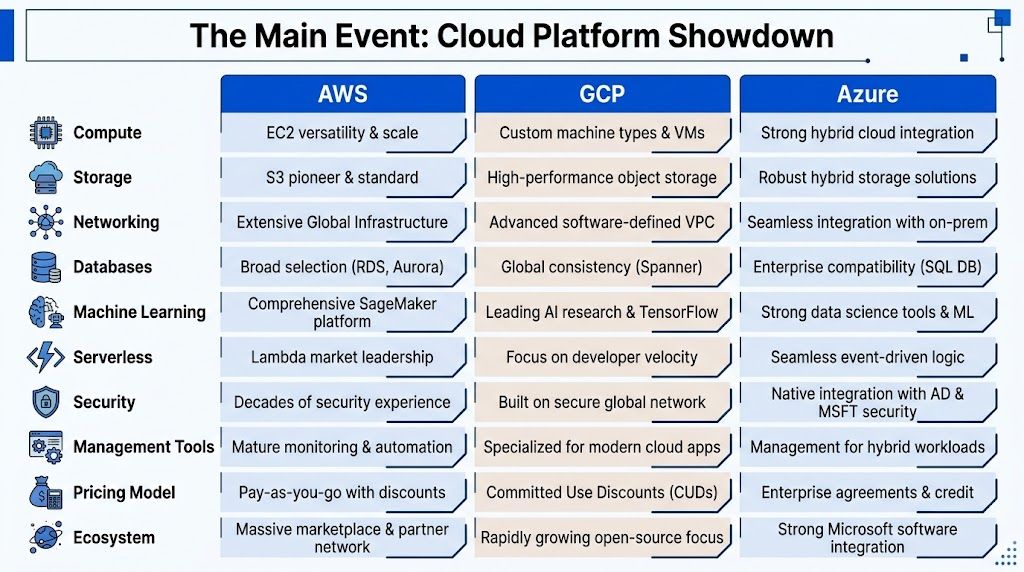
| Area | AWS | GCP | Azure | Winner |
|---|---|---|---|---|
| Compute | Broadest VM and managed compute options | Cleaner machine choices, strong container workflows | Strong enterprise VM and hybrid story | AWS for breadth, GCP for simplicity |
| Storage | Mature and battle-tested | Solid and straightforward | Strong in Microsoft estates | AWS |
| Networking | Excellent, with lots of knobs | Best architecture for global performance-sensitive setups | Strong hybrid connectivity | GCP |
| Databases | Huge menu, sometimes too huge | Great for analytics-led stacks | Strong for SQL and Microsoft-heavy teams | Depends on workload |
| ML and AI | Mature ecosystem | Strongest fit for data and model-heavy teams | Attractive for enterprise AI adoption | GCP |
| Serverless | Deep and flexible | Cleaner developer experience | Fine, but less pleasant | AWS for depth, GCP for ergonomics |
| Security and compliance | Strong, but easy to let sprawl | Good and easier to reason about | Best fit for Microsoft-governed orgs | Azure |
| Pricing model | Powerful and easy to overcomplicate | Usually easier to understand | Often best if tied to Microsoft commitments | GCP for clarity |
| Ecosystem | Largest | Strong open-source gravity | Best boardroom acceptance | AWS |
| Developer experience | Can feel like a warehouse club | Usually the least annoying | Often more process-heavy | GCP |
AWS still wins on raw coverage. If your workload mix is messy, your roadmap is still changing, or your team expects edge cases, AWS gives you the most room. It also gives your platform team the biggest chance to overbuild. More choice sounds great until every squad picks a different pattern and your hiring bar gradually shifts from "good engineer" to "person who already knows five AWS ways to do the same thing."
GCP is easier on teams that want consistency. Fewer product branches. Fewer naming puzzles. Better odds that a strong remote backend engineer can become productive fast without a guided tour from the staff architect.
Azure makes the most sense in companies with existing Microsoft gravity. Windows workloads, enterprise identity, procurement rules, and internal security controls all fit more naturally there. If that is your environment, Azure reduces organizational friction even when the product surface feels heavier.
For storage, all three are good enough. AWS gets the nod because the operational playbook is deeper, the edge cases are better understood, and finding engineers who have already seen the weird failures is easier.
Networking is where GCP earns its reputation.
Google’s private backbone and global VPC design make life simpler for distributed products, global user bases, and teams that do not want to rebuild network strategy from first principles. Google Cloud’s own networking documentation explains how Premium Tier traffic runs on Google’s global network, which is exactly why GCP often feels more coherent for latency-sensitive systems.
AWS networking is powerful, but it asks more from your team. You can get almost anywhere. You just pay in design effort, policy complexity, and the occasional moment where a senior engineer opens the console and mutters at it.
Azure is strongest in hybrid connectivity. If you need to connect cloud systems cleanly to a lot of corporate infrastructure, Azure belongs on the shortlist. If you are trying to move fast with a distributed product team, it is usually not the first one I would test.
If global latency, remote access patterns, or cross-region architecture are central to the product, start with GCP.
AWS offers the largest database catalog. That matters for unusual workloads and mature platform teams. It also creates decision debt. Give a dozen experienced engineers a giant AWS menu and you may get a dozen opinions, three pilots, and one architecture review nobody wanted.
Azure is the practical pick for SQL-heavy businesses and Microsoft-centered organizations. It is rarely exciting. It is often easier to govern, staff, and explain to risk teams.
GCP is strongest when analytics is part of the product, not an afterthought. BigQuery changes staffing math. You need fewer hand-built data warehouse patterns, fewer moving parts, and less operational babysitting. That shortens time-to-market for data products, especially if your team is distributed across time zones and cannot afford a lot of handoffs.
GCP is the clearest product-led choice for AI and data-heavy systems. The stack is more coherent. Data pipelines, analytics, infrastructure, and model workflows fit together in a way that reduces glue work.
For the economics, Aiven’s comparison of BigQuery, Redshift, and Snowflake is a better reference point than vendor chest-thumping. BigQuery’s serverless model often cuts operational burden for analytics-heavy teams. That matters because the hidden cost in AI projects is rarely just compute. It is the number of specialists you need to keep the pipeline healthy.
AWS is broad and capable in ML. Azure is increasingly attractive for enterprise AI rollouts because the governance story lands well with large organizations. But if your roadmap depends on fast iteration by product and data teams, GCP usually gets there with less orchestration overhead.
Azure wins when the organization already runs on Microsoft identity, policy, and compliance processes.
That sounds boring. Good. Boring is useful here.
AWS can meet serious security requirements, but it puts more responsibility on your team to create order. If you have a strong cloud platform function, that is fine. If you are scaling with a lean team and hiring globally, it can become a tax. You end up needing more cloud-specific expertise earlier than expected.
GCP is cleaner than its reputation suggests, but heavily regulated buyers often choose the platform that already fits the approval machine. In real companies, procurement momentum beats elegance all the time.
AWS pricing rewards experts. It also punishes distracted teams.
GCP pricing is usually easier to explain to finance and easier for engineers to reason about without becoming part-time purchasing analysts. That lowers coordination cost. It also helps remote teams because fewer pricing surprises means fewer emergency reviews and less tribal knowledge locked inside one staff engineer’s head.
Azure can be financially attractive if you already have Microsoft contracts, licensing advantage, and enterprise buying power. Startups rarely get the same benefit. Larger companies often do.
Benchmarks matter only when they map to your workload. Still, they are useful for spotting trade-offs that marketing pages politely ignore.
Squareshift’s Elastic Cloud benchmarking across AWS, GCP, and Azure showed Azure handling stronger metricbeat ingestion throughput than AWS in that test, while Azure’s search latency lagged behind AWS and GCP. That is a real architectural clue. Azure can be a strong fit for ingestion-heavy pipelines, but I would not make it my default for latency-sensitive search experiences.
| Workload shape | My pick |
|---|---|
| Broad mixed workloads with uncertain future needs | AWS |
| Data-heavy AI platform or analytics-led product | GCP |
| Log-heavy ingestion pipelines in enterprise context | Azure |
| Search-sensitive user-facing workloads | AWS or GCP |
Practical rule: Choose the cloud that handles your hardest workload with the least team drama.
AWS has the deepest ecosystem. More partners. More community knowledge. More people you can hire who have already solved the exact problem in front of you. That matters a lot once the company is big enough that staffing risk becomes as important as technical risk.
GCP has the best day-to-day developer experience for many modern teams. Cleaner mental model. Better fit for Kubernetes-native engineering. Faster onboarding for strong generalists. If you rely on remote hiring, that matters more than feature-count bragging. You can plug capable engineers into the system faster.
Azure has improved, but it still works best when the company itself is already structured like an Azure customer. If your org is enterprise-first, that is a strength. If your org is product-first and trying to keep platform overhead low, it often feels heavier than it should.
My verdict:
The biggest lie in cloud buying is that instance pricing tells you enough to decide.
It doesn’t.
The expensive part isn’t the VM. It’s the operational tax. The meetings. The glue code. The IAM sprawl. The migration regret. The fact that your best backend engineer is suddenly spending Tuesday untangling policies instead of shipping billing features.

Founders love saying “we’ll stay cloud-agnostic.” In theory, smart. In practice, often chaos.
According to Brolly Academy’s comparison, multi-cloud operational tax can spike ops costs by 30%. That tracks with what many teams learn the hard way. Two clouds rarely mean double flexibility. Usually it means double policy management, double monitoring nuance, and an architecture diagram that starts to look like a cry for help.
The same analysis notes that AWS Graviton can cut compute costs by 20 to 40%, which is real money, but switching away later can trigger a 6 to 12 month refactoring effort. That’s the part cloud reps don’t put on the first slide.
If your team bakes itself too tightly into provider-specific services to save money today, you may pay for that “optimization” with time-to-market tomorrow.
Cheap compute is expensive when it changes your roadmap.
Most comparisons commonly miss the point.
A cloud platform isn’t just infrastructure. It’s a hiring filter. AWS usually gives you the broadest hiring market because the talent pool is large and battle-tested. GCP often attracts strong modern platform and data engineers, but depending on your market, those hires can be harder to find quickly. Azure talent is plentiful in enterprise circles, but not always in startup environments where people need to move with less process.
Here’s the practical version:
A founder should care less about “cost per core” and more about “cost per shipped feature.” The latter is what your board eventually feels.
You don’t need a neutral answer. You need a useful one.
If you’re early, don’t optimize for theoretical future edge cases. Optimize for speed, focus, and a team that can keep infrastructure boring.
Pick GCP if your product leans into analytics, AI, or containers from day one. It tends to give small teams a cleaner path, especially when they don’t want to become full-time cloud archaeologists.
Pick AWS if your workload mix is unclear and you want the broadest ecosystem safety net. That’s still a sensible call for many startups, especially if your first hires already know AWS well.
I’d only push an early startup to Azure if the customer environment, compliance posture, or founding team’s background makes Microsoft alignment the obvious move.
At this point, the answer gets more contextual.
If your company already runs on Microsoft 365, internal identity standards, and enterprise IT controls, Azure is usually the path of least resistance. Not the sexiest answer. The most practical one.
If your engineering org is product-led and your roadmap depends on data pipelines, experimentation, and modern platform patterns, GCP is often the smarter medium-term choice. The cleaner platform experience can save real execution time.
If your business serves diverse workloads and your internal team wants maximum service optionality, AWS remains the safest all-rounder.
Big companies don’t choose clouds in a vacuum. They choose them through committees, audits, inherited systems, and procurement habits older than some startups.
That’s why Azure wins more often in enterprises than engineers on Hacker News would like to admit. If you have identity standards, hybrid realities, and serious compliance oversight, Azure aligns with how the business already operates.
AWS is still excellent for large-scale infrastructure programs and broad modernization efforts. GCP is often the strongest point solution for AI, analytics, and modern application platforms inside larger companies, but it can face more internal friction unless there’s an executive sponsor who gets it.
| Company situation | Recommendation | Why |
|---|---|---|
| Early startup building AI or analytics product | GCP | Cleaner data and ML path |
| Early startup with uncertain requirements | AWS | Broadest toolbox and talent pool |
| SMB with heavy Microsoft footprint | Azure | Lowest organizational friction |
| Enterprise with regulated workflows | Azure | Strongest alignment with governance-heavy orgs |
| Platform-heavy SaaS with global performance sensitivity | GCP | Strong networking and modern platform feel |
| Company that needs almost every service under the sun | AWS | Breadth still matters |
If your company’s biggest bottleneck is product velocity, choose the cloud that asks the fewest distracting questions.
A cloud strategy becomes real when actual humans can build and run it without setting Slack on fire.
That means your migration plan and hiring plan should be written together, not in separate decks by different people pretending they aren’t related.

Start with boring workloads first. Internal services, non-critical APIs, batch jobs, and development environments make better opening moves than customer-facing revenue paths.
Then standardize a few essential items:
Infrastructure definitions
Pick your IaC approach and make it the law, not a suggestion.
Identity and access model
If you improvise IAM during migration, you’ll regret it during audit season.
Observability baseline
Logging, metrics, tracing, and alerting should be ready before the first “successful” migration, not after.
Platform-specific red lines
Decide early which managed services you’ll embrace and which ones you’ll avoid for portability reasons.
Don’t hire “cloud engineers” as a generic category. Hire for the stack and operating style.
An AWS-heavy shop needs people comfortable with breadth and strong service boundaries. A GCP-heavy team benefits from engineers who understand containers, data pipelines, and modern platform tooling. An Azure-heavy org needs people who can work effectively across cloud and enterprise governance without whining every third ticket.
If you’re comparing delivery models, this breakdown of outsourcing IT companies is useful for framing what external support should solve.
For distributed teams, network behavior and working hours both matter. According to Microsoft Learn community discussion on Azure vs AWS vs GCP, GCP’s private global network delivers sub-100ms latency between São Paulo and Miami, while AWS Direct Connect sits at 120 to 150ms. If your US team hands work off in real time to engineers in Brazil, that’s not trivia. That affects responsiveness and collaboration flow.
Timezone overlap matters just as much as architecture diagrams. For companies staffing cloud work across the Americas, that’s one reason AWS cloud engineer hiring guidance tends to focus on practical execution and overlap, not just certifications.
The best cloud hire isn’t the person with the longest badge list. It’s the one who can keep your platform predictable while the product changes underneath them.
For most scaling companies, I’d start with:
That structure keeps the cloud from becoming a silo and keeps migration from becoming a hobby.
If your leadership team wants the one-page version, use this.
| Criterion | Amazon Web Services (AWS) | Google Cloud Platform (GCP) | Microsoft Azure |
|---|---|---|---|
| Startup friendliness | Strong if your team already knows it, but easy to overbuild | Best fit for many modern product teams | Usually not the easiest first cloud |
| Enterprise readiness | Excellent | Good, but may need stronger internal sponsorship | Excellent |
| AI and ML leadership | Strong and broad | Best overall fit | Strong inside enterprise workflows |
| Open source affinity | Good, but often AWS-shaped | Strongest cultural fit | Mixed |
| Talent pool depth | Deepest | Strong but narrower | Deep in enterprise markets |
| Risk of vendor lock-in | High if you lean into native services | High around data and AI stack | High around Microsoft identity and platform integration |
| Operational simplicity | Moderate | Best of the three for many teams | Moderate to heavy |
| Best default use case | Broad infrastructure and unknown future needs | Data, AI, Kubernetes, product velocity | Microsoft-heavy, hybrid, regulated environments |
If two clouds still look equal after this, choose the one your best engineers can operate confidently in the next ninety days. That’s usually the right tiebreaker.
Hard. Usually harder than the demo makes it sound.
Changing clouds is rarely an infrastructure project alone. It turns into a people project. Your runbooks change. Your hiring pool changes. Your remote engineers lose familiar defaults. Delivery slows while the team relearns networking, IAM, logging, and deployment patterns under pressure.
If you kept your stack portable and stayed disciplined about managed services, migration is painful but survivable. If your product depends on provider-specific databases, identity patterns, eventing, or AI services, you are not migrating. You are rebuilding expensive parts of the business while pretending it is a platform decision.
Pick your lock-in on purpose. Commodity compute is easy to replace. Deep platform habits are not.
For early and mid-stage companies, it is usually chaos with better branding.
Running two clouds means two IAM models, two networking philosophies, two billing puzzles, two security postures, and a much harder hiring brief. That tax shows up everywhere. Slower onboarding. More brittle incident response. Duplicate tooling. Split accountability. A monitoring stack that looks complete until the outage crosses clouds and nobody owns the full path.
Multi-cloud earns its keep only when the business case is specific and painful enough to justify the overhead. Regulatory separation. A customer mandate you cannot avoid. A resilience requirement backed by a team that can operate it.
For everyone else, multi-cloud is often a way to feel prudent while shipping less.
Startups and scaling product teams need fewer moving parts, sharper standards, and one cloud they can run well with the team they have.
Not by force. By gravity.
AWS rewards teams that are comfortable with service sprawl and opinionated managed building blocks. GCP fits teams that think in containers, data pipelines, and developer speed. Azure pulls hard toward Microsoft identity, governance, and enterprise workflow conventions.
Your code can still be written in the language you prefer. Your operating model shifts anyway. The cloud you choose changes what skills are easy to hire for, what good looks like in architecture reviews, and how quickly a remote team can become productive without constant hand-holding.
That second-order effect matters more than founders expect.
Do three things.
Indecision burns time. Half-committed multi-cloud burns time and payroll. One clear choice, run well, beats a beautiful strategy deck your team cannot execute.
If you’ve picked a direction and need people who can build it, CloudDevs helps US companies hire pre-vetted Latin American engineers fast, with strong timezone overlap and experience across AWS, GCP, Azure, AI/ML, and cloud-native stacks. It’s a practical way to turn a cloud decision into shipped product without bloating payroll or waiting months for the right hire.

Technical interviews are broken. Let’s not pretend otherwise. We've all been there—either as the interviewer asking some esoteric brain teaser or the candidate sweating over a whiteboard puzzle that has zero to do with the actual job. The "how many golf balls fit in a school bus" approach is a tired cliché, and it’s a...

Expanding your team globally used to mean one of two things: setting up a foreign entity yourself—a special kind of bureaucratic hell—or handing over a chunk of your company to a local partner. Turns out there’s more than one way to hire elite international talent without mortgaging your office ping-pong table. Welcome to the world...

When US companies need to build their tech teams quickly and affordably, they hire nearshore developers. It means tapping into Latin America's massive, timezone-aligned talent pool—a strategy that sidesteps the crushing costs of local hiring and the communication nightmares of offshore markets. Turns out there’s more than one way to hire elite developers without mortgaging...