Cost Benefit Analysis: A Founder’s Guide to Smart Choices

Victor
Posted on 18 May 2026



Every founder hits this wall sooner than they expect. Two expensive ideas are staring back from the whiteboard, both sold as “critical,” both wrapped in confidence, and both capable of lighting a pile of cash on fire.
Maybe it's a major feature push versus an infrastructure migration. Maybe it's hiring a senior backend engineer versus outsourcing a chunk of the roadmap. Maybe it's “we need this now” versus “if we don't fix the foundation, we're dead later.” Fun.
When the stakes get high, gut instinct stops being leadership and starts being gambling. That's where cost benefit analysis earns its keep. Not because finance loves acronyms, but because somebody in the room has to ask the annoying adult questions: What does this cost? What do we really get back? When do we get it? And what are we not doing if we choose this?
Table of Contents
Last year, a founder friend called me with the classic startup fork in the road. Option one was a flashy feature customers kept asking for. Sales loved it. Product loved it. The demo would look great in a pitch deck.
Option two was a messy infrastructure overhaul nobody wanted to brag about. It would reduce engineering pain, clean up deployment chaos, and probably stop the team from sacrificing weekends to the uptime gods.
Both had champions. Both had stories. Neither had a clean economic case.
That's how companies make dumb decisions. Not because the team is lazy. Because people confuse a persuasive narrative with a sound one. The loudest person in the room says “strategic,” someone else says “speed,” and suddenly you've committed months of payroll to a project nobody properly priced.
Practical rule: If the decision affects hiring, roadmap timing, or multi-quarter cash burn, stop calling it intuition and run a cost benefit analysis.
A founder-grade cost benefit analysis is not a finance ritual. It's a way to turn “I think this is smart” into “here's what this costs, here's what it returns, and here's why we can defend the bet.” It forces you to surface ugly stuff that pitchy internal proposals hide, like onboarding drag, management overhead, switching costs, and the very real chance your team is chasing a shiny object.
Big companies can survive expensive mistakes. They bury them under budget lines and PowerPoints.
Startups don't get that luxury. One bad hiring spree, one bloated rebuild, one enterprise tool nobody uses, and now you're explaining runway to the board with the energy of a hostage video.
Use cost benefit analysis when the decision can meaningfully change cash, speed, or focus. That's the bar. Not “is this interesting?” but “can this sink us if we get it wrong?”
You're not trying to predict the future perfectly. You're trying to avoid blind bets dressed up as strategy.
That alone is worth the spreadsheet.
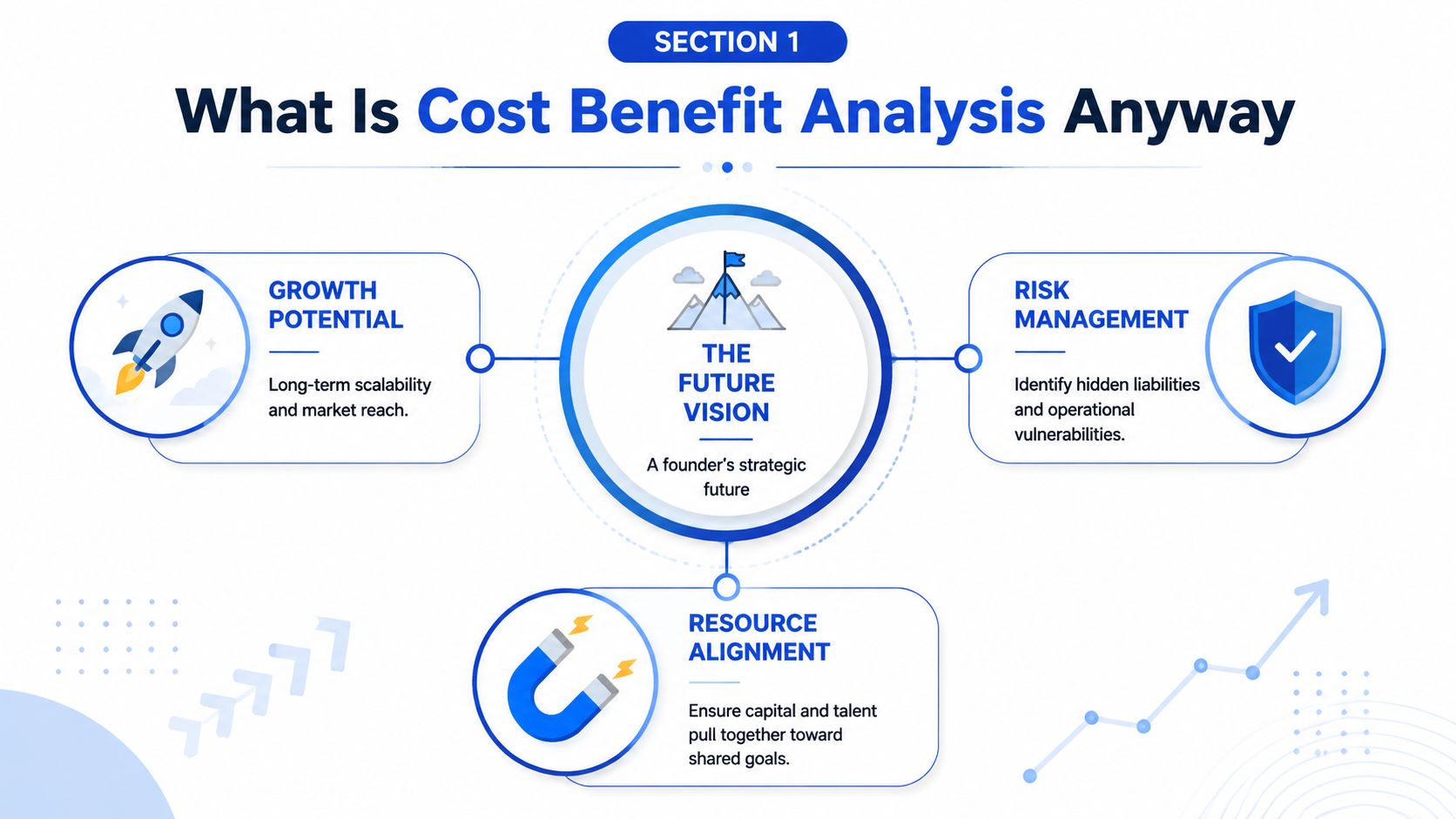
Cost benefit analysis is simple. You list what a decision will cost, list what it should return, convert the mess into comparable terms, and decide whether the trade is worth it.
That basic logic has been around in formal government use since the 1936 U.S. Flood Control Act, which required project benefits to exceed costs. The same rule still drives the method today. If your benefit-cost ratio is above 1.0, the investment clears the bar, according to Asana's overview of cost-benefit analysis.
That sounds dry until you apply it to normal founder chaos.
Say your team wants a fancy espresso machine for the office.
The obvious cost is the machine. Cute. Easy. But that's rookie math.
You also need to account for the hidden stuff:
That's the job. Not “pros and cons.” More like “tell the truth about what this decision does to the business.”
A decent cost benefit analysis does three things well:
Here's the quick sanity check:
| Measure | What it tells you |
|---|---|
| Benefit-cost ratio | Whether value exceeds spend |
| Net present value | Whether the investment creates value after accounting for timing |
| Opportunity cost | What you gave up to make this choice |
A lot of people treat CBA like ROI with better manners. It's not. ROI usually skips the harder questions. Cost benefit analysis asks what happens across time, who carries the burden, and which costs are hidden in plain sight.
Good CBA is a story with numbers. Bad CBA is a spreadsheet looking for permission.
That distinction matters more than most founders admit.
Not every decision deserves a model. If your team is debating snack subscriptions, please don't build a financial framework with seven tabs and color-coded assumptions. You have bigger problems.
But some choices absolutely require cost benefit analysis. If you skip it there, you're not moving fast. You're being reckless in a hoodie.
Run the numbers when the decision has one or more of these traits:
Hiring your first intern? Probably a gut-check plus basic budget sanity.
Opening a new delivery center, rebuilding the platform, or hiring a full engineering squad in a new market? That needs actual analysis.
You can wing it when the downside is contained and the decision is easy to unwind.
A few examples:
| Decision | CBA or gut call |
|---|---|
| Replacing a small internal tool | Gut call with a quick cost check |
| Choosing between two major hiring models | Full CBA |
| Testing a lightweight contractor for a narrow task | Lightweight review |
| Committing to a long strategic build | Full CBA |
The trick is matching rigor to consequence. Founders who analyze everything become slow, timid, and weirdly proud of indecision. Founders who analyze nothing become motivational speakers for their own mistakes.
If the choice changes your team structure, burn profile, or roadmap reliability, model it.
If the cost of being wrong is mostly annoyance, move on.
That's it. Keep the discipline where it matters, not where it flatters your inner spreadsheet goblin.
Founders don't usually lose money because they skipped a formula. They lose money because they built a model to justify a decision they already wanted.
Start with the ugly version. Write down every cost and benefit before you try to make the sheet look smart. Include the stuff nobody wants to own in the meeting. Founder time. Interview loops. Onboarding drag. Delayed releases. Rework after a rushed hire. The people costs are usually where the actual damage sits, and they're exactly what neat spreadsheets try to hide.

If you lump everything into “project cost,” you're lying to yourself.
Break it out:
For tech hiring, this matters a lot. A developer on payroll is never just payroll. A vendor invoice is never just the invoice. Somebody inside the company still pays in context switching, handoffs, and management time.
Benefits are allowed to be messy. That doesn't mean you get to be vague.
List the upside in plain English. More revenue. Lower support load. Faster shipping. Better retention. Fewer production issues. Less hiring friction. Then assign a value or, if the number is uncertain, use a range and say why.
That discipline matters most in software work, where founders love comparing hourly rates and ignoring delivery risk. This guide on software development cost estimation is useful because it forces you to price scope, complexity, and execution risk, not just developer hours.
One rule. If a benefit sounds like a keynote slide, delete it.
Timing changes the answer.
If the costs hit this quarter and the gains might show up next year, your model needs to reflect that. Convert future costs and benefits into present value, then compare them with standard measures like net present value and benefit-cost ratio. ProjectManager's explanation walks through the logic and shows why discounting future cash flows matters before you call a project “worth it.”
Founders often get sloppy here. They count distant upside at full value and treat immediate pain like a rounding error. Cash now is more valuable than possible gains later, especially when runway is tight and your team is already stretched.
If the benefit arrives late and the hiring pain starts Monday, your spreadsheet should make that obvious.
Run the downside case before reality does it for you.
Raise the cost. Extend the ramp. Cut the expected output. Assume the new hire takes longer to onboard. Assume the outsourced team needs more hand-holding than promised. If a small change in assumptions turns a “great decision” into a bad one, the decision was never that good.
I also like pairing CBA with risk planning. If this choice could disrupt delivery, staffing, or customer operations, it helps to build operational resilience with BIA so you can test what breaks, who gets hit, and how expensive the cleanup becomes.
A usable CBA does not give you fake certainty. It gives you a cleaner fight between real options. That's the whole job.
Cost benefit analysis gets real. Not in textbook examples. In hiring.
You need engineering output. You can either hire in-house or outsource some of the work. Everyone has opinions. Internal people talk about culture. Finance talks about cost. Product talks about speed. Nobody wants to admit that a bad hiring decision is often more expensive than a slower one.
So let's compare the decision the way founders should.

An in-house developer isn't just salary. It's sourcing, screening, interviews, coordination, onboarding, payroll admin, management overhead, and the risk that the person is wrong for the role but nobody admits it for three months.
Outsourcing isn't just a vendor invoice either. It can bring communication friction, context gaps, and less direct cultural integration if you set it up badly.
Here's the founder version of the comparison:
| Factor | In-house hire | Outsourcing option |
|---|---|---|
| Upfront recruiting effort | Higher internal time commitment | Usually lower if the provider pre-vets talent |
| Control over day-to-day work | Higher | Varies by setup |
| Payroll and compliance admin | You own it | Often handled externally |
| Time to useful output | Slower if hiring takes time | Can be faster if talent is ready to start |
| Flexibility | Harder to reverse | Usually easier to scale up or down |
| Culture integration | Stronger long-term potential | Needs active management |
Founders often fall into self-deception. They compare salary to contractor rate and think they're being analytical.
They're not.
Costs include:
Those don't always show up as line items. They still hit the company.
If you're weighing outsourcing seriously, you should also think through the surrounding operating model. This piece on choosing the right HR model is useful because hiring structure and HR structure usually create the same kind of trade-off: more control versus more operational burden.
For core leadership roles or integral product ownership, in-house usually wins because context and accountability matter more than short-term efficiency.
For execution-heavy roadmap work, burst capacity, or fast scaling when your internal recruiting machine is weak, outsourcing often wins because it cuts delay and administrative drag. One option in that bucket is using a marketplace to outsource a development team rather than assembling freelancers one by one and praying they behave like a team.
Founders rarely regret paying for speed and clarity. They often regret pretending a “cheap” hire was cheap.
The right answer depends on the work. But if your model only compares cash compensation, your model is lying to you.
Most bad cost benefit analysis isn't wrong because someone can't do math. It's wrong because the inputs are biased, incomplete, or conveniently flattering.
I've made all three mistakes below. If you haven't yet, congratulations. Your turn is coming unless you get disciplined.
This is the classic founder sin. You already want the feature, the hire, the migration, the office, the shiny AI tool. Then you build a spreadsheet that “proves” it.
That's not analysis. That's legal defense for a decision you pre-baked in your head.
Fix it by forcing someone on the team to argue the opposite case. Not performatively. Seriously. If nobody can make the anti-case, you probably haven't looked hard enough.
People call this forecasting. Sometimes it's just optimism with formulas.
If your benefits depend on best-case adoption, instant onboarding, flawless delivery, and zero rework, your CBA is a bedtime story. The model should reflect real operations, not your dream version of them.
A good habit is to tag assumptions by confidence level:
That simple labeling cuts a lot of nonsense.
This one sounds technical, but it has huge practical consequences. A bad discount rate can kill a smart long-term project or bless a short-term sugar high.
Federal guidance in the US has historically used 3% and 7% discount rates, and a proposed update would lower the default to 1.7%, as discussed by Policy Integrity. The important part for founders is not copying government rates blindly. It's understanding that a higher rate slashes the value of future benefits, which can unfairly punish investments whose payoff compounds over time.
That matters a lot in tech. Better architecture, stronger hiring systems, and improved developer tooling often look mediocre in a shallow model because the upside shows up later.
A discount rate is not a decoration. It tells your model how patient or impatient you are.
If you choose it carelessly, the whole conclusion bends around that choice.
You're about to approve a hire, sign an agency contract, or greenlight a build. The spreadsheet says yes. Good. That's the moment founders get sloppy.
A real cost benefit analysis earns its keep at the end, when you try to break it on purpose. If a small delay, a little extra management overhead, or one bad hiring assumption flips the answer, you do not have a decision. You have a fragile story.
The last pass is simple. Stress the assumptions that carry the outcome. Change the timing. Change the ramp-up. Change the people load. See if the math still works. If it only works in a clean-room version of reality, pass.

Start with the stuff founders love to underestimate. Time to productivity. Manager attention. Rework. Communication drag across time zones. The cost of a senior engineer babysitting a bad vendor or a weak new hire rarely shows up cleanly in the first model, but it hits the P&L all the same.
Use a few hard tests:
That gives you the break point. Founders need that number more than a polished ROI headline.
Run this before money leaves the account:
| Check | What you want to see |
|---|---|
| Benefits exceed costs | The economics work without fantasy assumptions |
| Timing still makes sense | Delayed gains do not kill the return |
| Hidden costs are named | Hiring drag, onboarding, admin, and management load are included |
| Alternatives were compared | In-house, contractor, and outsourced options got a fair look |
| The result survives pressure | Reasonable changes do not flip the answer immediately |
| It still fits strategy | The choice helps build the company you actually want |
One more rule. Use your gut last.
If the spreadsheet says yes, but your operator brain is screaming that this hire will drain your leaders or this vendor will create a coordination tax nobody priced in, stop and revisit the model. Spreadsheets miss people costs all the time. Founders pay for that mistake in missed roadmaps, slow teams, and expensive rewrites.
If you're making a hiring or delivery decision and want a cleaner way to compare speed, cost, and operational overhead, CloudDevs is worth a look. It gives startups a concrete alternative to full in-house hiring, which makes your cost benefit analysis a lot more honest than comparing one idealized option against another.

Let's cut the crap. When you're debating managed services vs. staff augmentation, you’re choosing between two fundamentally different ways to get work done. Staff augmentation is about borrowing talent—you bring individual experts into your existing team. Managed services is about outsourcing outcomes—you hand an entire project over to a vendor and hope for the best....

Tired of merge conflicts and broken builds? Learn what is continuous integration, how it works, and why it's the bedrock of high-performing dev teams.


Learn how to build a product roadmap with this practical guide. Discover expert tips to create a roadmap that aligns teams and drives success.