Docker Compose vs Kubernetes: The Founder’s Guide

Victor
Posted on 12 April 2026




You’ve lived this exact moment.
Your team has a tidy docker-compose.yml, the app boots, the database connects, and everybody feels productive. Then traffic starts climbing, customers ask rude but fair questions about uptime, and someone says “we should move to Kubernetes” like they’re volunteering your next three weekends.
That’s the essence of the docker compose vs kubernetes debate. It’s not about ideology. It’s about timing.
Founders and engineering leads mess this up in one of two ways. They either cling to Compose long after it’s clearly wheezing, or they jump into Kubernetes so early that they turn a fast product team into unpaid platform engineers. Both mistakes are expensive. One costs reliability. The other costs momentum.
If you’re scaling a startup, especially with a distributed team, this decision gets sharper. Simpler systems are easier to onboard, easier to debug, and easier to hand off across time zones. More complex systems buy you resilience, but only if you need what you’re paying for. That tension shows up in every stack decision, which is why broader cloud computing trends matter here too.
My opinion is simple. Start with Compose unless your business already has enterprise-grade infrastructure requirements. Move to Kubernetes when your operational pain is real, recurring, and expensive. Not when a conference talk made you feel underdressed.
Here’s the blunt version upfront, so nobody has to scroll in fear.
| Decision area | Docker Compose | Kubernetes |
|---|---|---|
| Best fit | Local development, MVPs, small deployments | Production clusters, multi-node systems, enterprise workloads |
| Operating model | One machine, simple service definitions | Cluster orchestration with desired-state management |
| Scaling | Manual | Automatic with HPA and cluster-level options |
| Learning curve | Low | Steep |
| Resource overhead | ~50MB overhead for small stacks according to Distr.sh | Heavier operational footprint |
| Founder recommendation | Default starting point | Earn the complexity, don’t inherit it by fashion |
Table of Contents
A startup doesn't “choose infrastructure.” It backs into it.
At first, you just want the app running. A web service, a worker, Postgres, maybe Redis. Compose feels great because it is great. One file. One command. Very little ceremony. You’re shipping product instead of reading platform docs written by people who haven’t met a deadline.
Then the shape of the problem changes.
One teammate starts asking how to restart failed services without babysitting a box. Another asks how you’ll do zero-downtime deploys. Sales brings in a bigger customer. Ops gets weird. Somebody SSHs into production and says, “I only changed one thing,” which is usually the opening line of a horror story.
Teams get emotionally manipulated by the phrase “production-grade” at this point.
That phrase has ruined a lot of perfectly sensible architecture decisions. Plenty of teams hear it and assume Compose is for toy apps while Kubernetes is for serious adults. That’s nonsense. Compose is serious when the problem is small enough that simplicity is the advantage.
A significant fork appears when your current setup starts creating repeated operational drag:
Kubernetes should solve a problem you can name. If it’s solving your anxiety, you’re probably too early.
Founders love to future-proof. Engineers do too. It feels responsible.
Sometimes it is. Often, it’s fear wearing a hard hat.
If you have a small product, a modest service graph, and a team trying to move fast, adding Kubernetes too soon is like hiring a full airport control tower to manage a parking lot. Impressive? Sure. Necessary? Not even close.
However, a definite tipping point exists. Once your app needs stronger guarantees around availability, scaling, and recovery, “simple” starts becoming “hand-maintained.” That’s when Compose stops being lean and starts becoming a collection of habits and scripts nobody trusts.
Docker Compose and Kubernetes aren’t competing answers to the same question. They’re tools designed for different jobs.
Compose is the blueprint. It lays out your application on one plot of land. App, database, cache, worker. Done. It’s the fastest way to make a multi-container app feel civilized.
Kubernetes is the city planner. It assumes you’re not managing one building. You’re managing traffic, zoning, repairs, routing, public services, and bad things happening at inconvenient times.

The origin story matters because it explains the personality of each tool.
Kubernetes was open-sourced by Google in 2014, drawing from Borg, their internal system that managed containers on a massive scale, while Docker Compose emerged around the same period as a simpler tool for single-host multi-container management, as described in this historical comparison of Docker Compose and Kubernetes. That’s why Kubernetes thinks in clusters, desired state, and survivability. Compose thinks in services you want running together without drama.
One was born from internet-scale operations. The other became beloved because developers wanted a sane way to run an app and its dependencies on one machine.
That difference still shows up every day.
Compose wins when you need:
Its biggest strength is psychological, not technical. Teams understand it. They don’t need a week-long detour into cluster abstractions before they can ship a feature.
Kubernetes earns its keep when the app can’t rely on one machine and one human paying attention.
It declaratively manages Pods, Deployments, Services, and ConfigMaps. That means you describe the state you want, and the system works to keep reality aligned with that state. Containers die. Nodes wobble. Deployments roll forward. The platform keeps moving.
Practical rule: Compose helps you build the product. Kubernetes helps you keep promises about the product.
That’s why I tell founders to stop asking which tool is better. Better at what?
If the job is developer speed, local parity, and a clean path to launch, Compose is the right answer more often than people admit. If the job is high availability, cluster scheduling, and operational resilience under pressure, Kubernetes stops being fancy and starts being necessary.
Beyond the philosophy, the technical differences shape your day-to-day operations fast.
Compose and Kubernetes solve different failure modes. If you force Compose to act like a cluster, your team becomes the scheduler, the failover system, and the deployment controller. If you drop Kubernetes onto a tiny product too early, you burn time feeding the platform instead of shipping the app.
This is the fork that matters during a scaling journey, especially with remote engineers. One tool keeps everyone productive on a small system. The other keeps the system reliable once growth, traffic, and team coordination start pulling in different directions.

Compose is built around one host and one clear definition of the stack. That is why developers like it. You write a YAML file, define services, networks, and volumes, and bring the whole thing up without turning deployment into a side career.
Kubernetes starts from a different assumption. Machines fail, workloads move, and the platform should keep chasing the desired state without waiting for a human to notice. Pods, Deployments, and Services exist because distributed systems get ugly fast when you manage them by hand.
Here’s the practical split:
| Technical area | Docker Compose | Kubernetes |
|---|---|---|
| Scope | Single host | Multi-node cluster |
| Main unit | Service in one compose file | Pod managed by controllers |
| Failure model | Limited restart behavior | Self-healing desired-state system |
| Deployment style | Straightforward and direct | More abstract, more capable |
If your production plan still depends on one machine behaving nicely, Compose is fine. If that assumption is already breaking, stop pretending YAML simplicity will save you.
Scaling is where the gap stops being academic.
Compose can start more containers. You still decide when to do it, where they run, and how to deal with uneven load. That works for a small team watching one app closely. It gets shaky once traffic spikes happen while half the company is asleep in another time zone.
Kubernetes treats scaling as platform behavior. You define the rules, and the cluster handles the repetition. That matters when your team is distributed and you cannot rely on the same two people to babysit production every evening.
Compose:
services:
  web:
    image: myapp:latest
    ports:
      - "8000:8000"
Manual scaling command:
docker-compose up --scale web=5
Kubernetes:
apiVersion: autoscaling/v2
kind: HorizontalPodAutoscaler
metadata:
  name: web
spec:
  minReplicas: 1
  maxReplicas: 10
A key difference is operational ownership. With Compose, scaling stays on your team’s to-do list. With Kubernetes, scaling becomes part of the system.
Compose networking stays pleasant because the environment is small. Services can reach each other by name, port mapping is obvious, and debugging usually takes minutes instead of a meeting.
Kubernetes networking is built for a larger, messier setup. Services give workloads stable identities. Ingress handles external traffic. Load balancers spread requests across replicas and nodes. That structure is what you need when multiple services, environments, and teams are all touching the same platform.
You pay for that power with more moving parts. DNS behavior, ingress rules, service types, and policy decisions all become part of normal operations.
Compose does not give you a polished production rollout model out of the box. You can script careful updates, add health checks, and build your own release rituals. Plenty of teams do. The problem is that those rituals live in shell scripts, team memory, and one senior engineer’s head.
Kubernetes gives you rolling updates and rollout controls as built-in behavior. That changes the game once deployments become frequent, visible, and risky.
If your release process depends on one person remembering the right command order, you do not have a platform. You have tribal knowledge.
That is usually the inflection point. The pain is not the first deploy. It is deploy number fifty, with customers online, three engineers remote, and no appetite for downtime.
State is where both tools demand respect.
Compose keeps persistence simple. Mount a volume, keep the data where it is, and move on. For a modest app on stable infrastructure, that is often the correct choice.
Kubernetes handles persistence with abstractions designed for workloads that may move between nodes. That is better for serious production environments, but it adds storage classes, claims, and another layer to configure correctly. If your team is still learning containers, this part alone can turn Kubernetes into a distraction.
Compose is easier to reason about under pressure. Logs are close. Container status is obvious. A developer can usually trace the problem without opening a stack of dashboards and deciphering cluster internals.
Kubernetes gives you much stronger observability once you wire it into proper monitoring, logging, and tracing. That pays off when you run enough services that one container log stream stops being useful. It also means debugging now includes controller events, scheduling behavior, and network rules.
Small systems need visibility. Larger systems need instrumentation. Those are different jobs.
Use Compose if you are still optimizing for speed, clarity, and team focus. It is the right tool for a product that fits comfortably on one machine and a team that needs every engineer shipping, not tending a cluster.
Use Kubernetes when the pain is no longer theoretical. You need safer rollouts, better fault tolerance, cleaner scaling, and a platform that still works when your engineers are distributed across time zones. That is the moment Compose stops being scrappy and starts being a liability.
Feature lists are cheap. Let’s talk about what happens on teams.
A founder with a fresh MVP doesn’t need a cluster. They need a product.
The backend has an API, a Postgres container, maybe Redis, and a worker. A couple of engineers are pushing fast, changing things daily, and breaking them in normal, healthy ways. Compose is ideal here because the setup is obvious and repeatable. New developers can get productive without reading an internal wiki that sounds like it was written during a caffeine incident.
A second good Compose use case is team onboarding. If you’ve got remote developers joining across multiple locations, the boring win matters. One file and a predictable startup flow beat a “works on my cluster” culture.
Then there’s CI and integration testing. Compose is good at spinning up app dependencies together so tests run in an environment that resembles reality without becoming an infrastructure science fair.
Your first serious traffic spike changes your standards fast.
If the app needs stronger self-healing, cleaner rollouts, and infrastructure that doesn’t rely on one machine behaving itself, Kubernetes starts making sense. The same goes for a service-heavy architecture where teams need clear service discovery, load balancing, and a more formal deployment model.
Uptime promises transition from marketing copy to engineering commitments at this juncture. One of the verified benchmarks in the source material indicates Kubernetes can achieve high uptime in production clusters and supports rapid pod recovery, while Compose lacks native high availability in the same way. That’s not a reason to use Kubernetes on day one. It is a reason to stop pretending Compose will handle every production requirement forever.
Small systems benefit from small tools. Large operational promises need larger machinery.
A lot of teams live in the middle for a while.
They use Compose for development and sometimes for smaller customer environments, while Kubernetes runs production or enterprise-facing deployments. That hybrid reality isn’t indecisive. It’s sane. Different environments have different jobs.
If you’re still debating based on labels like “modern” or “cloud-native,” stop. Ask a simpler question. Where does failure hurt more, and how much automation do you need between now and then?
That answer usually picks the tool for you.
Your first painful Kubernetes bill usually arrives right after a release went sideways, two engineers spent half a day reading YAML, and nobody can explain why a simple product now needs a control plane. That is the fork a lot of startups hit. The tool that felt ambitious starts acting expensive, not just in cloud spend, but in focus.
Compose wins early because it stays out of the way.

Founders often compare server costs and overlook the primary expense. The primary line item is operational drag.
With Compose, one engineer can usually understand the whole setup, change it, and explain it to the rest of the team without turning deployment into a specialist job. That matters even more when your team is split across time zones. Simpler systems survive handoffs better. Fewer moving parts mean fewer "wait for Alex to wake up" moments.
Kubernetes flips that equation. You are no longer just shipping an app. You are running a platform, defining policies, wiring observability, handling cluster concerns, and teaching the team how all of it behaves under failure.
That can be the right trade. It is still a trade.
Compose is cheaper in three ways.
It is faster to learn. It is faster to debug. It is easier to hand over to new engineers, contractors, or a remote team joining mid-sprint. If your release process pairs nicely with a basic continuous integration workflow, Compose often gives you enough structure without pulling the team into platform work too early.
That saved time becomes product velocity. For an early startup, product velocity pays the bills. Fancy orchestration does not.
Kubernetes starts making financial sense when the alternative is already expensive. I mean repeated downtime, brittle deployment scripts, manual recovery, uneven environments, and engineers babysitting production instead of building features.
At that point, Compose is not "cheap" anymore. It is cheap-looking.
This is the inflection point founders miss. The switch should happen when complexity already exists in the business and traffic pattern, not when someone on the team wants a more impressive stack. If you are hiring across regions and scaling the team fast, this threshold arrives sooner because undocumented tribal knowledge breaks remote execution. Kubernetes gives you more structure, and structure helps distributed teams stop relying on memory and heroics.
Use Compose while the system is small enough that one team can keep the deployment model in their head.
Move to Kubernetes when failed releases, scaling friction, and operational handoffs cost more than the platform itself. If your team needs a dedicated owner just to keep Compose scripts, environments, and recovery steps from drifting, you are already paying the Kubernetes tax. You are just paying it badly.
Do not adopt Kubernetes to look serious. Adopt it when simplicity stops being true.
Teams should avoid jumping from “one nice compose file” to “full Kubernetes platform initiative” in a single dramatic move. That’s how roadmaps get derailed and engineers start muttering at dashboards.
A better move is progressive migration. Keep Compose where it helps. Introduce Kubernetes where it solves real pain.
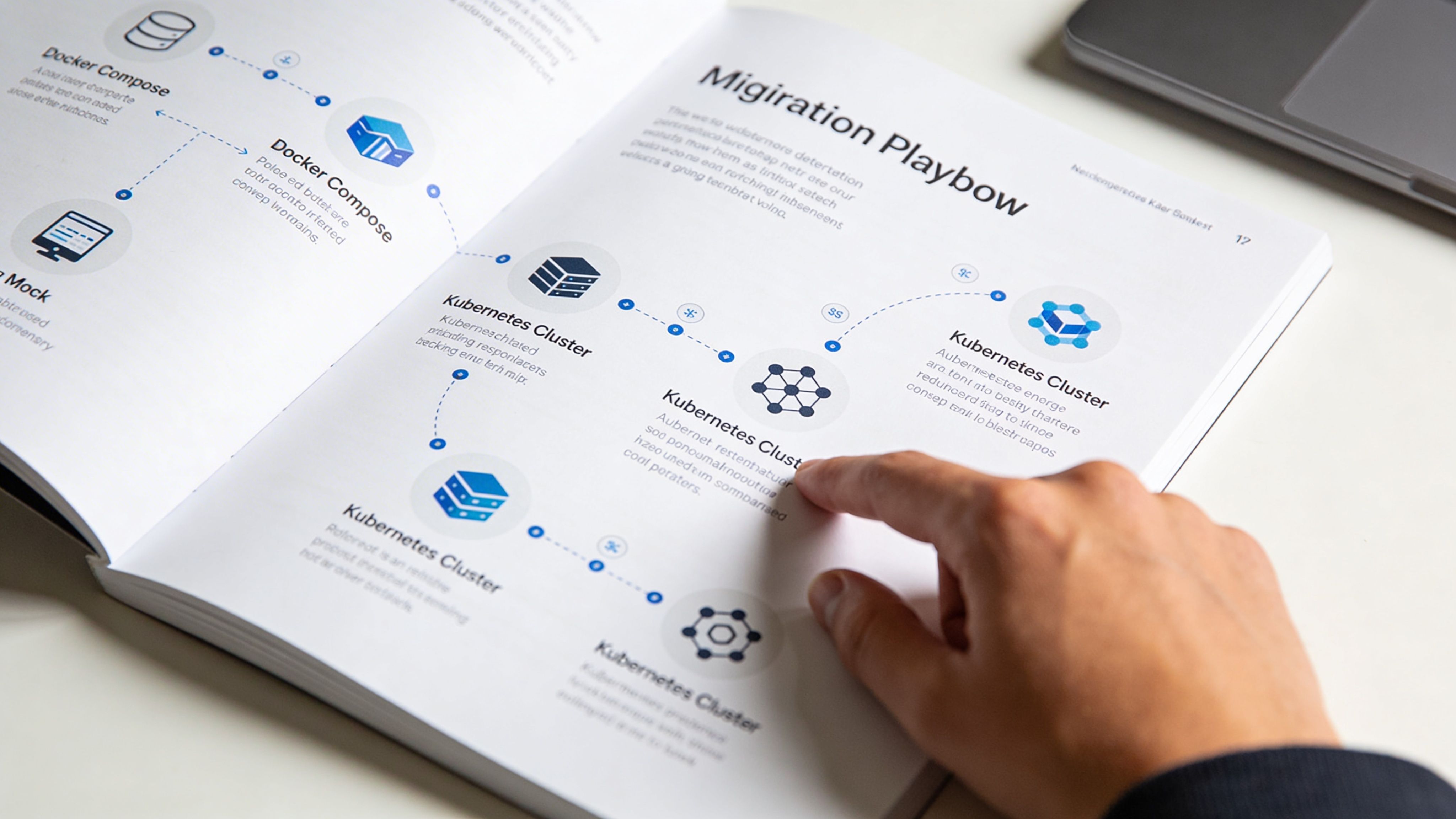
The move usually becomes justified when your team starts fighting the platform instead of using it.
A few signs are hard to ignore:
That’s when Compose stops being elegantly simple and starts becoming an accidental orchestrator.
The most practical path is the one teams resist because it isn’t pure.
A verified guideline recommends a hybrid strategy: use Docker Compose for initial development and customer onboarding when you’re under 20 customers and running 1 to 5 containers, then move to Kubernetes as production demands like auto-scaling and high availability become critical. That recommendation is laid out in this hybrid migration guide.
That’s a sane founder playbook. Keep local development and lightweight environments boring. Make production more capable only when production has earned it.
If I were leading the migration, I’d do it in this order:
Standardize the Compose setup first
Clean naming, environment variables, health checks, and service boundaries. Don’t migrate chaos.
Define production concerns explicitly
Which workloads need stronger availability? Which services need independent scaling? Which deploys must avoid downtime?
Move stateless services first
They’re easier to map into Deployments and Services. Stateful components deserve more care.
Keep dev workflows simple
Don’t force every engineer to run Kubernetes locally if Compose gives a faster feedback loop. Good continuous integration discipline matters more than ideological uniformity.
Run both for a while
Compose for development. Kubernetes for the production paths that require orchestration. That overlap is normal.
Migrate because operations demand it, not because architecture diagrams are starting to look modest.
Don’t rewrite the app and the platform at the same time.
Don’t make every service “cloud-native” in one sweep because someone discovered Helm and got excited. And don’t mistake YAML conversion for system design. Tools can help translate manifests, but they won’t decide readiness probes, rollout strategy, storage design, or how your team will support the result.
A good migration is boring from the customer’s perspective. The app keeps working. The team gets fewer unpleasant surprises. Nobody has to hold a postmortem because the company decided to become a platform startup by accident.
Most leadership decisions around infrastructure get worse the longer they stay theoretical.
You don’t need another vague pros-and-cons debate. You need a checklist you can drag into a planning meeting and use to end the argument.
You need speed more than ceremony
The team is shaping the product, changing architecture often, and shipping on short cycles.
Your environment is understandable on one machine
You can explain the whole stack without drawing a cluster diagram that looks like a subway map.
Your engineers should be writing features, not running a platform team
This is a big one. Founder-stage companies routinely sabotage momentum by overfunding infrastructure complexity.
Onboarding matters
New developers should be able to get the app running fast, without a guided tour of cluster internals.
A move to Kubernetes makes sense when you can answer “yes” to several of these:
| Signal | What it means |
|---|---|
| Deployments need stronger guarantees | You need cleaner rollouts and fewer human rituals |
| Recovery can’t depend on manual intervention | The platform has to react faster than a person can |
| Services need to scale independently | One-size server scaling starts getting clumsy |
| Reliability is now part of the product promise | Customers expect more than “we’ll restart it if it acts up” |
A CTO’s job isn’t to pick the most complex stack. It’s to pick the stack that supports the business without draining the team. If you want a solid external framing for that responsibility, this overview of CTO duties and responsibilities is a useful reminder that technical leadership is about tradeoffs, timing, and organizational advantage.
If you’re a startup, default to Compose.
If you’re dealing with real multi-node production demands, automated scaling, stricter uptime expectations, and operational complexity that keeps recurring, move to Kubernetes. Don’t be romantic about either choice. Compose is not “less serious.” Kubernetes is not “more mature” by default. They’re tools. Your job is to pick the one that matches the stage of the company.
Use the smallest thing that works. Upgrade when the pain is operational, not aspirational.
Yes, it can.
There’s a legitimate migration path some teams take: Compose ? Swarm ? Kubernetes. One verified source describes that path as spanning a period of several months in practical scenarios. I don’t hate it. Swarm can be a useful stepping stone if you want multi-node behavior without swallowing full Kubernetes complexity.
I wouldn't build a long-term strategy around “middle ground” because the team is indecisive. Transitional tools are fine when they reduce risk. They’re not fine when they become a parking lot for hard decisions.
Yes.
The better question is whether your production requirements fit it. If the environment is simple, the deployment topology is modest, and your team values clarity over orchestration depth, Compose can be sensible. If you need stronger availability guarantees, dynamic scaling, and richer traffic management, that’s where the cracks show.
No. They remove some infrastructure plumbing.
Managed services reduce cluster setup burden. They do not remove the need to understand Kubernetes concepts, deployment design, observability, storage behavior, or failure handling. You’re responsible for operating the system above the control plane. Plenty of teams discover this after they’ve congratulated themselves for “not having to manage Kubernetes.”
Not necessarily.
Uniformity is nice when it helps. It’s overrated when it hurts developer speed. Many healthy teams use Compose locally because it’s fast and obvious, then use Kubernetes in production because that environment needs more machinery. That split is pragmatic, not sloppy.
Use Compose until one or more of these become true:
If you’re not there, don’t cosplay as a platform company.
If you’re scaling your team as fast as your infrastructure, CloudDevs can help you bring in vetted Latin American engineers who can ship product, improve deployment workflows, and support the move from simple Docker Compose setups to more mature production environments without slowing the roadmap to a crawl.

Wondering what is technical leadership? Discover the essential skills that transform great engineers into the influential leaders your team needs.


Let's get straight to the point. You've heard that hiring in Mexico is the secret weapon for scaling your tech team without torching your runway. You're not wrong, but if you're thinking this is just about "cheap labor," you're making a rookie mistake that almost always ends in bad hires and buggy code. Turns out...

Stop guessing. We break down 8 essential database design best practices with real-world examples to help you build scalable, high-performance systems.