Express JS vs Node JS: A Founder’s Guide That Cuts Through the Noise

Victor
Posted on 23 March 2026




Let's get one thing straight about the "Express.js vs. Node.js" debate—it’s not a real debate. Asking which one is better is like asking whether you prefer a car engine or a fully assembled car. You can't compare them. Node.js is the powerful V8 engine, and Express.js is the chassis, steering wheel, and pedals that make it useful for a road trip.
You need both to get anywhere fast. And trust me, fast is the only speed that matters when you're burning through runway.
Table of Contents

Alright, let’s kill this confusion once and for all. If you landed here looking for a winner, you're thinking about the problem wrong. This isn't a showdown; it's a partnership. The real question isn't which one to choose, but why using them together is the default for getting a product to market before you have to start mortgaging the office ping-pong table.
Node.js is the runtime environment that lets you run JavaScript on the server. Think of it as raw, uncaged horsepower. It gives you the core ability to handle requests and manage I/O, but it offers zero help with the practical realities of building a web application. It’s powerful but primitive.
Express.js, on the other hand, is a web framework that sits on top of Node.js. It's the "opinion" in "unopinionated framework," providing the essential structure for routing, handling HTTP requests, and managing middleware. It's the tool that keeps your developers sane and prevents them from writing thousands of lines of boilerplate code just to say "Hello, World."
Understanding this relationship is critical for any founder or tech lead. Choosing to build with raw Node.js is like telling your team to assemble a car from scratch—including forging the bolts. You’ll spend months on plumbing that Express gives you for free.
Node.js has become a powerhouse in backend development. In fact, by 2026, it's projected to command over 75% of cloud-native JavaScript backends globally, enabling 30-50% faster development cycles compared to older stacks like Java. You can explore more data on Node.js growth trends to see its market dominance.
That speed, however, is unlocked by frameworks like Express.
The Bottom Line: You don't choose between Node.js and Express.js. You choose Node.js as your foundation and then select a framework—most often Express.js—to build on top of it. It’s the difference between potential energy and a functioning vehicle.
Here’s a quick, no-nonsense summary to hammer the point home. This table breaks down the roles and responsibilities of the engine versus the parts that make it drivable.
| Aspect | Node.js (The Engine) | Express.js (The Chassis & Steering) |
|---|---|---|
| Primary Role | JavaScript runtime environment | Web application framework |
| Level of Abstraction | Low-level; handles core I/O and networking | High-level; manages routing and middleware |
| Primary Use | Executes JavaScript code outside a browser | Builds web apps and APIs quickly |
| Analogy | A powerful, raw car engine | The frame and controls that make the engine useful |
Ultimately, this isn't a choice but an architectural decision. You start with Node.js and almost always add a framework like Express.js to build something real.

Let's cut through the jargon. Think of Node.js as a high-performance V8 engine sitting on a garage floor. It’s pure, raw power, but it’s not a car. You can’t drive it anywhere yet.
This is the best way to understand Node.js. It’s a runtime environment that lets you run JavaScript code on a server, not just in a web browser. When it first appeared, this was a game-changer. It meant you could use the same language for your frontend and backend, which was a huge win for productivity.
The secret to its power is its event-driven architecture. This non-blocking I/O model allows it to handle thousands of concurrent connections without getting bogged down. That's why it's the go-to for real-time applications like chat servers, financial data streams, and IoT backends.
But an engine alone is just a very loud, very expensive paperweight. It has all the potential in the world, but zero structure. This is the central problem with using raw Node.js for web development.
Want to build a simple API server using only Node.js? Get ready for a world of pain. You'll be manually parsing every single incoming HTTP request. You’ll have to write your own logic to read URLs, interpret headers, and handle different request methods like GET or POST.
It’s like being handed a crate of parts and told to build a car. It’s technically possible, but it’s a miserable, inefficient process. Your developers will spend all their time reinventing the wheel instead of building the features your business actually needs.
Every minute your team spends writing low-level HTTP routing logic is a minute they're not working on your product's core value. That's a direct hit to your bottom line.
Still not convinced? Let’s look at what it takes to write the simplest possible server in raw Node.js—one that just returns "Hello World." This isn't just code; it's a receipt for billable hours.
const http = require('http');

const hostname = '127.0.0.1';
const port = 3000;

const server = http.createServer((req, res) => {
  res.statusCode = 200;
  res.setHeader('Content-Type', 'text/plain');
  res.end('Hello World');
});

server.listen(port, hostname, () => {
  console.log(`Server running at http://${hostname}:${port}/`);
});
Look at all that boilerplate. You have to import the http module, manually set status codes and content types, and explicitly tell the server to start listening. It works, but it’s clumsy and verbose.
Now imagine adding more endpoints:
/users to fetch a list of users./products to view inventory./login to handle a POST request with credentials.Using raw Node.js, you’d quickly find yourself in a tangled mess of if/else statements, trying to parse req.url for every single request. It’s a direct path to unmaintainable code and developer burnout. This is the exact pain point that frameworks were created to solve.
Node.js gives you the raw power, but it's not a tool for building web applications quickly or sanely. It's the foundational layer—the uncaged beast. To do anything useful with it, you first need a way to tame it.
Think of Node.js as a powerful, raw engine. It’s got all the horsepower you need, but you can’t exactly drive it down the street. That’s where Express.js comes in—it’s the chassis, steering wheel, and pedals that make the engine usable.
After wrestling with that simple server in raw Node, you’re probably thinking there has to be a better way. You're right, and it's called Express.
Express.js is a minimal and unopinionated web framework that sits right on top of Node.js. It doesn’t try to replace Node’s core power; it just organizes it. It’s the brilliant manager who takes a chaotic but high-potential team and gives them just enough structure to be wildly productive.
This framework handles all the tedious HTTP plumbing that would otherwise burn through your team's sanity and your project’s budget.
So, what does Express actually do? It provides the essential toolkit for building web applications and APIs, and it does it fast. This isn't about adding fancy features; it's about abstracting away the painful, repetitive parts of building for the web.
This includes mission-critical features like:
if/else block trying to figure out which URL was requested, you get clean, declarative routes like app.get('/users'). This lets you cleanly direct traffic from different URLs to the correct logic.req and res objects, making it much easier to access query parameters, read request bodies, and send back JSON with a simple res.json().By taking care of these core tasks, Express frees up your developers to focus on what actually matters: your business logic. They get to spend their time building features, not reinventing the wheel for the thousandth time.
Remember that clunky "Hello World" server from before? The one that felt like it cost $500 in billable hours just to write? Let’s see what that same server looks like with Express.js.
Raw Node.js:
const http = require('http');
const server = http.createServer((req, res) => {
  res.statusCode = 200;
  res.setHeader('Content-Type', 'text/plain');
  res.end('Hello World');
});
server.listen(3000);
Express.js:
const express = require('express');
const app = express();
app.get('/', (req, res) => {
  res.send('Hello World');
});
app.listen(3000);
The difference is stark. The Express version is cleaner, more intuitive, and less than half the code. This is the exact moment every developer understands why Express became the de facto standard for Node.js web development. You can practically hear the collective sigh of relief.
This isn't just about saving a few lines of code. It's about establishing a clear, scalable pattern for building applications. The Express version isn’t just shorter; it’s fundamentally better organized.
This lean approach is precisely why Express dominates the ecosystem. Diving into the stats, Express clocks over 18 million weekly downloads on npm, completely dwarfing its competitors. Of the 48.7% of developers using Node.js, a massive 42.73% of them prefer frameworks like Express to build applications—a testament to its staying power since launching in 2010. You can get more details on Node.js and Express usage from recent surveys.
Its minimalism is its greatest strength, offering a level of freedom that's perfect for quickly shipping an MVP. But that freedom comes with a catch—it requires a disciplined team to build something that can scale without becoming a maintenance nightmare down the road.
Let's cut through the theory and talk about what really matters in a business: shipping a working product on time and on budget. The "best" technology is the one that gets you there efficiently.
So, when would you ever use raw Node.js for a web project? In practice, almost never. It excels in a very specific niche—the 1% of edge cases where the overhead from a web framework, no matter how small, is a real performance bottleneck. Think high-performance networking tools, like a custom TCP server, a lightweight proxy, or a background process that does nothing but crunch data.
For the other 99% of what you'll build, you’ll be reaching for a framework like Express.
If your project involves a web interface, an API, or anything a user will interact with over the internet, a framework isn't optional—it's your starting point. You're not building a web server from scratch with raw Node.js.
This decision tree helps visualize the choice.
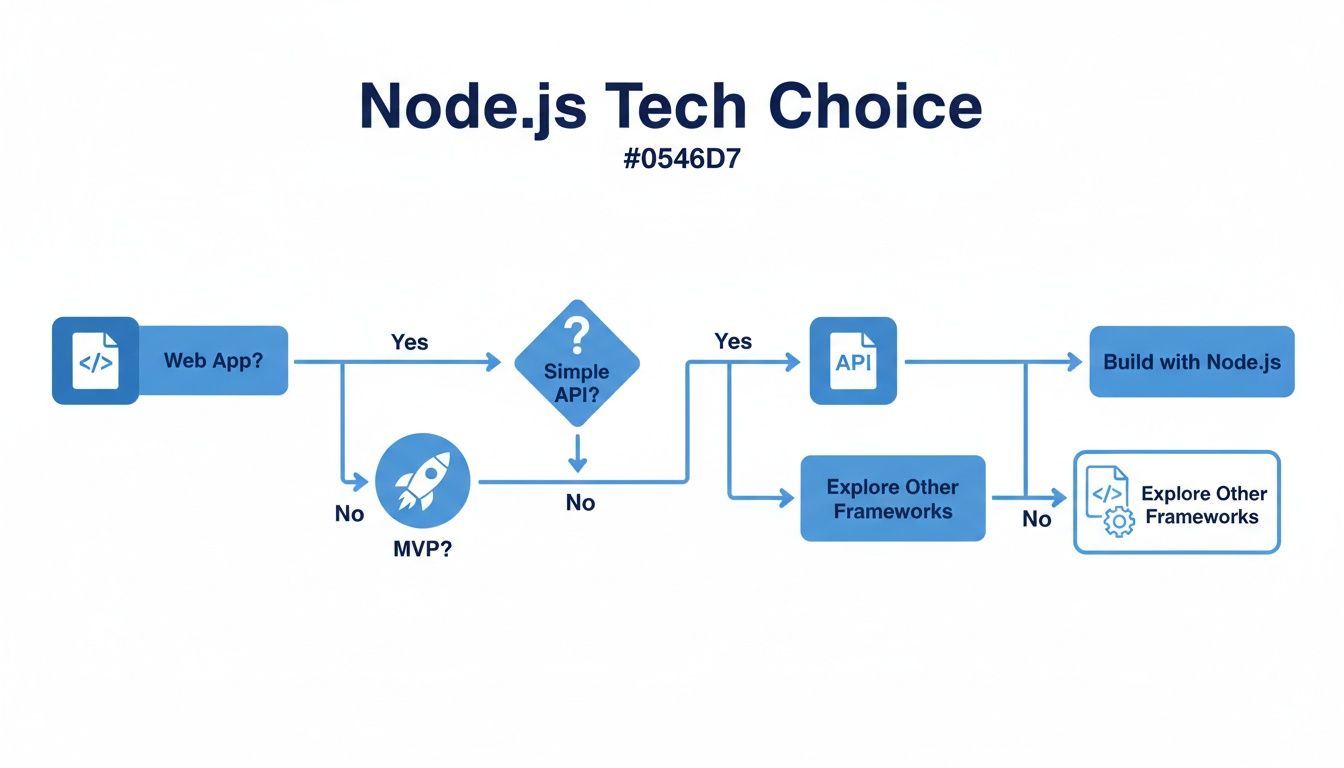
The flowchart makes it clear: for most web applications and APIs, a framework is the logical choice. The key takeaway is that speed-to-market and developer productivity almost always outweigh the micro-optimizations you might get from raw Node.
To help you decide, this matrix breaks down common development scenarios.
This table offers a practical guide for choosing the right tool based on your project's goals and constraints.
| Scenario | Your Best Bet | The Bottom Line |
|---|---|---|
| Building a SaaS MVP | Express.js | Speed is everything. Express lets you build and validate a REST API in a fraction of the time, getting your product to market faster. |
| Simple Mobile App Backend | Express.js | You need to build, test, and deploy endpoints for authentication and data retrieval quickly. Don't reinvent the wheel with low-level HTTP handling. |
| High-Performance Network Tool | Node.js (raw) | For a custom proxy, TCP server, or a data-intensive background worker, the minimal overhead of raw Node.js provides a tangible performance benefit. |
| Real-Time Chat Application | Express.js + Socket.io | While Node's core is perfect for WebSockets, you'll still want Express to manage the web server, HTTP routes, and client connections. |
| Server-Side Rendering (SSR) | Express.js | Express provides the server environment needed to render your React or Vue components into HTML, which is critical for SEO and initial page loads. |
| Complex Enterprise Application | Opinionated Framework (e.g., NestJS) | For large, multi-team projects, the structureless nature of Express can be a liability. A framework like NestJS enforces architecture and scalability. |
Ultimately, for most business applications, the structure and tooling provided by a framework like Express will save you significant development time and prevent common architectural mistakes.
Founder's Reality Check: Don't let your team get bogged down building a "hyper-optimized" server from scratch. The performance gains are nearly always negligible compared to the development time you lose. Ship first, optimize later.
This is where the discussion gets more nuanced. Can you build a massive application with dozens of microservices on Express? Absolutely. But its unopinionated, "do-it-yourself" nature can become a double-edged sword.
Without a senior team enforcing strong conventions, an Express project can quickly devolve into a tangled, hard-to-maintain mess. For these larger-scale systems, it's often wiser to look at more structured and opinionated Node.js frameworks like NestJS or AdonisJS.
These frameworks are still built on Node.js (and often use Express under the hood), but they provide a rigid, out-of-the-box architecture. This structure guides your team toward building more organized and maintainable code, which is critical for long-term success.
The choice always comes down to performance versus productivity. As demonstrated by migrations at companies like PayPal and Netflix, Node.js itself can deliver 50-60% faster loading times. Express simply adds the minimal layer needed to make that power useful for web applications—a key reason why over 70% of Node developers rely on it.
Whether you're building a simple API or a complex SaaS platform, understanding the trade-offs is crucial. And if you're focused on building APIs, make sure you're following API design best practices from day one. Your project's needs, team skills, and time-to-market are the only metrics that truly matter.
So, what's the verdict for your startup? After all the talk about engines and cars, what’s the real takeaway? Let’s be blunt: the "Express.js vs Node.js" debate is a distraction. For 99% of founders and CTOs, the choice was made years ago by industry convention.
You’re going to use Node.js with Express.js (or a similar Node framework). Frankly, the debate is a red herring. Your developers will thank you, your timeline will thank you, and your budget will thank you.
The decision isn't about the tech stack—it's about the talent. You’re not just picking tools; you’re picking the artisans who will use them. This is where a lot of startups get it wrong.
Express.js’s minimalist nature is both its greatest strength and its most dangerous flaw. It empowers skilled developers to build lean, fast applications. But in the hands of a junior developer, that same freedom can quickly become a tangled mess of spaghetti code that’s impossible to scale.
You don't want a developer who just learned Express. You need someone who knows its limitations and can architect a scalable, maintainable system from day one. That’s the difference between an MVP that flies and one that collapses under its own weight.
Making the right backend technology decision is a foundational step when considering how to launch a SaaS product successfully, as it directly impacts both scalability and development speed.
So, what's a founder to do? You could spend your days sifting through résumés and conducting technical interviews, but that's a full-time job in itself. You could also take a gamble on a local hire and hope for the best. Or, you can get smarter about building your team.
This is where we come in. (Toot, toot!)
Instead of navigating the hiring maze alone, you can tap into a pre-vetted talent pool of senior developers who already know the playbook. At CloudDevs, we connect you with elite Latin American Node.js and Express.js talent in as little as 24 hours. These aren't fresh-faced juniors; they're seasoned professionals who have built and scaled applications just like yours. If you're wondering where to begin, our guide on how to hire remote developers is a great starting point.
Here’s why that matters:
Ultimately, the Express vs. Node discussion is academic. The real business decision is how you'll execute your vision. Don't let a great idea get derailed by a messy codebase or a painfully slow hiring process. Your path to market is paved by the quality of your team, not just the names in your package.json file.
Alright, we've gone deep on everything from engines and cars to use cases and hiring. But if you’re like most founders or tech leads, a few questions are probably still bouncing around in your head.
Let’s clear the air and knock out the common queries we hear before a team commits to building their next big thing. No jargon, just straight-up answers.
No, and this is the classic mix-up. Thinking they're the same is like asking if a car's engine is the same as the car itself.
Node.js is the runtime environment—it’s the engine that gives JavaScript the power to run on a server. Express.js is a web framework that runs on top of Node.js, giving you the chassis, steering wheel, and pedals (like routing and middleware) to actually build a web application without pulling your hair out.
You absolutely need Node.js to use Express.js. But while you don't technically need Express to use Node, you'd have to be a masochist to build a web app without it.
Technically, yes. You can build a web server using nothing but the native http module in Node.js. We even showed an example earlier—it was clunky, long-winded, and a one-way ticket to code that no one can maintain.
The real question is, why on earth would you want to?
For 99% of web applications or API projects, using raw Node.js is like insisting on forging your own nails to build a house. It’s a colossal waste of time and money that your competitors will happily use to ship their product before you’ve even figured out how to handle your first POST request.
The only practical reason to go raw is for hyper-specific, non-web tasks, like a barebones TCP server or a high-performance proxy where every ounce of framework overhead is a real concern.
Not even close. While Express is the undisputed king for cranking out REST APIs in record time, that’s just one of its many talents. Its real superpower is its flexibility.
You can use Express to build a huge range of applications, including:
apollo-server-express.Express doesn't force you into a box. It just gives you a stable, minimal foundation for handling web requests and responses, letting you plug in whatever logic or libraries your project needs.
Let's be direct: yes, absolutely. The JavaScript world is notorious for its "flavor of the week" frameworks, but Express has shown incredible staying power for a reason. Its stability, gigantic community, and minimalist design make it a timeless tool.
Think of it as the dependable old pickup truck of the backend world—it’s not the flashiest, but it always, always gets the job done.
Newer frameworks like Fastify have popped up promising better performance, and more structured frameworks like NestJS (which often uses Express under the hood) offer a more opinionated architecture for large teams.
But for sheer speed of development, ecosystem support, and the sheer number of developers who already know it, Express is still the default. With over 18 million weekly downloads on npm, its relevance isn't just an opinion; it's a statistical fact.
This is a great question because it cuts right to the core of how Node.js operates. Express is built on Node, so it fully embraces its asynchronous, non-blocking I/O model.
Any operation that involves waiting—like a database query, an API call, or reading a file—should be handled asynchronously. This prevents it from blocking the main thread, allowing your server to handle other requests while it waits.
In modern JavaScript (ES6+), you'll almost always see this done with async/await syntax, which makes asynchronous code look and feel synchronous, making it way easier to read and reason about.
Here’s a quick, practical example of an Express route handler fetching a user from a database:
// A route to get a specific user by their ID
app.get('/users/:id', async (req, res) => {
  try {
    const userId = req.params.id;
    // The 'await' keyword pauses this function until the database query is complete
    // but doesn't block other incoming requests.
    const user = await db.users.findById(userId);

    if (!user) {
      return res.status(404).send('User not found');
    }

    res.json(user);
  } catch (error) {
    // If the database query fails, we catch the error and send a 500 response.
    res.status(500).send('Something went wrong');
  }
});
By using async/await, your server can juggle thousands of simultaneous connections. While one request is waiting for the database to respond, Node.js is already working on the next one. This is the magic of the Node.js event loop, and Express provides the perfect structure to harness it.
Yes. 100%. You can't learn to drive a race car without first understanding what an engine is and how a steering wheel works.
Since Express is a framework that runs on the Node.js platform, you need a solid grasp of Node fundamentals first. This doesn't mean you need to be an expert in building raw HTTP servers, but you should be completely comfortable with:
require() or ES Modules (import/export).async/await.Jumping straight into Express without this foundation is a recipe for confusion. You’ll just be copying and pasting code without understanding why it works, which is a dangerous place to be when you're building a business on it.
Still weighing your options and feeling the pressure to build your team? Instead of getting lost in framework debates, focus on what matters: execution. CloudDevs connects you with pre-vetted, senior-level Latin American developers who are experts in Node.js and Express in just 24 hours. Stop worrying about the hiring grind and start building your product. Find your elite developer today.

Planning a software project is about forcing brutal honesty about what you’re building, why, and what resources you actually have—before a single line of code gets written. It’s less about a perfect document and more about getting everyone rowing in the same direction. Why Most Software Project Plans Fail Before They Start Let’s be honest:...

Let’s be honest: hiring contractors isn't just about finding talent. It’s about avoiding disaster. Turns out there’s more than one way to hire elite developers without mortgaging your office ping-pong table. The real work is taking a hard look at the hidden costs of a bad hire—wasted time, torched projects, and a burnt-out team—and building...

Sure, the hourly rate for skilled offshore developers in places like Latin America or Eastern Europe hovers between $25 and $55. That looks fantastic next to the $80 to $150+ per hour you’d shell out for a similar mid-level engineer in the US. But if you think that hourly rate is the whole picture, you're...