Craft a Winning Front End Developer JD

Victor
Posted on 18 April 2026



You posted a front end developer jd. Now your inbox looks like a spam folder with better LinkedIn photos.
Half the applicants seem cloned. The other half copied a stack from somewhere around 2021, sprinkled in “React expert,” and hit apply before your coffee cooled. Then you waste days sorting through resumes, guessing seniority from vague bullets, and scheduling interviews with people who can name tools but can’t explain tradeoffs.
That’s not a candidate problem. It’s a job description problem.
A bad JD acts like a magnet for volume. A good one acts like a filter. It tells serious developers, “This team knows what it’s building.” It tells tourists, “Keep scrolling.” That’s the whole game.
Table of Contents

Most front end developer jd templates are lazy. They’re stuffed with recycled fluff like “fast-paced environment,” “rockstar developer,” and “must be passionate.” Passion is nice. Shipping reliable interfaces is nicer.
The bigger mistake is treating the JD like a wishlist. Founders and hiring managers dump every framework they’ve heard of into one document and hope a unicorn appears. What happens is you repel strong candidates who know the list is nonsense, and attract weaker ones who apply to everything.
A real JD should do three things:
That last one matters more than is often acknowledged. If your JD doesn’t repel anyone, it’s too vague.
You’re not hiring a JavaScript dictionary. You’re hiring someone to turn product decisions into usable, fast, maintainable interfaces.
The labor market still supports strong front-end hiring. The U.S. Bureau of Labor Statistics projects web developers and digital designers employment to grow 7% from 2024 to 2034, with about 15,500 openings each year, and lists a median annual wage of $90,930 for web developers in May 2024, according to the BLS occupational outlook for web developers. So no, the field isn’t dead. Your JD is just blending into the wallpaper.
Practical rule: If your JD reads like it could describe ten different companies, it will attract ten different kinds of applicants. Most of them wrong.
Top candidates read a JD and ask a simple question. “Do these people know what they need, or am I walking into chaos?”
So tell them:
Skip the chest-thumping culture lines. Nobody serious chooses a role because you wrote “we work hard and play hard.” That phrase should be launched into the sun.
Instead, respect their time. A sharp front end developer jd says, “Here’s the stack. Here’s the scope. Here’s the bar.” That’s how you attract adults.
A strong JD has bones. Most companies post mush.
You want a document that sounds like an actual team wrote it, not HR after a light weekend with ChatGPT. Here’s the structure I use when I want a front end developer jd to produce signal instead of noise.
The first few lines should answer one thing. Why should a good frontend person care?
Not “we are seeking.” Not “the ideal candidate.” Nobody talks like that outside of hostage videos and bad corporate templates.
Try this approach instead:
That framing attracts builders. Builders want context.
The best applicants don’t apply because you listed React. They apply because the job sounds real.
Words matter more than you think. A 2025 analysis of 595 job posts found that calling the role “Frontend Engineer” rather than “Frontend Developer” was associated with $44,939 higher average salary for the same work, as noted in this analysis of the frontend and full-stack job market.
That doesn’t mean you should play title games. It means candidates infer seniority, rigor, and compensation from wording. If the role involves system thinking, architecture, testing discipline, and product collaboration, “Engineer” may be the more accurate label.
If it’s a straightforward implementation role, keep it simple. Don’t inflate titles just to feel clever. Developers can smell title theater from orbit.
This sounds basic because it is basic. Yet teams still refuse to do it.
A usable front end developer jd might include:
That split does two useful things. It lowers pointless self-rejection from qualified people, and it exposes whether your team knows what’s essential.
If you need help generating a sane first draft before editing it like an adult, a tool like MyCulture.ai’s Job Post Generator can speed up the blank-page part.
Weak JDs list tasks. Strong ones define responsibility.
Bad:
Better:
Notice the difference. The second version gives candidates something to react to.
Teams often become timid at this point. Don’t.
If performance matters, say so. If accessibility is mandatory, say so. If your design system is a mess and you need someone to help fix it, say that too. Serious candidates prefer honesty over polished nonsense.
A practical structure:
| JD element | What to say | Why it works |
|---|---|---|
| Mission | What product surface they own | Gives context fast |
| Stack | Tools used in production now | Filters for relevance |
| Outcomes | What success looks like in role | Attracts ownership-minded candidates |
| Differentiators | Performance, testing, accessibility, design systems | Signals maturity |
| Collaboration | Who they work with and how decisions happen | Reduces mismatch |
Remove these on sight:
The point of a front end developer jd isn’t to impress everyone. It’s to attract the right few.
Using the same JD for every level is lazy management dressed up as efficiency.
A junior candidate and a lead candidate should not read the same expectations and somehow decode the differences by telepathy. If your team can’t describe level-specific scope, your leveling system probably isn’t real.
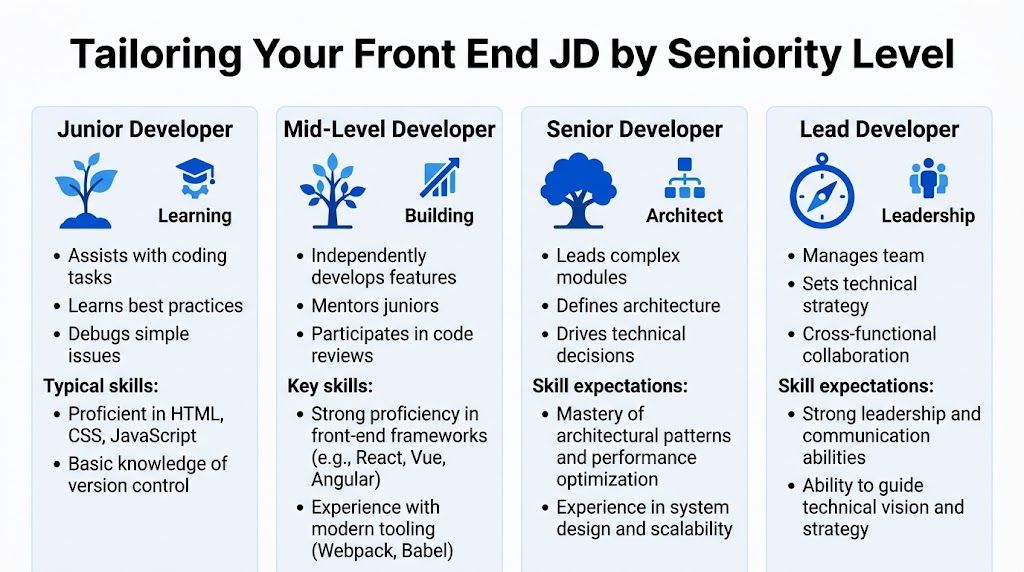
| Seniority Level | Primary Focus | Key Verbs to Use | Scope of Work |
|---|---|---|---|
| Junior | Learning, support, execution with guidance | assist, learn, implement, debug | Small features, bug fixes, team support |
| Mid | Independent delivery | own, build, improve, collaborate | Features end to end, routine technical decisions |
| Senior | Architecture, quality, mentorship | design, lead, define, mentor | Complex systems, standards, cross-team influence |
| Lead | Strategy, alignment, team leverage | set, align, guide, unblock | Technical direction, staffing input, delivery coordination |
A junior front end developer jd should focus on coachability and fundamentals. Stop asking juniors for every tool under the sun. If you want three years of production design systems experience, that’s not junior. That’s you trying to pay junior rates for a mid-level hire.
Good junior phrasing sounds like this:
Avoid words like “architect,” “own the roadmap,” or “drive platform decisions.” That language either scares off promising juniors or pulls in overconfident applicants who can talk big and deliver tiny.
This is the level most startups need and most JDs completely butcher.
A mid-level developer should be able to pick up a feature, ask smart questions, coordinate with design and backend, and ship without requiring babysitting. Not zero support. Just normal adult support.
Use language like:
The red flag here is accidental senior inflation. If your “mid-level” JD expects architecture leadership, team mentorship, and org-wide standards ownership, you don’t want a mid. You want a senior and a discount.
If every sentence in the JD screams “hero needed,” expect chaos merchants, not steady operators.
A senior front end developer jd should emphasize decision-making. Not just coding speed. Plenty of people can build fast. Fewer can make the codebase better while doing it.
Strong senior wording includes:
Notice what’s missing. No childish hype. No obsession with years. A real senior proves level through scope and judgment.
The lead role is where companies get especially sloppy. They write “Lead Front End Developer” and then describe a solo IC who also attends more meetings. That’s not a lead. That’s an annoyed senior.
A lead JD should talk about multiplying the team:
A lead candidate wants to know whether they’ll have actual authority or just inherited messes. Be honest.
Here’s the shortcut I’d use in a hiring review.
If you blur these lines, candidates will do one of two things. Great ones will opt out. Mediocre ones will opt in.
That’s an expensive mistake dressed up as an open role.
You don’t need another abstract sermon. You need something you can post after editing the company name and a few stack details.
If you want more examples after these, CloudDevs has a useful sample IT job description library worth skimming for structure ideas.
Title: Mid-Level React Developer
Role mission
You’ll build and ship customer-facing product features that are fast, clear, and maintainable. This role is for someone who can take a defined problem, work with design and product, and deliver clean UI without drama.
What you’ll do
What we need
Nice to have
How we work
Title: Senior Front End Engineer (Remote)
Role mission
You’ll shape the frontend architecture behind a product used daily by customers and internal teams. We need someone who can build, review, simplify, and raise standards without turning every decision into a committee meeting.
What you’ll own
What we’re looking for
Nice to have
What success looks like
That’s the difference between a useful front end developer jd and corporate oatmeal. One creates alignment. The other creates inbox sludge.
Remote hiring changed the rules. Most JDs still act like everyone sits three desks away from product and can resolve ambiguity by ambushing each other after lunch.
That’s fantasy.

A major gap in the average front end developer jd is remote collaboration. According to the Robert Half front-end developer hiring guide, 80% of tech roles are remote, yet most JDs still fail to specify remote collaboration metrics. The same source notes LATAM regions contribute 15% of global JavaScript commits, up 30% year over year, and many US companies still don’t write JDs that properly evaluate and attract that talent.
“Strong communication skills” tells candidates nothing.
Say what communication means on your team:
That language does two things. It gives disciplined remote developers confidence, and it warns off people who need constant hand-holding.
Remote collaboration isn’t a personality trait. It’s a work habit.
If your team is US-based and you need overlap, say it plainly. Don’t write “work from anywhere” and then implicitly expect attendance at recurring US-hour meetings. That bait-and-switch poisons trust before the first interview.
This is also where LATAM talent becomes especially practical for US companies. You get strong timezone overlap without the scheduling circus that often comes with farther-spread teams.
If you’re building a remote hiring process around that model, include specifics such as expected overlap hours, async norms, review turnaround expectations, and how decisions get documented. If you need a broader playbook for that setup, this guide on how to hire remote developers is a useful reference.
Good remote JDs don’t fetishize location. They define operating standards.
Ask for evidence of:
That’s how you attract high-caliber LATAM candidates without turning the JD into awkward geographic marketing copy. Serious developers want a fair process, real scope, and a team that knows how remote work functions.
Your JD gets better applicants. Your interview still has to expose who can actually think.

Stop asking trivia. Nobody cares whether a candidate can recite event bubbling definitions like they’re preparing for JavaScript pub quiz night.
Ask questions that reveal judgment:
Good candidates don’t just name tools. They explain constraints, tradeoffs, communication, and what they’d do differently now.
If you want to round this out with non-technical prompts, this list of common behavioral interview questions is a decent companion. Just don’t mistake polished storytelling for engineering judgment. Plenty of people interview like philosophers and code like arsonists.
Hire the person who can explain decisions clearly, admit mistakes, and connect frontend choices to user experience.
Short enough to read on a phone. Detailed enough to sound serious. If it takes forever to reach the actual work, you’ve written marketing copy, not a JD.
Yes. Always. Hiding compensation wastes everyone’s time and makes you look evasive.
They list tools instead of defining outcomes. Great candidates want to know what they’re responsible for, what quality bar matters, and how the team works.
Yes, if they matter to your product. According to the front-end job description guidance on roadmap.sh, neglecting accessibility (WCAG 2.1 AA) can lead to 15-20% user drop-off, and sites that pass Core Web Vitals can see bounce rates drop by as much as 32%. If those outcomes matter to the business, they belong in the JD.
Yes. Reusing one template across junior, mid, senior, and lead roles is the hiring equivalent of labeling every kitchen drawer “stuff.”
If you want to move faster without lowering the bar, CloudDevs is one option to consider for hiring pre-vetted Latin American developers with US-friendly timezone alignment. It’s a practical route when you need to scale quickly, avoid endless resume triage, and turn a sharper front end developer jd into actual interviews with relevant candidates.

Discover proven resource allocation optimization strategies to boost efficiency and reduce burnout. Maximize your team's productivity and impact today.


Hiring? Use these 7 sample IT job description templates for roles like Software Developer, Cloud Architect, and more to attract top talent.

Let's be honest: hiring remote developers is broken. You post a job, get buried in a mountain of irrelevant resumes, and waste weeks on candidates who, it turns out, can't actually code. The only alternative seems to be paying eye-watering US salaries that make your investors sweat. Turns out there’s more than one way to...