Hire Python Coders on a Budget Without Losing Your Mind

Victor
Posted on 31 January 2026




Let's be honest. Trying to hire Python coders right now feels like a street fight for the last slice of pizza. The demand is out of control, fueled by every company wanting a piece of the AI and data science boom.
Every funded startup is chasing the same handful of senior engineers. This leaves you with two terrible choices: either mortgage your office ping-pong table to afford their salary or prepare to drown in a sea of unqualified resumes.
The traditional hiring playbook is broken. Posting on a job board? Hope you enjoy spending your afternoons fact-checking resumes and running technical interviews—because that’s now your full-time job.
This isn't just a hunch; it's a brutal market reality.
Table of Contents
The demand for Python talent isn't slowing down. In fact, the US Bureau of Labor Statistics projects a staggering 17% growth in software developer jobs from 2023 to 2033, and Python is at the epicenter of that explosion.
With its dominance in high-growth fields—powering over 70% of ML projects—the competition is only getting fiercer. In major US hubs, this translates to eye-watering salaries. But the game has changed. Remote work has opened up a global talent pool where the numbers tell a very different story, as detailed in this Python developer salary guide from thisisanitsupportgroup.com.
The financial gap between local and global talent is no longer a small arbitrage play; it's a strategic chasm. Just look at this side-by-side comparison of what you'd pay in a top US tech hub versus the global remote average.
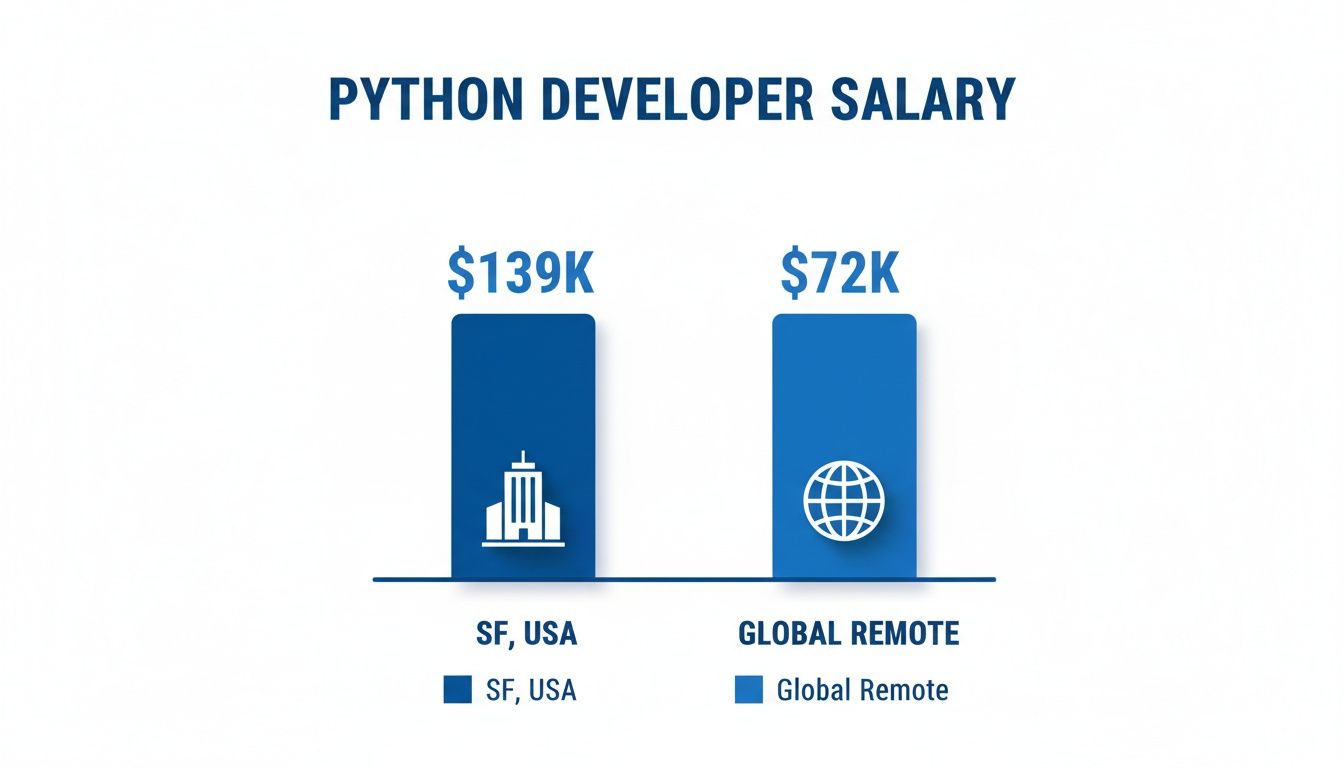
The data is clear. Hiring a Python coder in San Francisco costs nearly double what you’d pay for elite talent in the global remote market. This isn’t about finding "cheap" labor; it's about finding sustainable, high-quality engineering without setting your budget on fire.
To put it in perspective, let's break down the numbers.
Here’s a quick comparison of average annual salaries for Python developers in major US tech hubs versus the global remote average. The cost differences are significant.
| Location / Role | Average Annual Salary (USD) |
|---|---|
| San Francisco, USA | $139,997 |
| New York City, USA | $128,500 |
| Austin, USA | $122,000 |
| Global Remote Average | $72,000 |
As you can see, the premium for local talent in the US is massive. This cost differential allows you to either build a larger, more robust team or reallocate funds to other critical areas of your business.
The problem isn’t just the cost. It’s the entire process.
When you hire locally in the US, you're competing with giants who can offer stock options that look like phone numbers. This creates a few painful realities for most companies:
This isn't just about saving money anymore. It's a survival strategy. Accessing the global talent pool is how you build a world-class team without world-class burn rates.
Thinking globally is no longer a clever hack—it’s the default setting for smart, capital-efficient companies. Why limit yourself to a single, hyper-competitive zip code when you can access vetted, top-tier talent from thriving tech hubs across the world?
Before you write a single job post, stop. Seriously. Most companies hire the wrong person because they’re playing a losing game from the start—they never actually defined the problem they needed to solve.
You’re not just trying to hire Python coders; you’re trying to find someone to fix a specific, often expensive, business problem. The job title is the last piece of the puzzle, not the first.

Job descriptions are a wish list of acronyms and buzzwords. They attract everyone and no one at the same time. A "Problem Spec" is different. It’s a brutally honest document that lays out the challenge, the goal, and what winning looks like.
Instead of writing "Seeking a Senior Python Developer with 5+ years of experience," try framing the actual problem:
See the difference? One is a laundry list of skills. The other is a mission. Great engineers don't want to fill a seat; they want to solve a compelling problem.
Your engineering team will inevitably give you a list of 20 "essential" technologies. Politely ignore most of it. Your job is to separate the genuinely critical skills from the vanity metrics and pet technologies.
Here's a simple framework to cut through the noise:
Your goal is to find someone who can solve your business problem, not someone who has used the exact same tools in the exact same order as your current team. Over-indexing on nice-to-haves is the fastest way to shrink your talent pool to zero.
This ruthless prioritization is what separates a frustrating, three-month search from a swift, successful hire.
This is the secret weapon. How will you know if you made the right hire? Don't wait a year to find out. Define clear, measurable goals for the first 90 days that tie directly back to your Problem Spec.
This isn't about micromanaging; it’s about creating a shared definition of success.
A weak goal sounds like, "get familiar with the codebase." A strong goal is, "deploy the new asynchronous payment processing module to staging and reduce checkout latency by at least 50% in performance tests."
This clarity does two things:
By focusing on the problem first, you transform the hiring process. You stop collecting resumes and start auditioning problem-solvers. This single shift in mindset will save you countless hours and ensure the Python coder you hire actually moves the needle on what matters most.
Alright, you know the problem you’re trying to solve. Now comes the fun part: deciding how you’re going to get it done. Turns out there’s more than one way to hire Python talent without mortgaging your office ping-pong table, and picking the wrong one is a fast track to wasted cash and crippling delays.
Think of it like choosing a vehicle. You wouldn't take a sports car off-roading, and you wouldn't use a bulldozer for a quick trip to the store. Each hiring model is a tool built for a specific job. Your task is to match the tool to the terrain you’re facing right now.
Let's break down the three main paths. No fluff, just the battlefield realities of what you can expect from each.
Freelancers are the special ops of the development world. You drop them in for a specific, well-defined mission, they execute, and they’re out. Need a quick script to migrate some data? Building a small, one-off API integration? This is their sweet spot.
Platforms like Upwork or Toptal are flooded with talent, but it's a double-edged sword. For every rockstar, there are a dozen who look great on paper but vanish when the code gets tricky.
This model is a gamble on a single individual. If they're great, you look like a genius. If they're not, you're back to square one, often with a messy codebase to clean up.
This is the traditional route: find someone amazing, bring them into the fold, and make them a core part of your team. For your main product—the heart and soul of your company—this is often the right move. You get deep institutional knowledge, unwavering commitment, and someone who thinks about your business problems in the shower.
But let's be real. It’s also the most expensive and slowest path.
Hope you enjoy spending your afternoons fact-checking resumes, running endless interview loops, and figuring out payroll taxes—because that’s now your full-time job. Hiring a W-2 employee is a massive commitment of time, money, and administrative overhead.
Benefits, 401(k) matching, compliance… it all adds up. You’re not just paying a salary; you're building a miniature HR department around each new hire. This is a heavy lift, especially for a startup trying to stay nimble. If you need to scale your core engineering team for the long haul and have the resources, it’s the gold standard. If not, it can sink you.
So, what if you need the stability of a full-timer without mortgaging the company, and the flexibility of a freelancer without the commitment issues?
This is where the dedicated team model, especially through a managed marketplace, comes in. It's the hybrid that's been a game-changer for us. You get one or more developers who work exclusively for you, integrated into your team, your Slack channels, and your daily stand-ups.
They are, for all intents and purposes, your developers. The key difference? Someone else handles the brutal administrative work.
To make it even clearer, here’s a breakdown of how these models stack up against the factors that actually matter when you're under pressure to deliver.
| Factor | Freelancer (e.g., Upwork) | Full-Time Hire (Direct) | Dedicated Team (e.g., CloudDevs) |
|---|---|---|---|
| Speed to Hire | Very Fast (1-7 days) | Very Slow (2-4 months) | Extremely Fast (1-3 days) |
| Cost | High hourly rates | Highest (salary + benefits + taxes) | Moderate (flat rate, no overhead) |
| Commitment | Low (project-based) | High (long-term) | High (dedicated, but flexible contract) |
| Admin Overhead | Medium (invoices, 1099s) | Very High (payroll, HR, benefits) | Zero (fully managed) |
| Best For | Short, defined tasks | Core, long-term product development | Scaling teams, long-term projects |
The choice really hinges on your specific scenario. A quick MVP might scream "freelancer," while scaling your core platform points toward a dedicated team or a full-time hire.
For a deeper dive, our guide on the differences between contract vs direct hire can help clarify which path is right for you. The key is to be brutally honest about your needs, budget, and timeline before you commit.
So, you've defined the problem and picked your hiring model. Now for the main event: actually trying to hire Python coders.
Brace yourself. Unless you have a system, this is the part where your calendar evaporates, your productivity plummets, and you start questioning all your life choices.
The old way sucks. Let’s quickly run through the usual suspects before we get to what actually works.
If you follow the standard playbook, you’ll likely end up in one of three places. Each comes with its own special kind of headache.
Job Boards (The Firehose): Posting on sites like Indeed or LinkedIn Jobs is like putting a "Free Pizza" sign on your door. You'll get a ton of traffic, but most of it will be low-quality and completely irrelevant. Get ready for an avalanche of applications from people who think Python is a type of snake. The signal-to-noise ratio is just abysmal.
LinkedIn Outreach (The Cold Shoulder): This feels more targeted, right? You search for developers with the right keywords and send a thoughtful, personalized InMail. And then… crickets. Good developers get dozens of these messages a week. Yours is just another notification they’ll ignore while they’re busy pushing code.
Traditional Recruiters (The $50,000 Hello): Recruiters can save you time, but that service comes at a steep price—often 20-30% of the candidate's first-year salary. For a senior Python developer, that’s a $40,000+ fee just for an introduction. They can also be notoriously slow, often juggling multiple clients and recycling the same handful of candidates.
These methods feel broken because they were built for a different era. In a market this competitive, the best talent isn't actively looking; they're already employed and too busy to polish their resume.
Instead of casting a wide, inefficient net, focus on a curated approach. The goal is to filter aggressively and get to a real signal, fast. This is where pre-vetted talent marketplaces shine, because they do the initial, soul-crushing part for you.
But whether you use a platform or go it alone, a good vetting process should feel less like an interrogation and more like a collaborative problem-solving session.
Here’s a battle-tested flow that works:
The best test is a small, paid, real-world task that mirrors the actual work they'll be doing. A 3-5 hour paid trial project tells you more than a full day of theoretical interviews.
This structured approach weeds out the resume padders and lets the real problem-solvers shine through.
A great technical challenge is your secret weapon. It should be small enough to complete in a few hours but complex enough to reveal how a developer really thinks.
Here's a simple template for a backend Python role:
The Challenge: Build a simple REST API with one or two endpoints.
The Twist: Give them a messy, poorly documented dataset to work with.
What It Tests:
This simple exercise tells you everything you need to know about their practical skills. You’re not testing if they can reverse a binary tree on a whiteboard; you’re testing if they can ship production-ready code without hand-holding. That shift in focus is how you hire Python coders who make an impact from day one.
You did it. You navigated the talent pools, ran a killer vetting process, and found the perfect Python coder. Don't fumble the ball at the one-yard line.
A terrible onboarding experience is the fastest way to lose great talent before they even start. It screams chaos and makes your new hire second-guess their decision. Getting this right isn't about fancy welcome packages; it's about setting them up to win from day one.

The whole point of onboarding is to get your new developer contributing meaningful code as fast as humanly possible. Nothing makes an engineer feel more part of the team than merging their first pull request.
Here’s a simple checklist to make that happen on day one, not day ten:
README.md should be a masterpiece of clarity. It needs a dead-simple, one-command setup script to get the local dev environment humming. If getting started takes more than 15 minutes, your documentation is broken.The ultimate onboarding metric is "time-to-first-commit." If a new developer can clone the repo, run the project, and push a small fix on their first day, you've won. It's a massive signal that your team has its act together.
Getting the technical side locked in is huge, but it's only half the story.
This is where most DIY global hiring efforts die a slow, painful death. International payments, taxes, contracts, compliance—it’s an administrative minefield that can blow up in your face.
Trying to figure out labor laws in Brazil or the tax implications of paying a contractor in Argentina is not a good use of your time. Worse, misclassifying an employee as a contractor can lead to audits, fines, and legal headaches you really don't want.
This is the unglamorous, behind-the-scenes work that a managed marketplace handles for you. When you hire Python coders through a platform like CloudDevs, the legal and payroll mess isn't your problem. The platform acts as the Employer of Record, taking care of:
That single benefit is worth its weight in gold. It frees you from administrative quicksand so you can focus on what actually matters—building your product.
Finally, a remote developer who feels like a disconnected freelancer will act like one. You have to intentionally pull them into the fabric of your team.
This doesn't mean you need budget-busting virtual pizza parties. It just takes a little deliberate effort.
By nailing the onboarding process, you aren’t just kicking off a contract; you’re building a relationship. In the long run, that’s the only thing that makes great talent stick around. For more strategies on this, check out our complete guide on how to onboard remote employees.
Alright, you’ve made it this far, which tells me you’re serious about getting this right. Let’s cut to the chase and tackle the questions that are probably bouncing around in your head. These are the quick, no-fluff answers we give to founders and hiring managers in the trenches every single day.
If you’re handling the entire process yourself—posting on job boards, sifting through resumes, scheduling screens—buckle up. You’re looking at a 2-3 month marathon, easily. It’s a full-time job on top of your full-time job, and by the time you make an offer, your top candidate has likely accepted another one. We've seen that soul-crushing cycle play out countless times.
Using a pre-vetted talent marketplace completely flips the script. To toot our own horn for a second, we can typically present a shortlist of qualified, available Python pros in 24-48 hours. From there, you can interview and start a risk-free trial within the same week. It's the difference between fishing in the open ocean versus a fully stocked, curated pond.
For US-based companies, this is where the math gets a little scary. If you’re hiring a senior Python developer locally, you have to think beyond just the salary. Once you factor in a $150k+ salary, benefits, payroll taxes, and recruiting fees, you’re easily staring at a total annual cost over $200,000. That's a massive fixed cost on your books.
The alternative? Going remote with elite talent from Latin America through a platform like ours can slash that all-in cost by up to 60%. You get a simple, manageable monthly rate that covers everything—salary, benefits, compliance—without any long-term commitment. It transforms a crippling capital expense into a flexible operational one.
This isn’t about finding a bargain; it’s about smart capital allocation. It’s about building a bigger, better team with the same budget.
Hands down, the biggest mistake is treating a remote developer like a temporary ticket-taker instead of a truly integrated team member. A close second? Failing to set brutally clear expectations from day one. You can't just throw tasks over a virtual wall and hope for the best. That’s a recipe for miscommunication, disengagement, and failed projects.
Success with remote talent is intentional. It requires a proper onboarding process, daily check-ins (which is not the same as micromanagement), and including them in the same team meetings and strategic discussions as your local staff. This is where time-zone alignment—a huge, often overlooked advantage of hiring from Latin America—becomes a superpower. It makes seamless, real-time collaboration not just possible, but easy.
Please, for the love of all that is holy, stop asking developers to reverse a binary tree on a whiteboard. Those abstract algorithm puzzles are terrible predictors of on-the-job performance. They test for a very specific type of academic knowledge, not the practical, real-world problem-solving skills you actually need.
The absolute best way to test a developer is with a small, paid, real-world task that mirrors the actual work they’ll be doing.
A focused, 3-5 hour paid trial project tells you more about a candidate’s true abilities than a full day of theoretical interviews ever could. It shows you how they think, how they communicate, and whether they can deliver clean, functional code. It's the ultimate signal amidst all the noise when you need to hire python coders you can count on. We’re not saying we’re perfect. Just more accurate more often.
Ready to skip the chaos and hire elite, pre-vetted Python developers in under 48 hours? At CloudDevs, we connect you with top-tier talent from Latin America, handling all the payroll and compliance so you can focus on building your product. Start hiring with a risk-free 7-day trial today.

Discover the best countries to outsource software development and boost your business growth. Find the top locations for reliable, cost-effective tech talent in 2025.


Let's be honest. Funding a world-class mobile app with US-based talent feels like bankrolling a moon mission. But here’s the good news: there’s more than one way to hire elite developers without mortgaging your office ping-pong table. It turns out offshore mobile application development is the go-to strategy for startups and enterprises that want to...

Tired of broken integrations? We've tried everything. Here are 9 battle-tested API design best practices for building robust and developer-friendly APIs.