Planning the Software Project Without the Chaos

Victor
Posted on 4 February 2026



Planning a software project is about forcing brutal honesty about what you’re building, why, and what resources you actually have—before a single line of code gets written. It’s less about a perfect document and more about getting everyone rowing in the same direction.
Table of Contents
Let’s be honest: that pristine Gantt chart you spent a week perfecting is probably already obsolete. Most software planning goes off the rails long before the first sprint because we fall in love with the process of planning instead of its purpose.
We’ve all been there. You sit through endless meetings, crafting a beautiful document that maps out every conceivable detail. It feels productive. It feels professional. But it's often just a performance—a way to create the illusion of control before the beautiful mess of actually building software takes over.
The real failure doesn't happen when you miss the first deadline. It happens on day one, when the plan is built on a foundation of wishful thinking.
I’m not talking about the sanitized excuses you read in post-mortems. I’m talking about the real, gritty reasons projects fail—the stuff that keeps experienced engineering leaders up at night. These are the landmines you step on right at the beginning.
A lack of clear, agreed-upon goals is the silent killer. The data backs this up: a staggering 37% of projects fail outright because their objectives were never properly defined. Even for teams running Agile, a lack of clarity means 47% of projects go over budget or miss their deadlines. You can dig into more of the grim details in recent project management statistics.
The point of a plan isn't to predict the future. It's to force the difficult conversations early, create clarity, and build a shared understanding of what success actually looks like. The plan is a tool for alignment, not a crystal ball.
So, before you open another spreadsheet or book another "planning session," let's diagnose the common culprits that derail projects from the get-go.
To sidestep these all-too-common landmines, you have to know what they look like in the wild. Here’s a quick rundown of the top reasons software projects go south and the no-nonsense fixes for each.
| The Culprit | What It Looks Like | The No-Nonsense Fix |
|---|---|---|
| Ambiguous Objectives | The goal is a vague mission statement like "increase user engagement" without a single, measurable target. | Define one primary success metric. If you can't measure it, it's not a real goal. Force everyone to agree on what "done" and "successful" actually look like. |
| Hidden Agendas | Stakeholders nod along in meetings but have conflicting priorities they push through back-channel requests and mid-sprint scope changes. | Get written sign-off on the core scope and objectives from every key stakeholder. Make the project's 'North Star' metric brutally visible to everyone, all the time. |
| Scope Permissiveness | The backlog becomes a dumping ground for every "nice-to-have" idea without a ruthless prioritization process. | Implement a "one-in, one-out" policy. If a new feature request comes in, the stakeholder must nominate something of equal effort to be cut from the scope. No exceptions. |
| Ignoring Reality | The timeline is based on best-case scenarios and assumes no one gets sick, no dependencies are late, and no technical debt exists. | Build in buffers. Ask your senior engineers for their pessimistic timeline, not the one they think you want to hear. Plan for the project you have, not the one you wish you had. |
Recognizing these patterns early is more than half the battle. A plan built on clear goals, stakeholder buy-in, and a realistic view of your resources is one that will bend, not break, when it inevitably makes contact with reality.
Let's get one thing straight: scope creep isn't some monster that ambushes you in the dark. You invite it in through the front door with vague requirements.
Most teams are just plain bad at defining what they’re actually building. It usually starts with a well-meaning brainstorm that quickly turns into a chaotic wish-list festival. Everyone leaves feeling creative, but what you’re left with is a pile of disconnected ideas, not a real plan. That initial ambiguity is the single biggest invitation for scope creep to move in, put its feet up on your desk, and slowly bleed your budget and morale dry.
The path from a fuzzy idea to total project failure is shockingly short and predictable. It’s a domino effect that starts with ambiguity and ends with blown deadlines and wasted money.
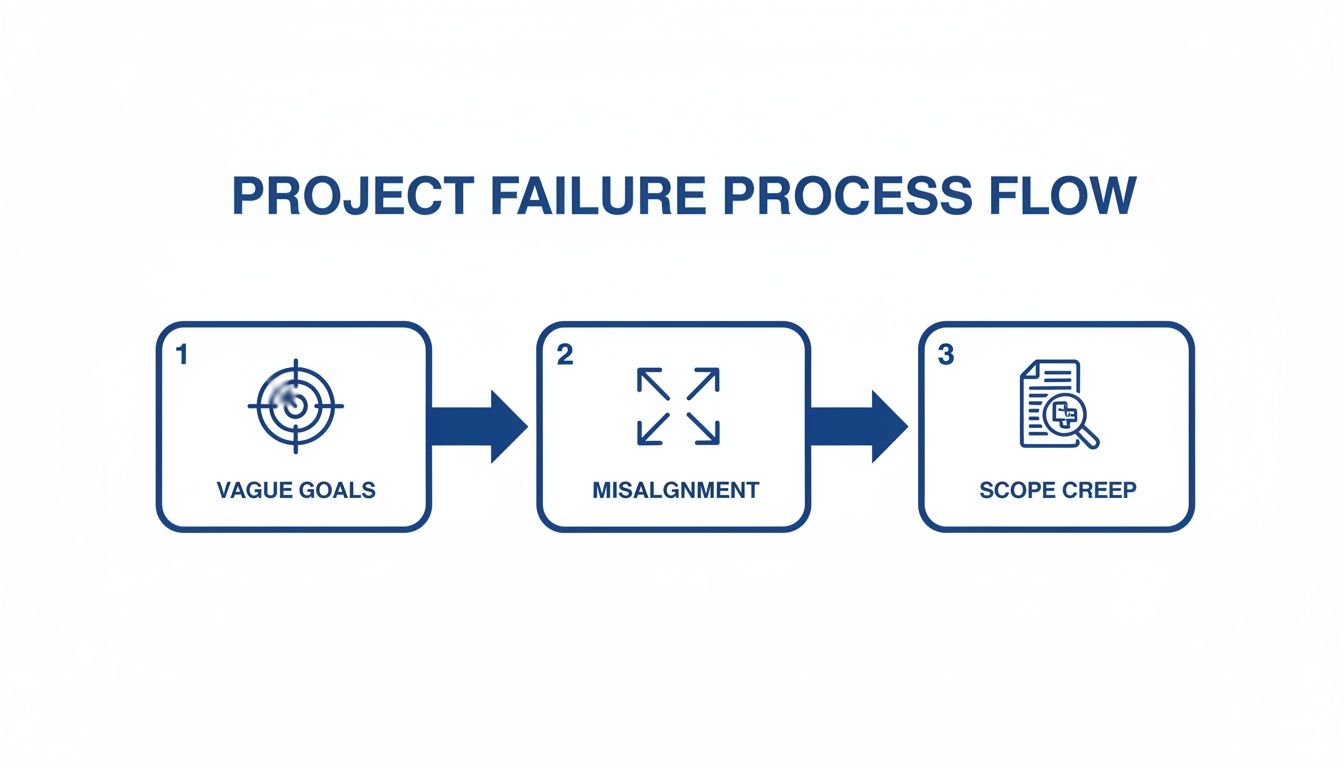
This isn't just a theory; it's the post-mortem of countless projects I've seen go off the rails. Vague goals directly cause misalignment, which makes it impossible to defend against the endless "hey, can we just add…" requests that are the hallmark of scope creep.
Forget those complicated prioritization matrices you saw in a textbook. In the real world of a fast-moving startup, prioritization is less about formulas and more about brutal, uncomfortable honesty. You can’t build everything. Your time is finite. Your resources are finite.
To force this clarity, you need to connect every potential feature back to a core business objective. A great way to lay this foundation is by using a SaaS business plan template. It forces you to justify every decision.
When your team is debating what to build next, ask these three questions and demand honest answers:
Anything that gets a "no" or a "maybe" goes straight to the "someday/maybe" list. This isn't a democracy; it's a triage unit for your roadmap.
Your backlog is not a wish list; it's a strategic weapon. Every item in it should be fighting for its life to prove its value. If it can't, it gets cut. No mercy.
Let's be real: most user stories are useless. They’re either so vague they’re meaningless ("As a user, I want a better dashboard…") or so prescriptive they kill any engineering creativity. A good user story is a conversation starter, not a contract.
A story that actually works has three parts:
The "why" is everything. It gives your engineers the context they need to make smart decisions without bugging you with a million questions. It’s the difference between building a feature and solving a problem.
Finally, you need a Definition of Done that isn't a punchline. This should be a simple, non-negotiable checklist that applies to every single user story before it can be considered complete.
This simple checklist eliminates the "it's done, but…" game that kills momentum. When something is done, it's actually done. No ambiguity, no excuses. This is how you build a flexible plan for success, not a rigid prison of endless change requests.
Your project plan, no matter how beautifully crafted, is just a fantasy document without the right people to bring it to life. But hiring is a full-time nightmare, right? You either spend a fortune on recruiters or become one yourself.
Hope you enjoy spending your afternoons fact-checking résumés and running technical interviews—because that’s now your full-time job.
Turns out there’s more than one way to hire elite developers without mortgaging your office ping-pong table. Modern team building isn't about finding local "rockstars"; it's about finding the right talent, wherever they are, and plugging them into your workflow seamlessly.

This is how you get vetted, time-zone-aligned talent in the door fast and get back to building what actually matters.
Let's kill this sacred cow right now. The debate over co-located versus remote teams is a relic of the pre-2020 era. For a US-based startup, going remote-first isn’t just a perk; it’s a massive competitive advantage.
Suddenly, you have access to a global talent pool, not just whoever lives within a 30-mile radius of your overpriced office.
But "global" is a big word, and time zones can be a productivity buzzsaw. Waking up to a wall of questions from a team 12 hours ahead is a special kind of hell. This is where most companies trip up. They hire great people in the wrong places, and the communication friction grinds everything to a halt.
I’m going to make an opinionated case here: tapping into the Latin American talent pool is the biggest cheat code for US startups today. You get time-zone alignment, exceptional technical skill, and significant cost savings. It’s a trifecta that’s almost impossible to beat.
This isn’t about outsourcing in the old-school sense. It’s about building an integrated, high-velocity team that just happens to be distributed. For a deeper dive, check out our guide on how to build a software development team that scales.
Stop writing job descriptions that read like a BINGO card of every trendy framework. You’re not just hiring a "Senior React Developer"; you're hiring someone to solve a specific business problem. Before you even think about hiring, you need to assess the skills that actually matter for your project.
Here’s a simple framework to cut through the noise:
Your goal is to build a team with a balanced portfolio of skills. You need the architect who can think three steps ahead, but you also need the pragmatic coder who can just get things done.
How you structure your team and its communication stack is just as important as who you hire. A brilliant team with a chaotic process will produce chaotic results.
Team Composition:
| Role | What They Really Do | The Red Flag to Watch For |
|---|---|---|
| The Tech Lead | Shields the team from noise, makes the tough architectural calls, and unblocks everyone else. | A lead who still wants to be the star coder. Their job is to elevate others, not to hog the best tickets. |
| The Product-Minded Engineer | Constantly asks "why" and pushes back on features that don't serve the user. | Someone who endlessly debates product decisions instead of committing and building. |
| The Specialist | The deep expert in a critical area (e.g., database performance, security, AI/ML). | A specialist who can't communicate their knowledge to the rest of the team in simple terms. |
| The Finisher | An engineer who loves taking a feature from 90% to 100%—squashing bugs and polishing the details. | A developer who only wants to work on new, "exciting" features and leaves a trail of technical debt. |
Your communication stack should be ruthlessly simple: Slack for quick chats, a project management tool (like Jira or Linear) as the single source of truth for work, and scheduled video calls for anything that needs real discussion. That’s it. Anything more is just noise.
Your tech stack and project management tools can either supercharge your team or drown them in administrative hell. Let's make sure it’s the former. This is a founder’s take on picking the right software—forget the endless feature-comparison spreadsheets; we’re focusing on what actually moves the needle.
Too many teams get paralyzed by choice. They spend weeks debating Jira vs. Asana vs. Monday vs. some trendy new app that promises to organize your life with AI-powered unicorns. Here's the secret: the "best" tool is the one your team will actually use without complaining. Pick one, get good at it, and move on.
The real win isn't the tool itself, but the discipline it creates.
If you’re still trying to run a software project on a shared spreadsheet and a prayer, you’re not being scrappy—you’re being reckless. Project management software isn't a luxury. It's the central nervous system of your project, the single source of truth that prevents the chaos of conflicting Slack threads and outdated email chains.
This isn’t just a feeling; the numbers are pretty stark. Companies with mature project management practices report that 66% of their projects finish within budget. For those without, that number plummets to a grim 47%. In a world where cash is king, that difference is everything.
In fact, mature PM practices can save 28 times more money than immature ones, a statistic that should make any founder's ears perk up. You can read more about these project management findings if you enjoy a good reality check.
My opinionated take on the tool stack:
Your tool stack should reduce friction, not create it. If a tool requires a certification course to use effectively, you’ve already lost. The goal is momentum, not bureaucracy.
Now, let's talk about the scariest spreadsheet of all: the budget. The first myth to bust is the idea of a 'perfect estimate'. It doesn’t exist. Your initial budget is your best-educated guess, and it will be wrong. The real goal isn’t perfect prediction; it’s building a financial plan that can absorb the shock of reality.
Instead of agonizing over precise numbers for a project six months out, focus on what you know right now.
The Per-Sprint Budget Model
This is my go-to for early-stage projects where the scope is still settling. Instead of trying to budget the whole monolith, you budget in short, fixed cycles.
This approach transforms the budget from a single, terrifying number into a manageable, burn-rate conversation. It forces you to constantly evaluate if the work planned for the next sprint is actually worth that $30,000 price tag. It grounds your software project planning in financial reality, one sprint at a time.
Let's be honest: most risk management plans are useless. They're corporate theater—a document created to make a VP happy, then promptly buried in a shared drive, never to be seen again.
We're not doing that.
A real risk plan is a living, breathing guide for navigating the chaos that will inevitably hit your project. This isn’t about being paranoid; it’s about being prepared. It's the difference between a minor course correction and a full-blown, budget-incinerating panic.
Before you can fight the monsters, you have to name them. Forget generic corporate-speak. Get specific. Get uncomfortable. Your project isn't going to be derailed by "shifting market dynamics"; it's going to get kneecapped by something tangible you could have seen coming.
Here are the usual suspects I’ve seen kill more projects than I can count:
Once you have your list of potential disasters, don't just stare at it in horror. Run each one through this brutally simple framework. No fancy spreadsheets required.
Don't over-engineer this. The goal isn't a 50-page document nobody reads. It's a handful of concrete actions, like "Cross-train Mark on the billing module" or "Dedicate 10% of next sprint to paying down tech debt in the checkout flow."
For a more structured approach, you can learn about creating a formal plan for software project risk management in our dedicated guide.
Now for the biggest, scariest monster of all: money. Or, more accurately, the lack of it when things go sideways.
Budget overruns and delays are the twin horsemen of the software apocalypse. A stunning 55% of managers cite budget issues as a top reason for failure. Even worse, 1 in 6 IT projects can swell to a terrifying 200% over their initial cost. For businesses, this translates to about $109 million wasted for every $1 billion invested due to poor management.
These are the kinds of numbers that get people fired.
So, how do you defend against this? You build in financial buffers. This isn’t about padding your estimates; it’s about creating a strategic contingency fund.
A 15-25% buffer on your total project budget isn't pessimism; it's professional realism. This fund is your get-out-of-jail-free card for when a risk you identified—or one you didn't—comes to pass. It gives you the breathing room to solve the problem without having to go, cap in hand, to your CFO. Because the mess is always coming. You might as well plan for it.
We’ve walked through the whole playbook, from dodging early landmines to building your dream team and locking down the budget. But let's be honest, every software project kicks up more questions than a five-year-old at the zoo.
I get it. I've been there. So, here are the real-world answers to the questions I hear most often from founders and engineering leaders. This is straight-from-the-trenches advice, not textbook theory.
Just detailed enough to start, but flexible enough to survive first contact with reality. Your initial plan isn't the place for a 100-page novel mapping out every user story for the next year. You'd just be writing fiction.
Instead, the plan has to nail the "what"—the core, hair-on-fire problem you're solving—and the "why"—the tangible business value this thing delivers. Focus on a high-level scope, the key milestones for the first couple of months, and a problem statement so clear that everyone can recite it in their sleep.
Get ruthless about defining the absolute, non-negotiable, must-have features for your MVP. Then, with all the enthusiasm of a tax auditor, push every single "nice-to-have" idea to a list bluntly labeled "Later."
The whole point of an initial plan is to create alignment and a clear direction, not to predict the future with pinpoint accuracy. A plan that’s too rigid will shatter the first time a stakeholder has a "brilliant new idea" or an engineer discovers your legacy code is held together with digital duct tape.
You handle them with a process, not a panic attack. Stop letting "quick chats" and drive-by Slack DMs dictate your roadmap. The second you let that happen, you’re no longer a project leader; you’re a short-order cook with a keyboard.
The rule is simple: all requests, no matter how small, go into the backlog. No exceptions. A verbal request is just a wish until it’s written down where everyone can see it.
Then, during your regular planning cycles (sprint planning, quarterly reviews, whatever your cadence is), you evaluate these new requests against your current priorities. This is where the magic happens, because you always, always communicate the trade-off.
Try a friendly but firm, "Great idea! We can absolutely build that. To get it into the next sprint, we'll need to de-prioritize Feature X. Are we all aligned on that?" This simple question is your greatest weapon. It forces stakeholders to understand that every "yes" to something new is a "no" to something else. It turns a demand into a strategic conversation.
Simple: stop treating QA as the last car on the train. Quality Assurance isn't a gate your code has to pass through at the very end; it's a mindset that needs to be baked into your process from day one. If you’re waiting until the end of a two-week sprint to start testing, you’ve already failed.
Here’s how you integrate quality without creating a bottleneck:
This approach catches bugs sooner, when they’re 10x cheaper to fix. It prevents QA from becoming that dreaded bottleneck and transforms them into a strategic partner who helps you ship high-quality software, fast. It’s a critical part of planning that too many teams ignore until it's way too late.
Feeling like your project plan needs more than just a good FAQ section? If you're struggling to find the elite engineering talent to bring that plan to life, CloudDevs can help. We connect you with pre-vetted, time-zone-aligned developers from Latin America in just 24 hours, so you can stop recruiting and start building. Find your next A-player at https://clouddevs.com.

Transform your hiring with a better developer skills assessment. Learn to design tests that predict real-world performance and attract top technical talent.


Learn expert tips on how to outsource your development team effectively. Our guide covers best practices for managing and vetting your outsource development team.

Discover key offshore software development benefits that can boost your business efficiency and decision-making. Learn more today!