Programmer vs Software Engineer: Who Should You Hire?

Victor
Posted on 9 April 2026



You got a quote for a senior hire, stared at the number, and briefly considered learning to code yourself.
I’ve been there. Most founders and hiring managers hit this wall at the same point. The product is growing, the backlog is ugly, customers want features yesterday, and the local hiring market starts throwing around compensation packages that feel better suited to pro athletes than backend people who argue about tabs versus spaces.
That’s when the programmer vs software engineer debate stops being internet trivia.
It becomes a budget decision. A delivery decision. A “will this codebase help us or mug us in six months?” decision.
A lot of teams mess this up because they hire for the task in front of them, not the system they’re creating. They say they need “a developer” when what they need is architectural judgment. Or they pay for engineering talent when all they need is a competent pair of hands to crank through a narrow ticket list.
Those are two different hires. Treating them as interchangeable is how you burn money twice.
Table of Contents
The usual story goes like this.
You need to ship a product update. Maybe it’s a customer portal, a billing workflow, or an internal tool that your ops team has been duct-taping together in Airtable, Slack, and prayer. You ask around, post a role, and the first few candidate expectations land in your inbox like a tax audit.
Suddenly the question becomes, “Do I really need a software engineer, or can I just hire a programmer?”
Good. That’s the right question.
Bad news though. Teams often ask it too late, after they’ve already written a vague job description, interviewed a bunch of nice people with GitHub accounts, and confused fluent coding with engineering judgment.
If your business only needs someone to implement a clearly defined task inside an existing system, hiring a programmer can be perfectly sensible. You’re buying speed on a bounded problem.
If your business needs someone to make system decisions, prevent future rework, and keep your product from turning into a haunted house of fragile integrations, you need an engineer.
That difference affects everything:
Rule of thumb: If this hire will influence how your product behaves six months from now, stop thinking in tickets and start thinking in systems.
Founders love the “just get it built” phase. It feels fast. It feels scrappy. It also creates some cursed codebases.
I’ve hired both types. The strongest programmers make visible progress quickly. They close tickets. They fix bugs. They ship the thing you asked for.
Strong engineers do something less flashy at first. They ask annoying questions. They push back on fuzzy requirements. They care about data models, failure modes, test coverage, deployment paths, and what happens when your happy little product suddenly has real users doing rude things at scale.
That second person usually saves you more money.
Not because titles are magical. Because the wrong hire creates technical debt with interest.
The cleanest way to understand programmer vs software engineer is this.
A programmer builds the thing you asked for.
A software engineer figures out what the thing sits on, what it connects to, what breaks under load, and what future changes will cost.

A good programmer is not “less than.” Let’s kill that nonsense.
A programmer can be highly skilled, fast, and valuable. Give them a clear blueprint and they’ll often execute with impressive efficiency. They live close to the code. They know the framework quirks. They can move from bug to feature to cleanup without needing a committee meeting and a systems diagram.
That makes them great for contained work.
But the mindset is usually task-first. The main question is, “How do I implement this?”
That works fine when the architecture already exists and someone else has done the heavy thinking.
A software engineer starts one level up. Sometimes three.
They ask:
Engineering principles apply here. According to Transparent, software engineers apply systematic principles like OOP and SOLID to build systems that scale, which can reduce deployment failures by up to 40% in complex projects.
That’s not a tiny distinction. That’s the difference between “we shipped” and “we shipped something stable.”
A programmer often sees a feature.
An engineer sees a chain reaction.
Say you want real-time notifications in your app. A programmer may focus on getting the event trigger and UI update working. An engineer will ask about queueing, retries, database writes, user preferences, delivery guarantees, observability, and what happens when notifications spike.
Both people can write code.
Only one is consistently thinking about system behavior over time.
Hiring tip: If a candidate talks only about implementation and never about trade-offs, maintenance, or failure modes, you’re probably talking to a programmer, not an engineer.
That’s not always a problem. It becomes a problem when you hand them a product with ambition.
Let’s put this on one page so nobody has to decode resume theater.
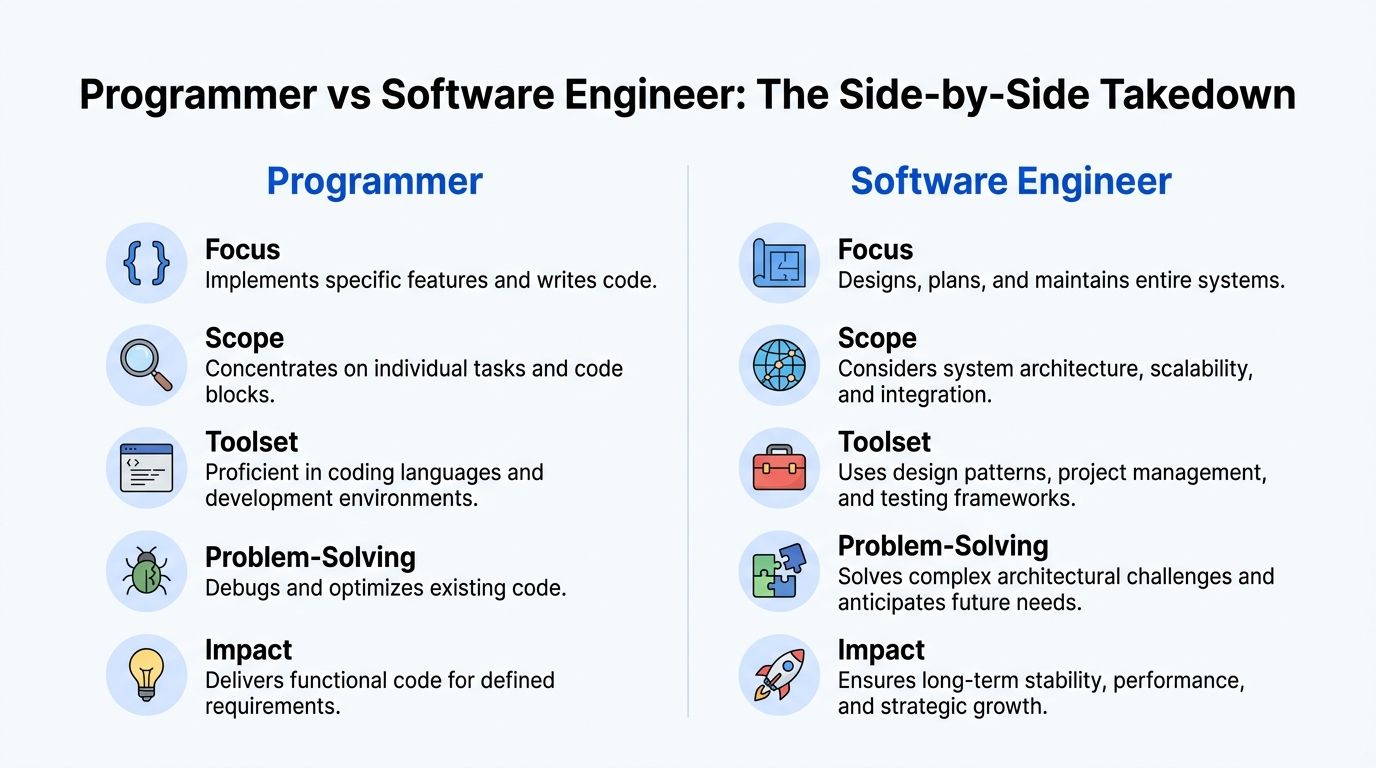
| Criterion | Programmer | Software Engineer |
|---|---|---|
| Primary focus | Implements specific features and writes code | Designs, builds, and maintains whole systems |
| Scope | Individual tasks, modules, bug fixes | Full lifecycle, architecture, integration, maintainability |
| Typical mindset | “How do I code this?” | “How should this system behave and evolve?” |
| Strength | Fast execution inside defined boundaries | Long-term reliability, scalability, and technical direction |
| Best fit | Narrow, well-scoped work | Core product, scaling systems, messy real-world complexity |
| Team role | Executes within a blueprint | Helps create the blueprint |
| Hiring risk | Can create future rework if used beyond scope | Costs more, but usually prevents expensive mistakes |
This is the biggest practical difference.
A programmer usually operates inside a system that already exists. They implement features, fix defects, write scripts, and improve code that someone else has structurally framed.
A software engineer owns much more of the software lifecycle. Indeed describes engineers as working across conception, design, development, deployment, and maintenance, while programmers focus more heavily on coding implementation. That broader ownership is also why Indeed reports software engineers in the US average $93,965 annually versus $69,277 for programmers, a 36% premium.
That premium is the market saying, “We’re paying for judgment, not just output.”
A lot of resumes flatten this difference because both roles list the same languages. Python. JavaScript. Java. Fine. Cute. That tells you almost nothing. This tells you almost nothing. Separation shows up in depth.
Programmers often know how to use frameworks, libraries, and development environments effectively. Engineers also need that, but they go further into architecture, algorithms, system design, testing strategy, data structures, and operational trade-offs.
If you want a useful refresher on the skills required for a software engineer, that breakdown is worth reading because it moves past “knows React” and into the stuff that affects production systems.
Programmers often work from requirements.
Engineers often help shape them.
That distinction matters when your product team is still figuring things out. Engineers tend to work across product, QA, DevOps, and design with enough context to challenge bad assumptions early. They’re not just waiting for tickets to appear in Linear or Jira like vending machine snacks.
If you’re hiring across experience bands, this guide to engineering levels is useful because title inflation is out of control and “senior” means wildly different things from one candidate to the next.
This area gets messy, and frankly, title worship makes it worse.
Many excellent programmers come from nontraditional paths. Bootcamps, self-teaching, internal transfers, years of shipping. That can work very well for execution-focused roles.
Engineers more often have formal training or have developed a strong systems mindset through experience. The title alone does not guarantee this. Plenty of people put “Software Engineer” on LinkedIn because it sounds better on an invoice.
So don’t hire the label. Hire the reasoning.
The “programmer vs software engineer” debate turns painfully real for CFOs.
The pay gap exists for a reason. You are not buying the same thing.
A programmer may be the cheaper hire upfront. If the work is tightly scoped and disposable, that’s smart. If the work becomes foundational, that cheaper hire can get very expensive later.
The engineer premium buys:
The wrong way to read salary data is, “Engineers are overpriced.”
The right way is, “The market charges more for people who reduce expensive downstream mistakes.”
Programmers often deepen around implementation. They can become strong specialists, trusted individual contributors, and highly effective delivery people.
Engineers usually grow toward architecture, platform thinking, leadership, reliability, and cross-functional technical ownership.
That doesn’t mean one path is noble and the other is not. It means the business value differs.
If the role touches your core product, data model, infrastructure choices, or future scaling path, hire for engineering capability.
If the role is narrow, supervised, and structurally constrained, a programmer can be the smarter buy.
Simple. Not easy, but simple.
Key takeaway: Titles overlap. Responsibilities do not. Write the job around ownership, complexity, and business risk, not around whatever title looked popular on LinkedIn that week.
There are absolutely times when hiring a programmer is the right move.
I do not believe every problem deserves a systems architect armed with opinions about distributed event flows and an allergy to shortcuts. Sometimes you just need someone to write the thing, test the thing, and stop the thing from catching fire.
A programmer is often the right hire when the work is bounded and the consequences of imperfect architecture are low.
That includes situations like:
In these cases, speed matters more than strategic system design.
They usually are, at least on isolated work.
As noted earlier in the piece, programmers tend to move quickly when the task is defined and the boundaries are clear. That is exactly why teams love them during sprint crunches.
The danger starts when leadership mistakes sprint velocity for product health.
You can absolutely get a feature built quickly and still make your future team miserable.
Qualitatively, the trap is straightforward. Fast code that ignores maintainability often creates refactoring pain, brittle dependencies, and weird edge cases that spread through the rest of the product.
The original build looks cheap. The cleanup is not.
Practical test: Ask yourself whether this work should still matter in a year. If the answer is no, hire a programmer. If the answer is yes, be careful.
Use a programmer when most of these are true:
Do not use a programmer as your first foundational technical hire unless you enjoy funding your own rewrite.
The most common failure is not hiring a programmer.
It’s hiring a programmer for an engineer’s job.
Founders do this when they need “someone technical” and don’t yet know how much system judgment the role requires. They hire the person who closes tickets fast, then six months later discover nobody really owns the architecture, the integrations are brittle, deployments are stressful, and every new feature feels like moving a couch through a submarine.
That is not the programmer’s fault. That is a hiring mistake.
If you’re building a real product, not a throwaway internal utility, you usually need an engineer.
Not because the title sounds fancy. Because startups live or die on compound decisions.
Early product decisions leak into everything.
Your database structure affects reporting. Your auth decisions affect enterprise deals. Your API shape affects mobile work. Your test strategy affects release speed. Your deployment setup affects customer trust the first time traffic spikes or a release goes sideways.
A programmer can absolutely build features in that environment.
An engineer is more likely to make those decisions in a way that does not punish you later.
Founders often say they want to “move fast.” Fair enough.
But real speed is not just shipping version one. Real speed is shipping version seven without dragging a dumpster of old assumptions behind you.
That takes engineering judgment.
The engineer asks unglamorous but profitable questions:
Those questions protect future velocity.
A startup’s codebase is not a college assignment. It has to survive handoffs, pivots, incidents, customer edge cases, and product changes driven by actual revenue pressure.
When your system gets touched by support, product, sales promises, compliance concerns, and customer deadlines, “it works on my machine” stops being charming.
This is why I push startups toward engineers, especially for core product roles. You want people who can hold the whole shape of the system in their head and make decisions that age well.
Engineering discipline helps you:
That last one matters most.
Startups pivot. Pricing changes. Integrations appear. New user types show up. If your technical foundation was built only for today’s ticket list, each change gets slower and more expensive.
CTO view: The best early engineer is not the fastest coder in the room. It’s the person who keeps your next ten product decisions from becoming technical debt.
Can a programmer grow into that role? Absolutely.
But if your company is already betting on software as the business, don’t hire as if software were just a side task.
Everybody’s a software engineer on LinkedIn now.
That title has been stretched so far it could wrap a server rack.
So you need a hiring process that exposes how a person thinks, not just what words they used on their resume.

If your interview process revolves around algorithm trivia and whiteboard theater, you’ll get polished performers and a lot of false confidence.
Real engineering ability shows up in trade-offs, system thinking, and decision quality.
Ask open-ended questions like:
Programmers often answer at the implementation layer. Engineers usually widen the frame and talk through constraints, scaling behavior, operational concerns, and downstream effects.
You’re not hunting for buzzwords. You’re listening for evidence that the candidate understands software as a living system.
Good signs include discussion of:
According to Terminal.io, strong software engineers show deeper proficiency in data structures, algorithms, and design patterns, which can reduce bug rates by up to 35% and improve system efficiency by 30-50% compared with ad-hoc coding.
That doesn’t mean every engineer should sound like a textbook. It means they should reason beyond the line of code in front of them.
A few patterns show up over and over.
A programmer can still be excellent with some of those traits. The question is whether you are hiring for execution or engineering judgment.
Use a layered process instead of one giant gotcha session.
That sequence reveals a lot more than “reverse this binary tree” nonsense.
Interview shortcut: Ask, “What would break first?” Engineers usually have an answer fast. Programmers often need to be pulled toward that way of thinking.
A polished repo can help, but don’t over-romanticize side projects. Plenty of excellent engineers have private work and boring public profiles.
What matters is whether they can explain structure.
If they show a project, ask why they chose that architecture, where they cut corners, and what they would change if the software needed to support a much larger user base. Their answer tells you far more than the repo’s star count.
Once you decide you need engineering talent, the next punch to the face is cost.
US compensation for strong engineers is no joke. You can absolutely pay it. Plenty of companies should. But many startups and growing teams do not need to confine their search to the most expensive hiring market on the planet.
That’s where global hiring stops being a buzzword and starts being basic financial literacy.

The strongest argument for hiring in Latin America is not “cheap labor.” I hate that framing.
A better argument exists. You can hire strong engineers in overlapping time zones, work in real-time with your US team, and avoid a lot of the communication drag that shows up when collaboration windows barely overlap.
That matters more than people admit.
And the cost difference is meaningful. As noted by Phoenix, companies can save 50-70% by hiring similarly skilled talent from LATAM, and US startups have driven 40% YoY growth in remote hires in the region.
That is not a niche trend. It is a pretty rational response to expensive domestic hiring.
Do not optimize for lowest hourly rate. That road is full of regret.
Optimize for this mix:
If you get those right, global hiring becomes easier than a lot of local hiring.
A vetted LATAM engineer often gives you something founders desperately need. Better economics without dropping quality standards.
That changes how you build teams.
Instead of forcing one overloaded “full-stack wizard” to own everything, you can structure a healthier bench. Maybe you hire an engineer for backend architecture and another for frontend execution. Maybe you add QA support earlier. Maybe you stop pretending your PM should also be your release manager.
The point is not just savings. The point is room to build sanely.
Some teams still approach remote hiring like it’s a gamble. Usually that’s because they’ve hired badly before, with weak screening and no process discipline.
The fix is not to avoid global talent. The fix is to use a process that checks technical depth, communication, and real-world delivery judgment before a candidate ever reaches your calendar.
If you’re exploring this route, start with a partner that already understands how to hire LATAM developers without dumping sourcing, vetting, and compliance headaches back onto your internal team.
That’s the move. Raise the talent bar. Broaden the map. Stop paying local-market premiums for every single engineering need if the work can be done just as well with a strong remote team in your time zone.
If you need engineering talent without dragging your team through weeks of sourcing, screening, and compliance paperwork, CloudDevs is worth a serious look. They match US companies with pre-vetted Latin American engineers and designers in 24 to 48 hours, help companies reduce costs significantly, and handle the messy parts like payroll, taxes, and local compliance. It’s a practical way to hire real engineering talent faster, without turning your hiring process into a second full-time job.

What is technical debt? It's the silent killer of startup momentum. Learn what it is, how you got it, and the real-world plan to manage it before it's too late.


Let's cut to the chase. You have a killer product vision, but your budget doesn't quite match the six-figure salaries of senior developers in your city. You’ve heard about offshore software development services, and maybe some of the horror stories that come with them. But here’s the secret: when done right, this isn't about finding...

Learn how to build a product roadmap with this practical guide. Discover expert tips to create a roadmap that aligns teams and drives success.