Mastering Software Engineer Career Paths: 2026 Insights

Victor
Posted on 8 May 2026




Most advice about software engineer career paths is stale on arrival. It treats the profession like a polite corporate staircase where everyone starts at the bottom, climbs neatly upward, and eventually becomes either a manager or some mythical “10x engineer” who lives on cold brew and Kafka clusters.
That's nonsense.
Real careers in software are messy. People move from backend to data. From mobile to product. From coding to management, then back again because they miss building things. Teams hire globally, tools change under your feet, and whole categories of work appear out of nowhere. If you're still thinking in terms of a tidy ladder, you're using the wrong map.
The better question is simple. What kind of problems do you want to solve, and in what environment do you want to solve them?
Table of Contents
The ladder metaphor survives because HR loves clean charts. Engineers should know better.
The market doesn't behave like a ladder. According to Coursera's overview of software engineer career paths, the field is projected by the BLS to grow 15% from 2024 to 2034, with over 129,200 job openings each year. That kind of demand creates sprawl, not order. People branch into product management, data science, and specialized work like AI/ML because the industry keeps creating new corners to occupy.

Many engineers make the same mistake. They chase the next title before they have decided what kind of work they want. That is how you end up as a miserable manager who misses coding, or a senior IC who secretly hates architecture reviews and just wants to ship product.
A healthier way to think about software engineer career paths:
That last one matters more than most career guides admit. The global market has changed the shape of ambition. Engineers aren't limited to local companies anymore, and hiring managers aren't limited to local talent anymore either.
Practical rule: Optimize for scope, skill density, and leverage. Titles come later.
A few years ago, “AI orchestration” wasn't on many career maps. Now it's a real path. The same thing has happened before with DevOps, cloud, AppSec, and mobile. It'll happen again.
That's why I like the jungle gym metaphor. You can climb, swing, pause, and change direction without pretending you failed. Sometimes the smartest move is not “up.” Sometimes it's toward a better problem set.
If you're trying to make sense of how AI agents fit into the craft itself, I'd also suggest exploring Devin for software development. Not because every shiny tool deserves worship. Most don't. But because understanding where tooling is going helps you avoid building a career around work that's becoming commodity labor.
Every engineer who sticks around long enough hits the fork. Stay on the individual contributor track, or move into management.
At this point, a lot of companies start lying to people.
They present management as “the next step.” It isn't. It's a different job. If you move into management because you think it's the only way to grow, you're volunteering for a career you may not even like.
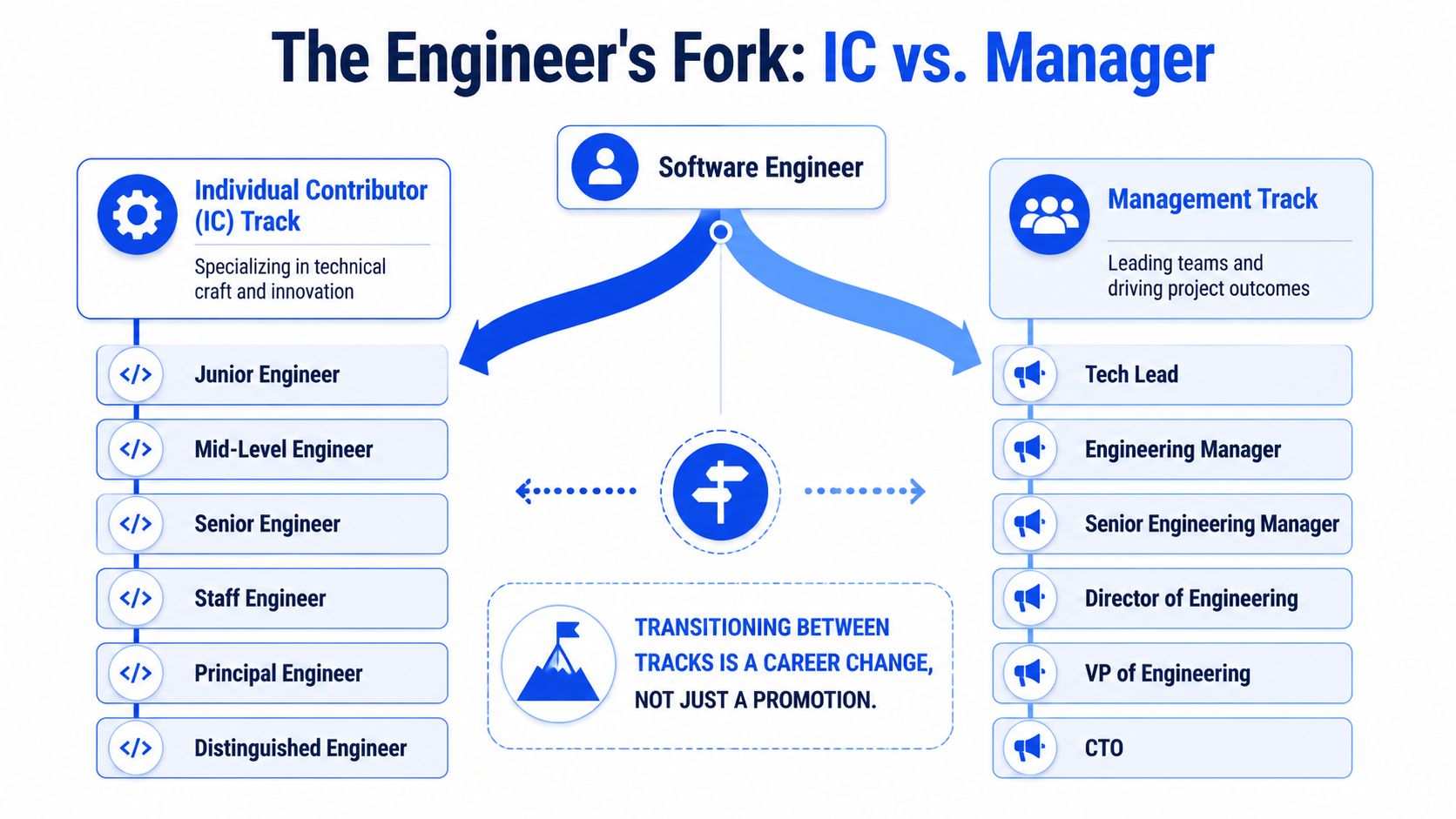
The IC track rewards engineers who can solve nastier problems with broader impact. Not just “writes clean code.” Lots of people write clean code. The bar gets much higher as you move from senior to staff to principal.
Per The Pragmatic Engineer's breakdown of career paths at larger tech firms, getting to principal means demonstrating 10x impact. That can mean architecting systems for 100M+ daily users or redesigning systems to cut latency by more than 50%. That's not a “good programmer” job. That's a systems judgment job.
Here's the blunt version. Junior and mid-level engineers usually own components. Senior engineers own systems. Principal engineers own consequences.
Managers don't get paid to be the best coder in the room. They get paid to build an environment where ten other people can do great work without chaos, drift, or endless Slack melodrama.
A good engineering manager spends time on hiring, performance, planning, conflict resolution, stakeholder wrangling, and protecting the team from nonsense. If that sounds thrilling to you, great. If it sounds like death by calendar invite, don't do it.
You're not picking status. You're picking which hard problems you want to wake up to.
Here's the comparison I give senior engineers when they ask me for advice.
| Track | What you actually do | What breaks your day | What gets you promoted |
|---|---|---|---|
| IC | Architect systems, drive technical direction, mentor through design and execution | Ambiguity, legacy systems, scaling failures, technical debt | Technical judgment, cross-team influence, durable outcomes |
| Manager | Build teams, allocate work, hire, coach, align engineering with business needs | Underperformance, politics, vague priorities, misalignment | Team health, delivery quality, retention, organizational trust |
If you want a clearer picture of how companies usually define progression, engineering levels explained is a useful reference point. Just don't confuse level charts with destiny. They're approximations, not commandments.
“Software engineer” is too broad to be useful. It's like saying “I work in medicine.” Great. Are you a surgeon or a radiologist?
Your specialization determines what your days feel like, what tools you live in, and which kinds of frustration you'll tolerate. Choose badly and you'll be competent but bored. Choose well and you'll build compounding advantage.
Backend is where products become systems. You'll spend time in APIs, databases, queues, auth, caching, and the unpleasant reality that users keep showing up even when your schema wasn't ready for them.
Core tools usually include Python, Java, Node.js, PostgreSQL, Redis, and some cloud stack. This path suits people who like logic, performance, and invisible work that matters a lot.
If you enjoy solving “why did this break under load?” more than “why is this button misaligned?”, backend is your playground.
Frontend looks glamorous until you've debugged state management, browser inconsistencies, and a design system with seventeen exceptions no one documented.
You'll likely live in JavaScript, TypeScript, React, Vue, CSS, and browser dev tools. This is a good fit if you care about user experience, visual feedback, and fast iteration. It also helps if you can tolerate strong opinions from design, product, and your own past self.
Mobile engineers deal with product intimacy and platform pain. Users notice everything. So do app stores.
Typical stacks include Swift, Kotlin, React Native, and Flutter. This path rewards engineers who are product-minded, detail-heavy, and willing to care about device behavior, offline use, sensors, and release discipline.
This is the “keep the machine alive” corner of the profession. You'll automate environments, improve deployment safety, tighten feedback loops, and get very familiar with infrastructure that everyone ignores until it catches fire.
Common tools include Docker, Kubernetes, Terraform, GitHub Actions, ArgoCD, and cloud services. If you like systems thinking and hate fragile delivery processes, this is excellent work.
Data and ML roles range from practical pipeline engineering to model development and deployment. Plenty of people romanticize this path. A lot of the actual job is still wrangling ugly data and making systems reliable.
You'll probably touch Python, SQL, Spark, Kafka, TensorFlow, or PyTorch, depending on the role. This suits engineers who like experimentation, ambiguity, and analytical work more than pixel-perfect shipping.
Security specialists are paid to distrust everything. Healthy paranoia helps.
Application security and security engineering reward people who like threat models, controls, abuse cases, and reducing blast radius. You'll work across code, infrastructure, identity, and policy. If you enjoy asking “how could this fail or be exploited?” all day, welcome home.
One of the more interesting shifts in software engineer career paths is the rise of hybrid AI work. Not everyone will become an ML researcher, and frankly most companies don't need one. They need engineers who can connect products, workflows, models, and human review.
According to this discussion of non-traditional paths for software engineers, demand for skills tied to AI orchestration and human-in-the-loop work like SFT, RLHF, and DPO is up 150%, and engineers moving into these roles can earn salary premiums of 25% over pure coding roles. That's a strong signal. Not because every engineer should pivot, but because the boundary between software and AI operations is getting blurry fast.
If you can combine software fundamentals with workflow design, data judgment, and AI tooling, you become hard to replace.
| Specialization | Core Tools | Best For You If… | Typical US Salary Premium |
|---|---|---|---|
| Backend | Python, Java, Node.js, PostgreSQL, Redis | You like data flow, APIs, and system reliability | No fixed premium cited |
| Frontend | JavaScript, TypeScript, React, Vue, CSS | You care about user experience and fast visual feedback | No fixed premium cited |
| Mobile | Swift, Kotlin, React Native, Flutter | You enjoy product polish and platform-specific constraints | No fixed premium cited |
| DevOps/SRE | Docker, Kubernetes, Terraform, GitHub Actions | You want to improve deployment, infrastructure, and uptime | No fixed premium cited |
| Data/ML | Python, SQL, Spark, TensorFlow, PyTorch | You like analytical work and messy data problems | No fixed premium cited |
| Security | OWASP tooling, IAM platforms, CI/CD security checks | You think in risks, controls, and failure modes | No fixed premium cited |
| AI orchestration and HITL | SFT, RLHF, DPO workflows, evaluation tooling | You want a hybrid path between software and applied AI operations | 25% premium cited in the source above |
Let's talk compensation without the usual LinkedIn cosplay.
In the US, software engineering still pays well because competent engineers remain expensive and hard to replace. According to General Assembly's 2026 salary guide, engineers with 1 to 3 years of experience earn $86,000 to $141,000, while engineers with 15+ years can earn more than $118,000 to $204,000+. That spread tells you two things. First, experience still compounds. Second, companies pay heavily for judgment, not just keyboard output.

A lot of early-career engineers fixate on base salary because it's the easiest number to compare. Fair enough. But once you get into larger startups and established tech companies, compensation often becomes a stack:
My opinion is simple. If you're evaluating an offer, don't get hypnotized by paper upside. A decent base in a solid environment usually beats fantasy equity in a confused company with a ping-pong table and no roadmap.
This is the elephant in the room. Those US salary bands are one reason so many companies are rethinking where they hire. If your budget has to cover several senior engineers, US-only hiring can turn into a finance problem before it becomes a staffing problem.
Good compensation data is useful for two audiences. Engineers use it to negotiate. Hiring managers use it to confront reality.
If you're an engineer, know your band and negotiate from evidence, not vibes. If you're a hiring manager, know what US-market salaries imply for headcount planning. Otherwise you'll spend months approving reqs you can't fill or offers you can't afford.
Most hiring managers say they can't find enough strong engineers. A lot of them really mean they can't find enough strong engineers in one country, on one budget, under one outdated hiring model.
That's a self-inflicted wound.

The smartest US teams I know don't treat Latin American talent as a discount rack. They treat it as a strategic hiring lane.
According to RedShift Recruiting's discussion of niche software engineering paths, over 20% of US remote developer hires come from Latin America. The same source notes that US companies can save 40% to 60% on salaries by hiring vetted LATAM engineers, with typical compensation of $40K to $70K compared to the $120K+ US average.
That should get the attention of any CFO, but the cost angle is only half the story.
Nearshore teams in Latin America often give US companies what offshore experiments often failed to deliver. Time zone overlap. Strong English. Familiar product instincts. Better day-to-day collaboration. Fewer 2 a.m. standups no sane person wants.
For engineers in LATAM, this creates a real career path too. Not a side hustle. Not “freelancing until something better comes along.” A serious route into international teams, higher-quality projects, and broader technical exposure without visa roulette.
A few blunt truths:
Good remote hiring is not bargain hunting. It's operational discipline.
For engineers, especially outside the US, the global market changes the old career logic. You no longer have to wait for a local company to provide senior-level problems. You can target companies that already operate at that level. That changes what skills are worth building, how you present your portfolio, and how aggressively you invest in written communication.
For hiring managers, ignoring LATAM isn't prudence. It's a strategic blind spot.
Advice is cheap. Career moves are not. If you're going to change direction, do it deliberately.
This transition fails when people assume “good engineer” automatically means “good manager.” It doesn't.
Start doing the work before you get the title:
For a grounded view of what that looks like in practice, technical leadership fundamentals is worth reviewing.
Yes. But stop expecting your old title to do the work for you.
A senior backend engineer moving into data engineering brings over useful strengths: debugging, APIs, system design, and delivery discipline. That still does not buy instant credibility in the new domain. You keep your engineering maturity. You repay a short relevance tax while you learn the data stack, the failure modes, and the business context.
No. Forced management tracks create mediocre managers and waste strong builders.
If your best work comes from solving hard technical problems, stay on the IC path. Then raise your value through system design, decision-making, technical leadership, and bigger scope. Titles matter less than whether you make the team faster and the product better.
Early in your career, yes. Later, far less.
A degree can still help get your foot in the door, especially with larger companies and rigid hiring filters. After that, evidence wins. Shipped systems, good judgment, clean communication, and strong references beat pedigree. Hiring managers should treat degrees as one signal, not a proxy for capability. That matters even more when evaluating LATAM engineers, where strong talent often gets screened out by lazy credential bias instead of being judged on output.
You're ready when people trust you with unclear problems, cross-team coordination, and consequences.
Senior engineers do more than implement tickets. They define the approach, surface trade-offs, ask better questions, ship reliably, and deal with the operational mess after launch. If that already sounds like your week, the title is behind the work.
Worry about becoming interchangeable.
The safest engineers combine coding with judgment, product sense, communication, and the ability to work through messy systems with other humans. Tools will keep shrinking the value of commodity implementation. Engineers who can frame problems, make trade-offs, and drive outcomes will keep getting paid. Hiring managers should adjust for that now. If you are building teams in the US, pairing senior local leadership with strong LATAM execution is not a budget trick. It is a speed and coverage advantage.
Ask for proof of ownership. Ask how they write. Ask how they handled incidents, ambiguity, and disagreement. Then shut up and listen for specifics.
Remote hiring fails when managers obsess over syntax trivia and ignore communication quality. If you want a useful framing device for how automated hiring systems and recruiting workflows are evolving, AI recruiting system FAQs is a decent place to pressure-test your assumptions. Software should not replace judgment. Better process usually beats louder interviews.
They wait for permission.
Engineers wait for someone to bless the next move. Hiring managers wait for a perfect candidate who checks every box. Both choices waste time and create weaker teams. Careers move faster when engineers start doing the next level of work before they get the title, and when managers hire for business problems instead of fantasy resumes.
If you need to scale engineering without paying US-market premiums for every seat, CloudDevs is worth a look. It gives startups and engineering leaders access to pre-vetted LATAM developers and designers for full-time, freelance, and team-based hiring, with fast matching and timezone alignment that won't wreck your operating rhythm.

Let's get straight to the point. You've heard that hiring in Mexico is the secret weapon for scaling your tech team without torching your runway. You're not wrong, but if you're thinking this is just about "cheap labor," you're making a rookie mistake that almost always ends in bad hires and buggy code. Turns out...

Learn what is Jenkins used for and how it automates builds, improves efficiency, and powers modern CI/CD pipelines. Discover its main uses today!


Let’s be honest. Most articles on the biggest trends in cloud computing are just a laundry list of buzzwords your IT department already knows. We’re here to talk about the stuff that actually matters—the shifts that determine whether you scale or get stuck footing a five-figure cloud bill for a glorified test server. We’re talking...