The Time Zone Advantage: Why South America Is Your Secret Weapon for Hiring Developers

Victor
Posted on 25 February 2026




When you're hiring remote talent, the time difference in South America is your biggest advantage—and frankly, anyone telling you otherwise is trying to sell you on a broken offshore model. Major tech hubs like São Paulo and Buenos Aires are just one to three hours ahead of US Eastern Time. This isn't a small detail; it's the thing that kills the 3 AM stand-up nightmare and makes real-time collaboration actually real.
Forget the 12-hour gaps that cripple offshore teams. This is nearshoring, and it just works.
Table of Contents
Let's get straight to the point. You're trying to scale your engineering team without mortgaging your office ping-pong table or living on asynchronous Slack messages. This whole conversation about the "time difference South America" isn't about geography—it's about shipping product.

When your team is 12 hours away, every minor bug turns into a full-day delay. A quick question becomes an overnight wait. You don’t have a team; you have a series of disjointed handoffs. That model is broken, expensive, and frankly, demoralizing.
The siren song of traditional offshoring disappears fast once you taste the bitter reality of massive time differences. Productivity tanks, communication becomes a game of telephone, and your team culture never even gets off the ground. You end up with two separate teams operating in different universes.
Here’s what that actually looks like:
This isn't just an inconvenience; it's a direct hit to your bottom line. We’re not saying we’re perfect, but our guide on the benefits of nearshore outsourcing shows how time zone alignment impacts everything from project velocity to employee retention.
South America spans four main time zones (UTC-2 to UTC-5), putting most of its major tech hubs squarely within one to three hours of US Eastern Time. This massive workday overlap is a game-changer. It unlocks the kind of real-time problem-solving and spontaneous collaboration that offshore models can only dream of.
Better yet, most key countries like Argentina and Colombia have ditched daylight saving time. That means year-round schedule stability. No more biannual calendar chaos.
Let's get one thing straight: South America isn't one giant, convenient time zone. Assuming that is a rookie mistake, and you’re not a rookie. Trying to nail down the actual time difference can feel like a game of whack-a-mole, especially when you're relying on outdated blog posts.

This is your no-nonsense guide. We’re cutting through the noise to focus on what actually matters: the major tech hubs and their real-world UTC offsets. Because knowing the time in São Paulo is a lot more useful than knowing it in the middle of the Amazon rainforest. No offense to the Amazon.
To make things simple, here is a quick-reference table of the key South American tech hubs and their time zones.
| Country | Primary Tech Hub | Time Zone Abbreviation | Standard UTC Offset | Observes DST? |
|---|---|---|---|---|
| Brazil | São Paulo, Rio de Janeiro | BRT (Brasília Time) | UTC-3 | No |
| Argentina | Buenos Aires | ART (Argentina Time) | UTC-3 | No |
| Colombia | Bogotá, Medellín | COT (Colombia Time) | UTC-5 | No |
| Peru | Lima | PET (Peru Time) | UTC-5 | No |
| Chile | Santiago | CLT/CLST | UTC-4 / UTC-3 | Yes |
| Uruguay | Montevideo | UYT (Uruguay Time) | UTC-3 | No |
| Ecuador | Quito, Guayaquil | ECT (Ecuador Time) | UTC-5 | No |
This table covers the most common locations for sourcing top-tier developers. As you can see, the vast majority of these countries have ditched Daylight Saving Time, creating a stable, predictable schedule for collaboration. Hallelujah.
When you're hunting for elite talent, you’re likely looking at a few key countries. Each has its own quirks, but they generally hover in a very manageable range for US-based teams.
Here’s the ground truth for the biggest hotspots:
This alignment across key hubs means you're almost always within a 0 to 2-hour difference from your team on the East Coast. That’s not just convenient; it’s a massive operational advantage.
Now for the best part—the glorious, beautiful mess that is Daylight Saving Time (DST). Or, more accurately, the lack of it. While you’re busy remembering to "spring forward" and "fall back," most of South America has opted out of the chaos entirely.
Argentina ditched DST. Peru doesn't use it. Colombia never did. And the vast majority of Brazil, including all major business centers, stopped observing it back in 2019. This stability is your secret weapon for reliable, year-round scheduling.
This means that for most of the year, the time difference between you and your South American team remains constant. No more biannual calendar adjustments or confusing meeting invites.
While your US clocks are jumping around, their schedules are a rock-solid foundation you can build your sprints on. It’s one less headache you have to deal with, and frankly, we could all use fewer of those.
Let's be pragmatic for a moment. While this guide is focused on "time difference South America," ignoring Mexico is like leaving money on the table. It’s technically North America, sure, but if you’re hunting for elite LATAM talent, Mexico is an absolute goldmine—and its time zone setup is a total game-changer.
Forget about wrestling with complicated time conversions. Mexico brilliantly mirrors US time zones. This means you can hire a developer in Guadalajara who operates on the exact same clock as your team in Denver. No math, no mistakes, just seamless collaboration from day one.
This isn't just a minor convenience; it's a massive operational advantage. Mexico's multi-zone structure spans four distinct time zones that align perfectly with US regions, creating incredible flexibility for distributed companies. The vast majority of Mexico's tech workforce—we're talking over 200,000+ developers—operates on Central Standard Time (UTC-6). This puts them just one hour behind EST, opening up a huge window for real-time work.
This alignment creates a powerful regional ecosystem that just clicks:
This isn't just about sharing a workday; it's about sharing a work culture. When your team is on the same clock, you build camaraderie, solve problems faster, and eliminate the friction that plagues offshore models. It feels less like outsourcing and more like expansion.
For companies targeting Mexico, understanding the local context is key. You can explore relevant Spanish language insights to aid in cultural and business communication. And if you're curious how this time zone alignment impacts compensation, check out our guide on developer salaries in Mexico. It’s the kind of insider knowledge that turns a good hiring decision into a great one.
Alright, theory is great, but what does the time difference in South America actually mean for your Tuesday stand-up? Let's get practical. You're not trying to become a UTC expert; you're trying to ship product without your team burning out.
The whole point is to move from "I hope they're online" to knowing with certainty that "Our core collaboration block is 10 AM to 4 PM EST." This isn't just wishful thinking—it's completely achievable when you hire from the nearshore talent pool. This is your framework for building a team that actually feels connected, not just a group of avatars you see once a day.
Forget complicated charts for a minute. Your "golden window" is that sweet spot of workday overlap where real work gets done. It’s when your product manager in San Francisco can jump on a spontaneous call with your developer in São Paulo to squash a bug before it becomes a major blocker.
This isn’t just about scheduled meetings. It's about the impromptu Slack huddles, the quick code reviews, and the shared "aha!" moments that truly define a high-functioning team. With most of South America just 1 to 3 hours ahead of EST, you get a massive 5 to 7-hour overlap every single day.
That’s more than enough time for daily stand-ups, pair programming sessions, and full sprint planning meetings without anyone sacrificing their morning coffee or evening family time. This isn't a compromise; it's a genuine competitive advantage.
So what does a typical day look like when you nail the time zones? Let's break it down with a common scenario:
In this setup, your entire team has a solid four to five-hour block for deep, focused collaboration. The East Coast gets a head start with the LATAM team, and the West Coast joins perfectly for afternoon syncs and end-of-day handoffs. Nobody is waking up at dawn or logging off after dark.
This table shows some of the most common pairings and the generous overlap they provide, making it easy to find that perfect collaboration window.
| If Your Team Is In | And Your LATAM Dev Is In | Standard Overlap (Hours) | Optimal Collaboration Window (Local Times) |
|---|---|---|---|
| New York (EST) | São Paulo, Brazil (BRT) | 6 Hours | 10 AM – 4 PM EST / 11 AM – 5 PM BRT |
| Chicago (CST) | Bogotá, Colombia (COT) | 8 Hours | 9 AM – 5 PM CST / 9 AM – 5 PM COT |
| Denver (MST) | Mexico City, Mexico (CST) | 7 Hours | 9 AM – 4 PM MST / 10 AM – 5 PM CST |
| San Francisco (PST) | Buenos Aires, Argentina (ART) | 5 Hours | 9 AM – 2 PM PST / 2 PM – 7 PM ART |
As you can see, the overlap isn't just a small window—it's a significant portion of the workday, allowing for deep, uninterrupted collaboration. This makes nearshore teams a powerful extension of your domestic operations, not a siloed offshore unit.
While we've focused on the time difference in South America, it's worth noting that Mexico offers an even tighter alignment for US companies.
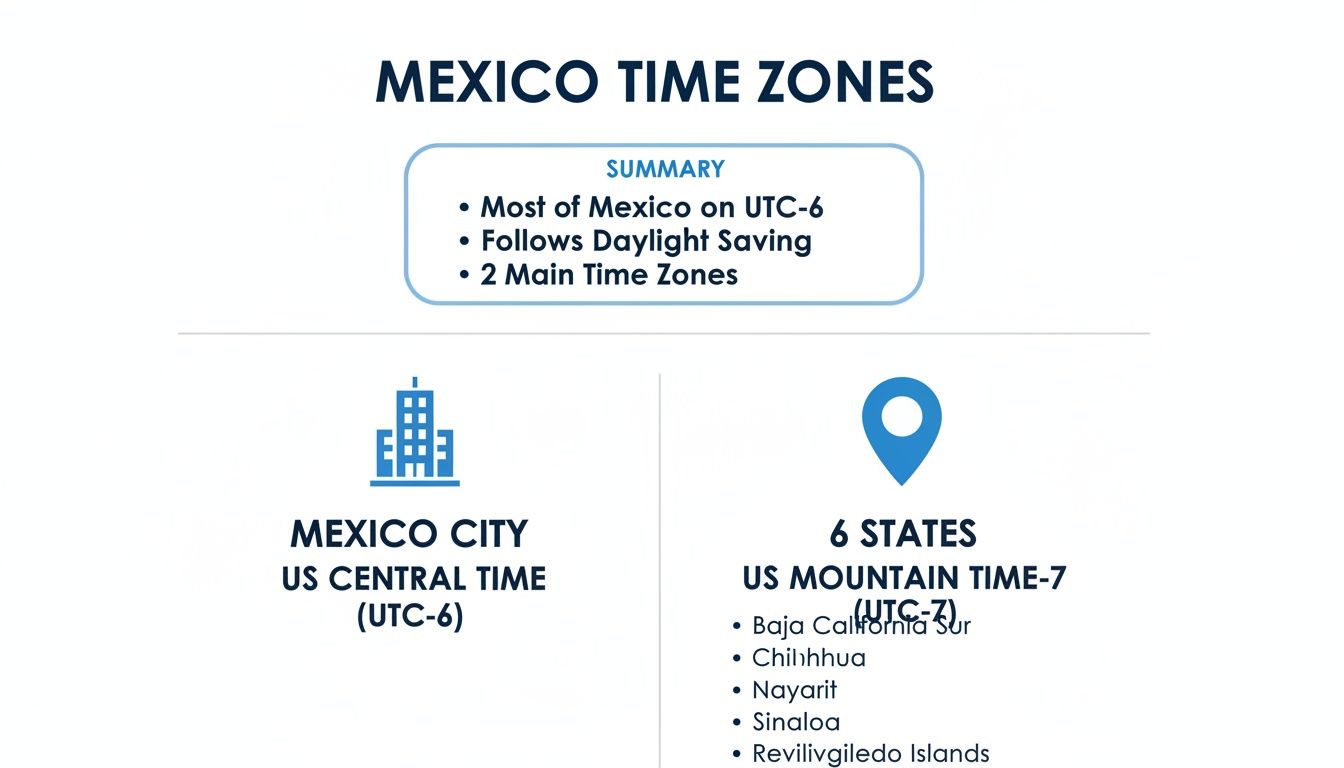
The infographic above shows how you can hire developers in Mexico who share the exact same workday as your teams in Chicago or Denver, completely eliminating any time zone friction.
Of course, while mastering time zones is crucial for virtual collaboration, effective international engagement often involves more than just calls. For instance, understanding the logistics of planning international business travel to Brazil can further strengthen team bonds and optimize your global strategy. It’s all about building a cohesive unit, whether you're on a video call or meeting on the ground.
Ever feel like you’re a professional cat-herder instead of a hiring manager? You find the perfect developer, but then the real work begins: trying to pin down a time for that first interview. This isn’t just an admin task. It's your first impression, and getting it wrong tells a top-tier candidate everything they need to know about how you operate.
A bungled scheduling attempt looks disorganized, disrespectful, and frankly, amateur. Nail it, and you signal that you're a professional team that knows how to manage remote collaboration.
I call a scheduling screw-up "The $500 Hello." Why? Because that’s the minimum value of engineering time you just torched—the candidate's, yours, and anyone else on your team who now has to shuffle their calendar. One simple mistake over the time difference in South America sends a loud, clear message: "We don't have our act together."
Your first interaction sets the entire tone. A crisp, clear, time-zone-aware scheduling process shows you respect the candidate's time and are competent enough to run a distributed team. A sloppy one gets you ghosted.
Stop the endless, painful email chains. We've been in the trenches scheduling thousands of interviews, and this is the simple, professional playbook that just works. It gets interviews on the calendar without the drama.
We once A/B tested our outreach emails. The versions that included pre-converted time slots and a direct scheduling link had a 30% higher booking rate than the emails with open-ended questions. Clarity wins. Every single time.
This isn't about being rigid; it's about being respectful and efficient. You want the conversation to be about their skills and your company, not about whose calendar app messed up converting UTC-3 to PST. Get this first step right, and you're already ahead of 90% of your competition.
Constantly Googling "what time is it in Buenos Aires" is the remote equivalent of showing up to a meeting in your pajamas. It signals you're running an amateur operation. A professional remote team needs a professional tool stack, period.
We've seen it all—teams trying to rely on memory, complex dashboards, and a dozen browser plugins. The goal isn't just to know the time; it's to build a workflow where the time difference in South America becomes a background detail, not a daily obstacle. The right tools make time zone awareness automatic.
Forget the all-in-one "remote OS" platforms that cost a fortune and do nothing particularly well. The real solution is simpler and cheaper. You just need a few core tools configured the right way.
Here’s our opinionated, battle-tested take on the absolute essentials:
Slack (Configured Properly): This is non-negotiable. Slack's built-in time zone awareness is surprisingly powerful, yet so many teams ignore it. Seeing a colleague's local time right next to their name builds an immediate, subconscious sense of empathy and context. It’s the little feature that stops you from pinging a developer in São Paulo about a non-urgent issue at 7 PM their time. It fundamentally changes team communication for the better.
A Smart Calendar: Whether you live in Google Calendar or Outlook, the "World Clock" feature is your best friend. Set it up to permanently display your own time, UTC, and the local times for your key South American hubs. Seeing the time blocks visually laid out is what stops you from suggesting a 5 PM PST meeting, which is a brutal 9 PM in Santiago during their summer.
Beyond the basics, a couple of other tools can smooth out the remaining friction points.
Project management tools like Jira or Asana are critical for async work. Every comment, ticket update, and status change is timestamped, creating a clear, unambiguous record of who did what and when. This becomes your single source of truth, eliminating any confusion over deadlines that span multiple time zones.
We’ve found that a well-configured Slack and calendar setup handles 90% of all time zone challenges. Tools like Time.is are great for a quick one-off check, but they shouldn’t be part of your daily workflow. If your team is constantly looking up world clocks, your system is broken.
So, what's a waste of money? In our experience, it's the expensive, dedicated time zone dashboard apps. They look slick, but they just duplicate information that your core tools should already be providing. Stick to the basics, integrate them deeply into your process, and save your budget.
You’ve got questions, and we’ve got answers forged from years of managing teams across the Americas. These aren't hypothetical problems; they're the real-world issues that come up long after you've bookmarked the basic time zone map. No theory, just what actually works.
In a word: no. Let me be crystal clear on this one: do not ask your senior LATAM developers to work graveyard shifts. The whole advantage of nearshoring is tapping into the incredible time zone alignment, not erasing it by forcing people to work unnatural hours.
Think about it. Asking a developer in Bogotá to mirror a 9 AM to 5 PM PST schedule means they’re clocking in at noon and working until 8 PM their time, every single day. That's a surefire recipe for burnout, and it signals a deep lack of respect for their life outside of work. Top-tier talent has plenty of options, and they won’t stick with a company that treats them like a 24/7 help desk.
That golden window of collaboration—that 4 to 6-hour daily overlap—is there for a reason. Lean into it. Schedule your critical sync-ups and meetings within that window, and trust your team to manage their deep-work time effectively on their own. Trying to micromanage schedules across continents is a game you will always lose.
This is much simpler than it sounds. You just need to track them. The easiest way is to set up a shared company calendar that includes the public holidays for every single country where you have team members, both in the US and South America.
Don't be that manager who tries to schedule a major sprint planning meeting on Colombia’s Independence Day. A little bit of foresight makes a huge difference. This isn't just about avoiding a scheduling snafu; it's about showing your team you see them as people, not just names on a spreadsheet. Acknowledging and respecting local holidays is the absolute baseline for building a healthy, distributed company culture.
This happens all the time, especially as you grow. You might have a developer in São Paulo (UTC-3) who is two hours ahead of your QA engineer in Medellín (UTC-5). The key here is to establish a single, official "team time zone" for all recurring meetings and company-wide events. Nine times out of ten, this will default to US Eastern Time (EST).
Using EST as the anchor creates a consistent, reliable reference point for everyone. All-hands meetings, daily stand-ups, and product demos get scheduled in EST, and each team member is responsible for converting that to their local time. This kills the ambiguity and stops the endless "wait, is that my time or your time?" chatter that drains productivity. Just make sure your shared calendar events are set up correctly to display in each person's local time zone automatically.
Ready to build a world-class engineering team without the time zone headaches? CloudDevs connects you with elite, pre-vetted developers from across Latin America who are ready to integrate seamlessly with your US-based team. Find your perfect hire in just 24 hours at https://clouddevs.com.

Stop burning cash on software development. Learn battle-tested strategies to reduce software development costs from a founder who has seen it all.


Let's be real. You're here because you needed to scale your tech team yesterday, and now you're stuck between two buzzwords that sales reps love: staff augmentation and managed services. One sounds like renting a developer on-demand, the other like making your problems someone else's. The truth? Turns out there’s more than one way to...

Discover the best countries to outsource software development and boost your business growth. Find the top locations for reliable, cost-effective tech talent in 2025.