What Is an Engineering Manager? Role & Hiring Guide

Victor
Posted on 16 April 2026



You’re probably here because one of two things is happening.
Either your engineering team is growing and you’re starting to feel the strain. Deadlines slide. Senior engineers spend half their day untangling people problems. Product wants predictability, and engineering gives them a shrug and a Jira board with trust issues.
Or you already have someone “acting as manager,” which usually means your best engineer got voluntold into people management and now nobody’s happy. They write less code, the team still lacks direction, and your one-on-ones feel like awkward status updates with feelings stapled on.
That’s why founders keep asking what is an engineering manager. Fair question. The internet usually answers with a bland corporate definition that sounds like it was written by a committee trapped in a conference room.
Here’s the answer. An engineering manager is the person accountable for turning a group of engineers into a reliable, effective team that ships useful software without burning itself to the ground. Not the best coder in the room. Not a glorified scrum host. Not a calendar-powered hall monitor.
A good engineering manager is a force multiplier. A bad one is organizational sand in the gears.
Table of Contents
Most companies get this wrong at first.
They think an engineering manager is a senior engineer with direct reports. Clean promotion. Bigger title. Same person, plus meetings. That assumption causes a lot of expensive damage in a very short time.

Promoting your strongest individual contributor into management can work. It often doesn’t.
Why? Because the skills are different. Writing excellent code and building an excellent team are not the same craft. One is mostly about solving technical problems yourself. The other is about helping other people solve them together, consistently, and without stepping on each other’s oxygen hoses.
The weak version of this role is the “player-coach” fantasy. You know the one. They’re supposed to code half the week, mentor everyone, hire well, run delivery, resolve conflict, and somehow keep architecture coherent. Sounds efficient. Usually it’s chaos in a blazer.
An engineering manager’s influence doesn’t come from cranking out tickets. It comes from setting priorities, allocating people well, reducing friction, and making sure the team can execute without daily heroics. That’s why effective engineering managers improve team productivity by 20 to 30% through sprint planning, dependency assessment, and strengths-based task assignment, according to Indeed’s overview of the role at Indeed’s engineering manager job description.
The best engineering managers are human systems engineers.
They debug bottlenecks, not just bugs. They spot where code review is stalling, where ownership is fuzzy, where two senior engineers are fighting a turf war, and where a high performer is one bad quarter away from quitting.
Practical rule: If your “manager” spends most of their energy proving they’re still the best technical operator, they’re probably managing their ego more than the team.
That doesn’t mean technical depth stops mattering. It does. A manager who can’t follow architecture discussions or ask hard questions will get snowed by confident engineers with bad judgment. But they don’t need to be the person merging the most PRs. They need enough technical range to guide tradeoffs, challenge weak reasoning, and connect engineering decisions to business outcomes.
A real engineering manager owns a system with three moving parts:
That’s a management job. Not an honorary badge for seniority.
If you’re hiring for this role, stop asking, “Can this person still code?” Start asking, “Can this person make eight engineers better at once?” That’s the whole game.
If you strip away the fluff, the job comes down to three things. People. Process. Technical guidance.
Miss one, and the whole setup wobbles.

This is the part a lot of companies underestimate because it feels soft right up until it gets expensive.
A great engineering manager knows who’s growing, who’s stuck, who’s overloaded, and who’s disengaging. They run useful one-on-ones. They give clear feedback. They don’t avoid hard conversations until HR gets invited and everyone suddenly speaks in legalese.
The cost of getting this wrong is ugly. Tech attrition rates average 13 to 15% annually and can go over 20% in high-burnout teams, while replacing someone can cost 1.5 to 2x salary per departure. Teams with engaged managers also see 15 to 20% lower turnover, according to these engineering manager metrics from testRigor.
That’s not a culture issue in the abstract. That’s real money, lost momentum, and a bunch of rework disguised as recruiting.
A strong manager pays attention to signs like:
A manager’s calendar should have one-on-ones on it. If it only has status meetings, you hired a coordinator, not a leader.
Good process feels boring. That’s a compliment.
The manager’s job is to make delivery predictable enough that the team can focus on real work instead of ritual theater. Sprint planning should clarify tradeoffs. Code review should move. Dependencies should be visible before they become excuses. Incident follow-up should improve the system, not produce a graveyard of action items nobody remembers.
Mediocre managers often hide behind tools. Jira, Linear, Slack, Notion, dashboards. Fine. Useful. None of them save you if the underlying workflow is sloppy.
One area where this shows up fast is technical debt. If your team keeps shipping around old architecture, hand-waving ownership gaps, and postponing cleanup until “after launch,” your manager needs to treat that as an execution problem, not a future problem. Aakash Gupta has a practical piece on managing technical debt that’s worth reading if your roadmap keeps getting mugged by past shortcuts.
A good engineering manager builds a process that helps the team answer three questions quickly:
People often get confused by this.
The engineering manager is not supposed to be the oracle who wins every architecture debate by sheer force of seniority. That’s how you create a dependent team and a manager who can’t take a vacation.
Their role is to raise the quality of technical decisions. They ask sharper questions, connect roadmap choices to engineering cost, and make sure the team doesn’t drift into clever nonsense.
Here’s the simplest version:
| Core function | What great looks like | What weak looks like |
|---|---|---|
| People | Clear feedback, growth plans, trust | Avoidance, favoritism, surprise reviews |
| Process | Predictable delivery, visible risks | Fire drills, bottlenecks, meeting soup |
| Technical guidance | Sound tradeoffs, aligned decisions | Architecture by opinion, endless churn |
If you remember one thing, remember this. The engineering manager owns the conditions for good engineering. That’s the job.
You can’t evaluate an engineering manager by asking whether the team “feels good.”
I mean, sure, morale matters. But every struggling team can produce one cheerful retro and one beautifully color-coded roadmap. That doesn’t mean they can ship.

The clearest signal of management quality is whether the team gets work through the system cleanly.
That’s why I like deployment frequency, cycle time, and defect rate. They’re not perfect, but they’re hard to fake for long. If code takes forever to move from commit to production, something in the system is broken. If releases keep spraying bugs into production, quality discipline is weak. If deployments happen rarely, the team is carrying too much batch size and too much risk.
The benchmark gap is not subtle. Top-performing teams deploy daily and keep cycle times under one day, while low performers may take weeks or even months for a single deployment. These elite teams are also 2.5x more likely to exceed profitability and market share goals, based on the engineering KPI analysis at Jellyfish’s guide to engineering KPIs.
That’s the kind of data an engineering manager should know how to use. Not to punish teams. To diagnose bottlenecks.
A decent manager looks at metrics and asks better questions.
If cycle time balloons, they don’t say, “Work harder.” They look for slow reviews, unclear ownership, flaky tests, or a planning process that stuffs too much into one stream.
If deployment frequency is poor, they don’t immediately demand more shipping. They examine release mechanics, risk tolerance, handoff friction, and whether the team has built a system that makes small releases practical.
If defect rate spikes, they don’t just lecture everyone about quality. They ask what changed. Scope? Staffing? Review rigor? Missing test coverage? Bad incentives?
The right use of metrics is diagnostic, not theatrical. Dashboards should help a manager find friction, not decorate a QBR.
Founders frequently make this mistake.
They praise visible busyness. Lots of meetings. Lots of updates. Lots of tickets moved around. None of that matters if delivery is sluggish and fragile.
Use a compact scorecard instead.
A manager who improves those outcomes is doing the job, even if they never touch a production PR. A manager who runs polished ceremonies while the team crawls is not.
Companies blur these roles all the time. Then they wonder why nobody owns the actual problem.
Here’s the clean version. A Tech Lead drives technical direction inside the work. An Engineering Manager runs the team that does the work. An Engineering Director aligns multiple teams to broader business goals.
That’s the distinction. Not title prestige. Not who talks the most in planning.
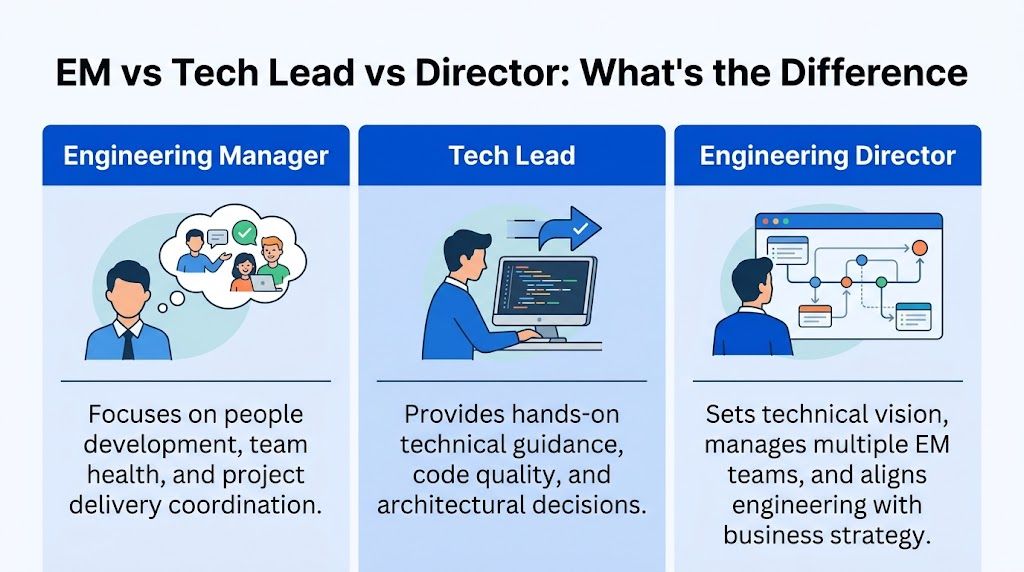
| Attribute | Tech Lead | Engineering Manager | Engineering Director |
|---|---|---|---|
| Primary focus | Technical design and code quality | Team performance and delivery | Org strategy across teams |
| Main scope | One team’s technical choices | One team’s people and execution | Multiple teams and managers |
| Day-to-day work | Architecture, design reviews, implementation guidance | Hiring, feedback, planning, prioritization, risk management | Resourcing, organizational design, cross-team alignment |
| Success looks like | Strong technical decisions | Healthy team that ships reliably | Teams moving in the same direction |
| Common failure mode | Ivory tower architecture | Meeting-heavy drift and weak accountability | Strategy with no operational follow-through |
Hire a Tech Lead when the main problem is technical ambiguity. The team can build, but it needs stronger architectural judgment, coding standards, and technical direction.
Hire an Engineering Manager when the main problem is team execution. Priorities are fuzzy. People aren’t growing. Delivery is inconsistent. Tension lingers because nobody owns the human side of engineering.
Hire a Director when the issue spans teams. You need someone deciding tradeoffs across multiple groups, setting direction, and translating business priorities into engineering structure.
If your team says, “We don’t know what to build,” you may need stronger product and technical leadership. If they say, “We can’t seem to work together and ship reliably,” you need management.
Yes, the roles overlap.
A good Tech Lead often mentors people. A good Engineering Manager can challenge technical decisions. A good Director should understand delivery realities. But overlap doesn’t mean sameness.
The easiest rule is this:
If you hire the wrong one, you won’t fix the underlying problem. You’ll just give it a fancier title.
Hiring the wrong engineering manager doesn’t just waste a salary line. It warps the team.
A weak EM lowers standards slowly. They tolerate vague ownership. They avoid difficult feedback. They turn one-on-ones into checklists. Six months later, your good engineers are frustrated, your weaker ones are confused, and delivery somehow got more bureaucratic without becoming more reliable. Quite an achievement.
I don’t care how many programming languages they list. I care whether they’ve managed outcomes.
A strong EM resume usually shows a few things:
Be wary of candidates who describe themselves like superhero ICs who happened to attend meetings. That’s usually code for “I never really left the keyboard, and I’m not sure I like management.”
Most interviews for EMs are too clean. You don’t need perfect frameworks and polished stories. You need evidence of judgment under pressure.
Ask things like:
Then listen for specifics. Real managers talk about tradeoffs, conversations, consequences, and what they’d do differently. Fakers hide in abstractions.
If you want a useful framework for structuring that interview loop, there's a practical guide to interviewing best practices for hiring that helps keep panels consistent and less biased.
This is the blind spot.
A lot of hiring advice for engineering managers still assumes everyone sits in the same office, overhears the same conversations, and can patch trust gaps with hallway banter. That world is gone for a lot of teams.
The data on remote leadership is blunt. 62% of managers report productivity drops due to communication gaps in distributed setups, only 15% of hiring guides cover strategies for timezone differences or psychological safety in virtual one-on-ones, and 70% of tech hires are now remote, according to LeadDev’s discussion of the engineering manager role.
So when hiring for a distributed team, especially one spread across the US and Latin America, ask different questions.
A remote EM should be comfortable operating in Slack, written docs, shared planning rituals, and deliberate one-on-ones. Not because tools are magic. Because remote teams punish vagueness faster.
Some warning signs are subtle. These aren’t.
| Red flag | Why it matters |
|---|---|
| They brag mostly about personal coding wins | They may still want an IC job with authority |
| They can’t explain how they develop people | Coaching is core, not optional |
| They avoid discussing conflict | Teams don’t stay healthy by accident |
| They speak vaguely about metrics | Management without measurement gets political fast |
| They’ve never led distributed communication well | Remote teams need intentional structure |
One more practical note. If you’re building a serious interview loop, add a written exercise. Ask the candidate to respond to a scenario involving a missed deadline, a frustrated PM, and two engineers who disagree on the fix. Written thinking matters in remote environments.
And if you need a sharper question bank, this set of engineering manager interview questions is a useful starting point.
A good engineering manager doesn’t stay static.
The role usually starts with one team. Then scope expands. More coordination. More organizational design. Less direct problem-solving, more system design at the team level. Eventually, the job becomes less about one squad’s execution and more about making several teams work coherently.
A common progression looks like this:
That path matters because scope changes the profile you should hire for. A first-time EM can be excellent for a single team that needs leadership and coaching. They’re not automatically the right hire if your real problem is multi-team alignment or organizational design.
This section is where a lot of articles start inventing salary tables with suspicious confidence. I’m not doing that.
Compensation for engineering managers varies sharply by market, stage, company expectations, and whether the role is local or remote. The useful point isn’t a fake salary band. It’s this: a strong engineering manager pays for themselves by improving delivery, reducing avoidable attrition, and preventing expensive organizational drift.
If you under-budget, you usually don’t save money. You buy delay.
For remote hiring, especially across Latin America, the opportunity is less about bargain shopping and more about widening the pool. You can often find experienced managers who overlap well with US hours, communicate clearly, and understand distributed execution. That matters more than chasing a ZIP code.
If you’re trying to calibrate level before budget, this breakdown of engineering levels is useful because many hiring mistakes come from mismatching scope to seniority.
When budgeting for this role, I’d pay more for:
I’d pay less attention to prestige logos, management buzzwords, and whether they can still whiteboard a clever algorithm on demand. That’s not what makes the hire valuable.
If your team is small, aligned, and shipping cleanly, maybe not yet.
If your senior engineers are spending too much time mediating conflict, rewriting priorities, or acting as unofficial therapists with GitHub access, then yes, you probably need one. Same answer if deadlines are unreliable, performance feedback is inconsistent, or remote collaboration feels like everyone is working from a different planet.
That’s what is an engineering manager in plain English. Someone who makes the team work better together and ship better work. Not by hovering. Not by collecting status updates. By creating clarity, accountability, and a sane operating system for engineering.
The mediocre ones add meetings.
The great ones amplify results.
If you’re feeling the pain already, don’t wait for your org chart to “earn” the role. By the time founders start asking whether they need an EM, they usually needed one a while ago.
If you want to hire a vetted engineering manager or build a timezone-aligned remote engineering team without getting dragged into endless sourcing and compliance headaches, CloudDevs is worth a look. They connect US companies with pre-vetted Latin American talent quickly, which is a far better use of your time than spending another month reviewing resumes that all say “strategic leader” and mean wildly different things.

So, you’re looking to hire a Django developer. Let's get straight to the point: what's the real cost, not just in dollars, but in your time and sanity? The short answer? It depends entirely on how you hire. A full-time US-based developer can easily command $120,000+ a year. Or, you could tap into pre-vetted talent...

Let's cut to the chase. You're here because your infrastructure is groaning under the weight of your success, or your next big move requires some serious cloud horsepower. An AWS Cloud Engineer isn't just another IT hire; they are the master builders of your digital empire on Amazon Web Services. They take that sprawling, often...

Your “data-driven” strategy is probably broken. Not because you don’t have enough dashboards. Not because your team forgot how to use SQL. And definitely not because you need one more analytics platform with a glossy homepage and a suspicious number of pastel charts. It’s broken because most companies treat data analysis like a side quest....